




DOT Audit Criticizes Federal Safety Investigations
A newly released DOT audit report, ordered in the wake of GM’s ignition switch recalls, offers a disturbing assessment of NHTSA’s efforts to identify and investigate vehicle safety defects.

SCOVEL

SCOVEL
The National Highway Traffic Safety Administration’s efforts to identify and probe vehicle safety concerns have been persistently hampered by deficiencies in data analysis, staff size and training, use of regulatory authority over automakers, and a host of other problems, according to a newly released government audit.
The audit report, released by U.S. Department of Transportation Inspector General Calvin L. Scovel III, is unsparing in its criticism of NHTSA’s Office of Defects Investigation (ODI). U.S. Transportation Secretary Anthony Foxx requested the report in the wake of the General Motors ignition switch recalls in 2014. NHTSA is an agency within the DOT.
The report notes that ODI first looked at GM air bag non-deployments as a potential safety issue in 2007. Also, the office received data on the ignition switch defect as early as 2003. But in 2007 staff members decided against investigating the problem and failed to identify the ignition switch defect as the root cause of the air bag failures. More than 110 fatalities and 220 injuries have been linked to the defective ignition switches.
“ODI lacks the procedures needed to effectively identify safety defects that warrant an investigation,” the report states. “Specifically, ODI has not developed guidance for applying the factors it established for opening an investigation. In addition, the factors that influence ODI’s decisions on whether to open an investigation are not transparent, and it is unclear who is accountable for these decisions. This was the case with ODI’s decision not to investigate the GM air bag non-deployment defect.”
According to the report, ODI staff members who screen consumer complaints and analyze crash data often lack adequate technical training to conduct proper research and testing before opening investigations. This can result in potential safety defects being overlooked.
The ODI neither follows standard statistical practices when analyzing crash data from manufacturers, nor thoroughly screens consumer complaints, the report noted.
“For example, ODI’s initial screening of the roughly 330 complaints received daily is not thorough, and about 90 percent of complaints are set aside,” the report said. “While screeners are encouraged to query all complaints for similar issues in their area of concentration, half of them told us that they do not consistently do this.”
Such systemic weaknesses led ODI to overlook a GM-provided state trooper report suggesting that a faulty ignition switch in a Chevrolet Cobalt might have caused air bag failure in a 2007 fatal collision, the report asserts.
The audit report is particularly critical of ODI’s lack of transparency in its decision-making.
“Of the 56 investigation proposals for light vehicle safety defects in 2013, 32 were not investigated – 18 of which lacked documented justifications for not investigating,” the report said. Because staff screeners fail to learn what management deems worthy of investigation, they rely on precedents. As a result, past investigative mistakes aren’t likely to be revisited and corrected.
Additionally, according to the report, ODI fails to verify that manufacturer-provided crash data – including injury and death reports – are complete and accurate. Even when the office suspects non-compliance, officials don’t take prompt enforcement action. Variation in how manufacturers code and categorize data also contributes to investigatory lapses.
Given the volume of consumer complaints and crash data received, the ODI staff’s limited size also hinders its effectiveness. ODI consists of eight defect screeners, four early-warning data analysts and 16 investigators. The Obama administration has pushed for raising ODI’s budget to $31.3 million – approximately triple the current level.
The report concludes with 17 recommended actions to improve ODI’s collection, screening and analysis of vehicle safety data. NHTSA Administrator Mark Rosekind, a relative newcomer to the agency who took over the position last December, has agreed to implement all 17. Under Rosekind’s leadership, NHTSA earlier this month released its own report proposing sweeping reforms within the agency.
The 17 recommendations included in the DOT inspector general report are:
Develop and implement a method for assessing and improving the quality of early warning reporting data (crash data from manufacturers, including injury and death reports).
Issue guidance or best practices on the format and information that should be included in non-dealer field reports to improve consistency and usefulness.
Require manufacturers to develop and adhere to procedures for complying with early warning reporting requirements, and require ODI to review these procedures periodically.
Expand current data verification processes to assess manufacturers’ compliance with regulations to submit complete and accurate early warning reporting data. At minimum, this process should assess how manufacturers assign vehicle codes to specific incidents and how they determine which incidents are reportable.
Develop and implement internal guidance that identifies when and how to use oversight tools to enforce manufacturers’ compliance with early warning reporting data requirements.
Provide detailed and specific guidance to consumers on the information they should include in their complaints, as well as the records they should retain (such as police reports and photographs) in the event that ODI contacts them for more information.
Develop an approach that will determine which early warning reporting test scores provide statistically significant indications of potential safety defects.
Periodically assess the performance of the early warning reporting data tests using out-of-sample testing.
Institute periodic external expert reviews of the statistical tests used to analyze early warning reporting data to ensure that these methods are up-to-date and in keeping with best practices.
Implement a supervisory review process to ensure that all early warning reporting data are analyzed according to ODI policies and procedures.
Develop and implement a quality control process to help ensure complaints are reviewed thoroughly and within a specified timeframe.
Update standardized procedures for identifying, researching and documenting safety defect trends that consider additional sources of information beyond consumer complaints, such as special crash investigation reports and early warning data.
Document supervisory review throughout the pre-investigative process, including data screening.
Evaluate the training needed by pre-investigative staff to identify safety defect trends. Also, develop and implement a plan for meeting identified needs.
Develop and implement guidance on the amount and type of information needed to determine whether a potential safety defect warrants an investigation proposal and investigation.
Develop a process for prioritizing, assigning responsibility, and establishing periodic reviews of potential safety defects that ODI determines should be monitored.
Document and establish procedures for enforcing timeframes for deciding whether to open investigations. Also, establish a process for documenting justifications for these decisions.
_________________________________________________________________________
_________________________________________________________________________
More Safety

Nexar-Nauto Merger Aims to Give Fleets Better Safety Intelligence Through Larger Driving Dataset
Stefan Heck tells Automotive Fleet that combining more than 10 billion miles of driving history with Nexar's AI models will give fleets deeper insights into driver risk and roadway conditions than either company could provide independently.
Read More →
Don't Wait for a Crisis: 5 Ways to Build Mental Health Into Your Fleet Safety Program
For Suicide Prevention Month, fleet and safety leaders have an opportunity to put mental health where it belongs: at the center of workplace safety.
Read More →
How Camera Data Can Strengthen a Fleet’s Insurance Renewal
Insights from a commercial insurance carrier and a broker show how fleets can turn video telematic data, driver coaching, and improved claims results into a stronger case at insurance renewal.
Read More →
The Safest Fleets Aren’t the Ones with the Most Technology
You’ve made the telematics investment. Here’s how to capture the other half of its value and build the safest fleet on the road.
Read More →
Hidden in Plain Sight: Fleet Compliance Risks
Fleet compliance isn't just about having policies — it's about consistently enforcing them. This practical guide reveals six hidden compliance risks common in public sector and shared fleet operations and outlines proven strategies to improve visibility, accountability, and audit readiness
Read More →
NETS Sets 2026 Fleet Safety Benchmark Conference for Indianapolis
The Sept. 15–17 program will feature fleet benchmarking data, case studies, emerging technologies, and implementation strategies while running alongside the NSC Safety Congress & Expo.
Read More →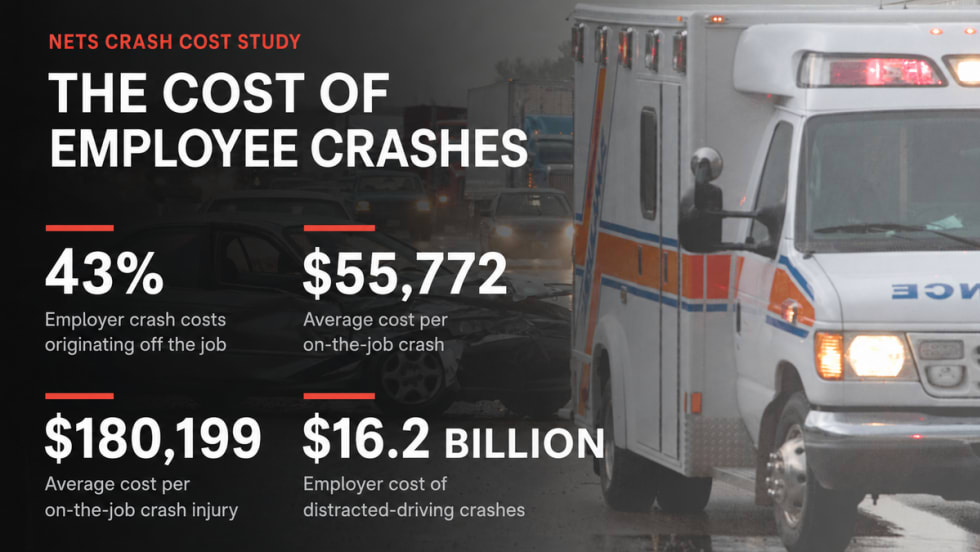
Off-the-Job Crashes Account for 43% of Employers’ $61.7 Billion Crash Burden
NETS quantifies costs dispersed across fleet, risk, HR, and other departments while providing new per-crash benchmarks for employers.
Read More →
Ram Recalls More Than 1.27 Million 1500 Pickups for Seat Belt Anchor Issue
The recall affects certain 2019-2026 Ram 1500 pickups that may have improperly attached second-row seat belt buckle anchors.
Read More →
How Better Visibility Cut Speeding Violations by 48%
Fleet leaders don't need more data, they need clearer visibility into what the data is saying. This case study explores how one utility replaced speeding-event counts with a single metric — miles driven in violation — to strengthen safety and significantly reduce speeding violations.
Read More →
Operation Safe Driver Week: Why the Industry's Oldest Safety Campaign Still Matters to Fleets
A look at how a 2007 enforcement initiative became one of the most consequential weeks on the fleet safety calendar, and what it means for your drivers in 2026.
Read More →