




Differences in Crash Test Requirements Hinder Import of European Models
NEW YORK --- According to automakers, conflicting vehicle safety regulations governing everything from air bags to bumpers to lighting in the U.S. and Europe are hindering efforts to bring fuel-efficient European models to the U.S. quickly.
NEW YORK --- According to automakers, conflicting vehicle safety regulations governing everything from air bags to bumpers to lighting in the U.S. and Europe are hindering efforts to bring fuel-efficient European models to the U.S. quickly.
An Associated Press report asserts that European regulators, the U.S. National Highway Traffic Safety Administration, and the Insurance Institute for Highway Safety also have different crash tests in which they publicly rate vehicles.
Ford's promise to bring six small, fuel-efficient vehicles from Europe and start building them in North America in 2010 puts a new focus on the challenge of satisfying governments' varying requirements, AP reported.
Ford plans to save billions by designing products for global sales, boosting profits on small cars. But competing interests among automakers, governments and the insurance industry are hampering efforts to standardize safety requirements worldwide. The result: extra engineering to make different versions of vehicles for different markets, AP reported.
"Each party negotiating this has their own views about their own standards being better," Ronald Medford, senior associate administrator of vehicle safety at the National Highway Traffic Safety Administration, told AP. "But as long as we can show we're not lowering safety and we're lowering cost, we're all interested in that."
Some differences are significant, like the U.S. rule that requires protection for passengers not wearing seat belts. There is no European equivalent. Others are small, like the U.S. requirement that vehicles have side lights, which are optional in Europe, AP pointed out.
The ultra-compact Smart car was sold overseas for nine years, but before Daimler AG could bring it to the U.S., it had to make the car longer to meet U.S. crash standards, spokesman Ken Kettenbeil told AP.
Automakers know how to retrofit their vehicles but question the time and expense involved when the changes may not make those vehicles safer, Jim Vondale, director of Ford's safety office, told AP.
"It may involve changes to the structure, it may involve changes to material, but they result in not so many differences in the safety levels of the vehicles," he said.
Ford recently studied 43 regulations in Europe and the U.S. and found that just 11 were equivalent, Vondale said. Fourteen had major differences that would require significant changes. Asian countries' regulations, which are closer to European requirements than those in the U.S., add even more complexities.
Automakers also have to contend with the Arlington, Va.-based Insurance Institute for Highway Safety, which is funded by the insurance industry and runs its own closely watched set of crash tests.
Tests may look similar on the surface but contain crucial differences. The European frontal crash test uses a deformable barrier — made to mimic another car — that slams into 40 percent of the front of the vehicle. That challenges engineers to spread the energy from the crash across the rest of the car. The fixed barrier in the U.S. test absorbs no energy, causing a severe crash that evaluates the vehicle's overall strength, AP reported.
Adding to the complexity of the frontal test is that the U.S. and Europe put their crash test dummies in different seating positions, which can affect how the air bags should deploy, said IIHS President Adrian Lund.
These are summaries of those tests.
Frontal crash test:
* Europe: A deformable barrier that covers 40 percent of the front of the vehicle strikes the vehicle at 40 mph. Adult crash test dummies are belted.
* NHTSA: A rigid barrier that covers the entire front of the vehicle strikes the vehicle at 35 mph. Dummies are belted. A separate test at 25 mph rates performance for unbelted dummies. Adult dummies are used, but a dummy representing a small woman will be used starting in 2010.
* Insurance Institute: A deformable barrier that covers 40 percent of the front of the vehicle strikes the vehicle at 40 mph. Adult dummies are belted.
Side crash test:
* Europe: A deformable barrier representing a small car strikes the side of the vehicle at 30 mph.
* NHTSA: A deformable barrier representing a car strikes the side of the vehicle at 38.5 mph.
* Insurance Institute: A deformable barrier representing a truck or sport utility vehicle strikes the vehicle at 31 mph.
Child Restraint Test:
* Europe: Dummies representing 1 1/2- and 3-year-old children are placed in the rear seats of frontal and side crashes in the restraints recommended by the manufacturer.
* NHTSA: None.
* Insurance Institute: None.
Rollover test:
* Europe: None.
* NHTSA: Test predicts a vehicle's chances of rolling over by combining measurements and the results of a moving test.
* Insurance Institute: None.
Pole test:
* Europe: An optional test in which the car is propelled sideways into a pole at 18 mph.
* NHTSA: Pole tests will begin in 2010.
* Insurance Institute: None.
Bumper test:
* Europe: A series of tests that replicate hitting adult and child pedestrians at 25 mph.
* NHTSA: None.
* Insurance Institute: A series of tests at 6 and 3 mph measuring damage to the vehicle.
More Safety
The Safest Fleets Aren’t the Ones with the Most Technology
You’ve made the telematics investment. Here’s how to capture the other half of its value and build the safest fleet on the road.
Read More →
Hidden in Plain Sight: Fleet Compliance Risks
Fleet compliance isn't just about having policies — it's about consistently enforcing them. This practical guide reveals six hidden compliance risks common in public sector and shared fleet operations and outlines proven strategies to improve visibility, accountability, and audit readiness
Read More →
NETS Sets 2026 Fleet Safety Benchmark Conference for Indianapolis
The Sept. 15–17 program will feature fleet benchmarking data, case studies, emerging technologies, and implementation strategies while running alongside the NSC Safety Congress & Expo.
Read More →
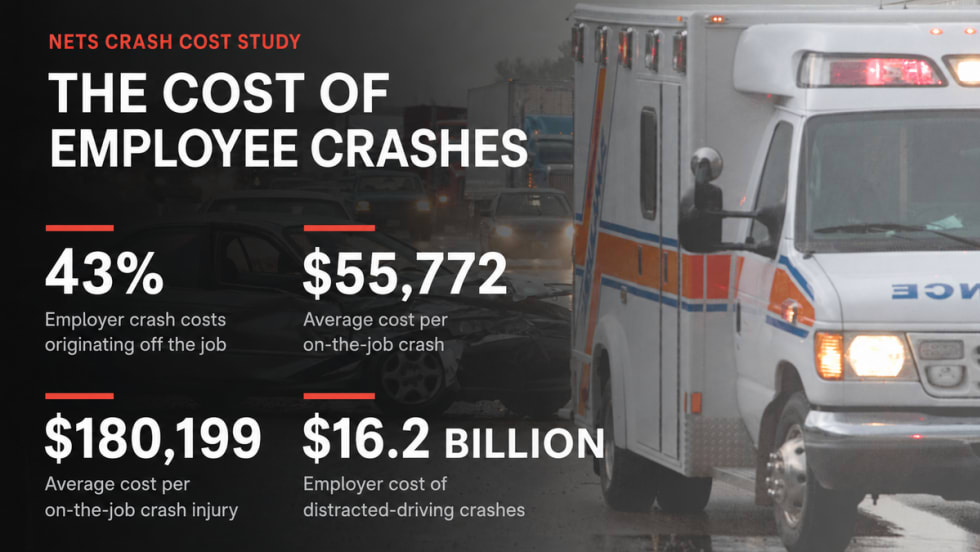
Off-the-Job Crashes Account for 43% of Employers’ $61.7 Billion Crash Burden
NETS quantifies costs dispersed across fleet, risk, HR, and other departments while providing new per-crash benchmarks for employers.
Read More →
Ram Recalls More Than 1.27 Million 1500 Pickups for Seat Belt Anchor Issue
The recall affects certain 2019-2026 Ram 1500 pickups that may have improperly attached second-row seat belt buckle anchors.
Read More →
How Better Visibility Cut Speeding Violations by 48%
Fleet leaders don't need more data, they need clearer visibility into what the data is saying. This case study explores how one utility replaced speeding-event counts with a single metric — miles driven in violation — to strengthen safety and significantly reduce speeding violations.
Read More →
Operation Safe Driver Week: Why the Industry's Oldest Safety Campaign Still Matters to Fleets
A look at how a 2007 enforcement initiative became one of the most consequential weeks on the fleet safety calendar, and what it means for your drivers in 2026.
Read More →
Nexar-Nauto Merger Aims to Give Fleets Better Safety Intelligence Through Larger Driving Dataset
Stefan Heck tells Automotive Fleet that combining more than 10 billion miles of driving history with Nexar's AI models will give fleets deeper insights into driver risk and roadway conditions than either company could provide independently.
Read More →
From Silos to Solutions: Relationship Management for Safer Fleets
From telematics adoption and driver accountability to policy consistency and risk mitigation, this episode breaks down what it really takes to build a safer fleet culture without slowing business down.
Read More →
IIHS Launches First Commercial Vehicle Safety Evaluations
The Insurance Institute for Highway Safety has begun evaluating heavy-duty pickups and cargo vans for driver protection. Which models earned top marks?
Read More →