




Can Drivers Overly Rely on Driver Assistance Tech?
Research from IIHS and MIT AgeLab suggests that drivers can be susceptible to distraction while using a parking assist feature.
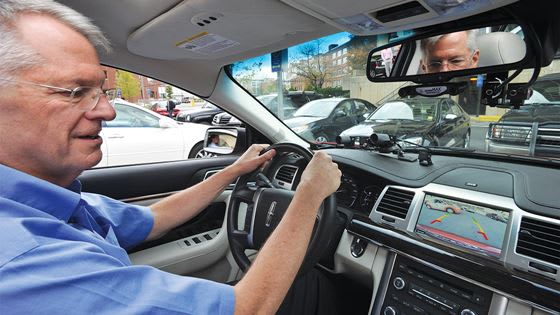
A driver uses a parking assist system to parallel park. Photo courtesy of IIHS.
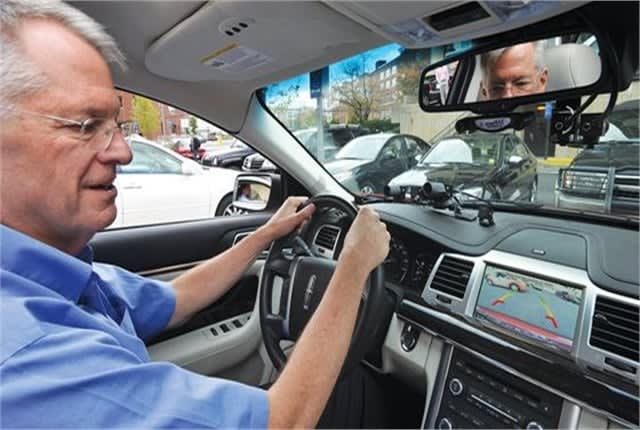
A driver uses a parking assist system to parallel park. Photo courtesy of IIHS.
Some safety advocates worry that over-dependence on advanced driver assistance technologies may have unwanted consequences for those motorists who let their guard down: diminishing focus and driving skills. Recent research on how drivers interact with parking assist systems raises some of these concerns, specifically about driver inattention.
Researchers from the Insurance Institute for Highway Safety and the MIT AgeLab and New England University Transportation Center studied volunteer drivers while they operated a system that helps identify a parking spot and uses automated steering to maneuver into the space. The 31 volunteer drivers each parallel parked a 2010 Lincoln MKS, which was equipped with Active Park Assist, into a space between two inflatable dummy cars. During the experiment, drivers parked the car both with and without Active Park Assist in use.
“When using the automation, drivers spent more time looking at the dashboard and less time looking at the parking spot or at the road in front of or behind them,” an IIHS summary of the study noted. “This was even true when the system was searching for a parking spot but steering wasn’t automated.”
Active Park Assist helps locate a parking space and then directs the driver to remove his or her hands from the steering wheel so the automated steering function can take over to park the car. The driver, however, still handles the car’s forward and reverse movement, as instructed by the system.
Researchers found that drivers in the study generally glanced at the parking space less often and spent less time looking at it when steering was automated than when it wasn’t, according to IIHS. And during the automated steering, the proportion of glances and time spent looking at the dashboard display — which relayed information about the automation — increased dramatically.
The researchers fully expected drivers to look at the instrument cluster more and the vehicle’s surroundings less during the automated parking maneuvers. What wasn’t anticipated was how pronounced this pattern was while the vehicle approached a parking space — before the automated steering began and while the driver was still in complete control.
According to the study, the drivers spent 46% of their time looking at the dashboard as they approached an available parking space while using Active Park Assist, compared to just 3% while not using the driver assistance feature. Drivers also spent less time looking forward (31%) and rearward (9%), compared to when they parked without the automation (44% and 17%, respectively).
The system calculates whether a parking space is big enough during the approach and then sends a message to the instrument cluster and sounds a chime. Though the drivers knew they didn’t need to continually monitor the display, they still diverted their attention away from the road, researchers observed.
“Although we don’t know how this change in glance behavior affects crash risk, manufacturers should consider how the design of new technologies can affect driver behavior in ways they might not intend,” said David Kidd, an IIHS senior research scientist and lead author of the study.
More broadly, advanced driver assistance features need to be used as intended. A car equipped with several such features is not a fully automated vehicle. Drivers still need to focus their attention on the road and resist distractions. Used properly, driver assistance technologies can help with this task — not detract from it.
This issue of misusing driver assistance technologies figures to gain more attention in the coming days.
On Tuesday, Sept. 12, the National Transportation Safety Board will meet to discuss the probable cause of a May 2016 fatal crash involving a Tesla Model S and a tractor-trailer truck near Williston, Fla. Preliminary NTSB reports have indicated that the Model S driver, who lost his life in the accident, was operating the car in Autopilot mode at the time of the collision. The car warned the driver, 40-year-old Joshua Brown of Canton, Ohio, seven different times to place his hands back on the steering wheel during the 40 minutes preceding the crash.
The Autopilot mode in use relied on advanced driver assistance systems, Traffic-Aware Cruise Control and Autosteer lane keeping, but fell well short of industry criteria for what’s considered a fully automated vehicle. Tesla had advised drivers to stay alert and continue to keep their hands on the steering wheel during this mode so they could readily take control when needed.
NTSB investigators downloaded system performance data from the car’s vehicle recorder and from Tesla’s servers to reconstruct what led to the collision. The Model S was traveling 74 mph at the time of the crash, according to the preliminary reports. Brown had engaged Autopilot for 37 of the 41 minutes just before the collision. During those 37 minutes, Brown’s hands were detected on the steering wheel for a total of just 25 seconds.
A separate probe by the National Highway Traffic Safety Administration concluded that Brown never applied the brakes before the collision. His last action was setting the cruise control to 74 mph — 9 mph above the speed limit.
In September of last year, Tesla introduced improvements to Autopilot to further restrict hands-off driving.
Brown’s family on Monday, Sept. 11, released a statement, through a law firm, absolving Tesla of blame for the death, according to a Reuters report.
“We heard numerous times that the car killed our son. That is simply not the case,” the statement reportedly said. “There was a small window of time when neither Joshua nor the Tesla features noticed the truck making the left-hand turn in front of the car.”
The statement went on to say that “change always comes with risks, and zero tolerance for deaths would totally stop innovation and improvements.”
The Sept. 12 NTSB meeting will offer analysis, conclusions and recommendations that the preliminary crash reports lacked.
More Safety

What’s Next for Fleet? Safety, AI & Industry Recognition | AF News Recap
Could your company's culture be encouraging distracted driving? This week, we're exploring how workplace expectations affect driver safety, what AI, EVs, and autonomous vehicles could mean for the future of fleet management, and how fleet professionals can strengthen their award nominations.
Read More →
Does Your Fleet's Culture Encourage Distracted Driving?
What happens when the people responsible for enforcing safety rules are the ones setting the wrong example? The answer may reveal why some of the biggest risks to fleet drivers have little to do with what's written in the employee handbook.
Read More →
Fleet Manager’s Ultimate Playbook: Navigating the New Standard in OEM Connectivity
Rising operating costs, driver safety concerns, and unplanned downtime are putting unprecedented pressure on modern fleets. Discover how fleet managers use embedded OEM connectivity and real-time vehicle data to cut TCO, prevent downtime, and protect drivers without aftermarket telematics hardware.
Read More →
From Driver Well-Being to EV Charging | AF News Recap
Mental health belongs in the fleet safety conversation. This week, we’re looking at five ways fleets can support employee well-being before a crisis, plus Holman’s expansion in Mexico, new one-day Fleet Forward passes, and why EV charging demand is outpacing infrastructure growth.
Read More →
Nexar-Nauto Merger Aims to Give Fleets Better Safety Intelligence Through Larger Driving Dataset
Stefan Heck tells Automotive Fleet that combining more than 10 billion miles of driving history with Nexar's AI models will give fleets deeper insights into driver risk and roadway conditions than either company could provide independently.
Read More →
Don't Wait for a Crisis: 5 Ways to Build Mental Health Into Your Fleet Safety Program
For Suicide Prevention Month, fleet and safety leaders have an opportunity to put mental health where it belongs: at the center of workplace safety.
Read More →
How Camera Data Can Strengthen a Fleet’s Insurance Renewal
Insights from a commercial insurance carrier and a broker show how fleets can turn video telematic data, driver coaching, and improved claims results into a stronger case at insurance renewal.
Read More →
The Safest Fleets Aren’t the Ones with the Most Technology
You’ve made the telematics investment. Here’s how to capture the other half of its value and build the safest fleet on the road.
Read More →
Hidden in Plain Sight: Fleet Compliance Risks
Fleet compliance isn't just about having policies — it's about consistently enforcing them. This practical guide reveals six hidden compliance risks common in public sector and shared fleet operations and outlines proven strategies to improve visibility, accountability, and audit readiness
Read More →
NETS Sets 2026 Fleet Safety Benchmark Conference for Indianapolis
The Sept. 15–17 program will feature fleet benchmarking data, case studies, emerging technologies, and implementation strategies while running alongside the NSC Safety Congress & Expo.
Read More →