




Learn More: BMW Starts E-Drivetrain Production for iX and i4 EVs
BMW i Hydrogen NEXT Testing Begins
The first prototypes of the hydrogen-powered vehicles are now being tested on European roads.
by Staff
June 18, 2021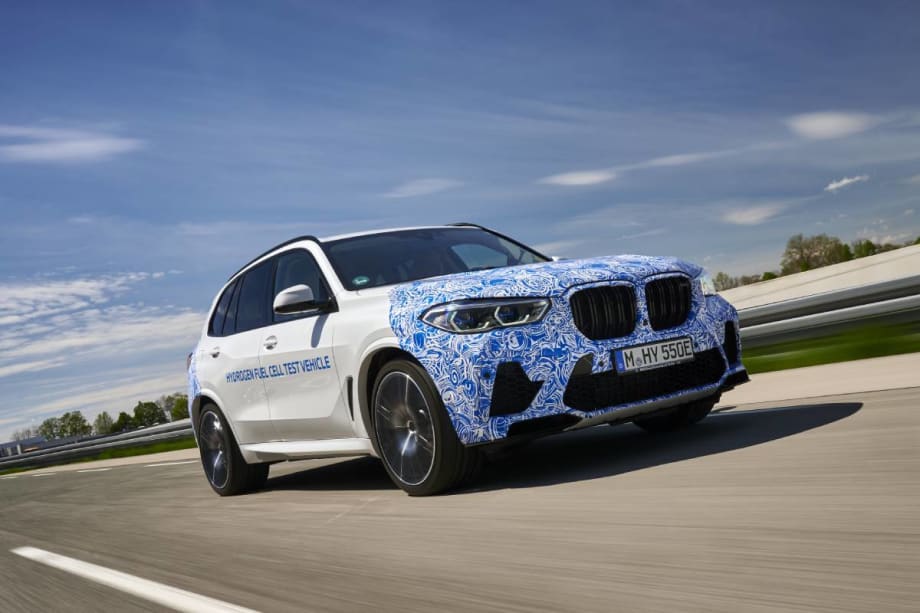
The first prototypes of the hydrogen-powered vehicles are now being tested on European roads.
Photo: BMW
3 min to read
The BMW Group is beginning to test near-standard vehicles with a hydrogen fuel cell drive train in everyday conditions on European roads. Prototypes of the BMW i Hydrogen NEXT will examine how effectively the CO2-free drive train, model-specific chassis technology, and vehicle electronics systems work together under real-life conditions. The BMW i Hydrogen NEXT is a pure electric vehicle that uses hydrogen as fuel by converting it into electricity in a fuel cell. The recently launched testing program will pave the way for the BMW Group to present a small-series model with this sustainable drive technology, developed on the basis of the BMW X5, in late 2022. Extensive field testing of these vehicles will provide practical experience in the use of this sustainable drive technology.
Hydrogen fuel cell technology has the long-term potential to supplement internal combustion engines, plug-in hybrid systems, and battery-electric vehicles within the BMW Group’s flexible drive train strategy. It could become an attractive alternative to battery-electric drive trains – especially for customers who do not have their own access to electric charging infrastructure or who frequently drive long distances.
Like the fuel tank of a conventional combustion-engine model, the hydrogen tank of the BMW i Hydrogen NEXT can also be filled within three to four minutes.
Field testing focused on efficiency, safety, convenience, reliability – and driving pleasure
A central element of the BMW i Hydrogen NEXT road tests now underway is fine-tuning the software that controls all driving and operating functions. The fuel cell system, hydrogen tanks, performance buffer battery, and central vehicle control unit have all previously been tested individually and together in hundreds of test runs conducted on test benches. This functional testing is now being followed with field testing on the roads. The intensive program, which is conducted under everyday conditions and real traffic situations, helps development engineers validate the efficiency, safety, convenience, and reliability of all components. At the same time, the test series is designed to ensure the characteristic driving pleasure of BMW models – even with locally emission-free mobility using pioneering hydrogen fuel cell technology.
The BMW i Hydrogen NEXT uses fuel cells from the product development cooperation with the Toyota Motor Corporation. The individual cells come from Toyota, while the fuel cell stack and complete drive system are original BMW Group developments. The cooperation established in 2013 seeks to optimise the everyday practicality and scalability of hydrogen fuel cell technology for use in each company’s respective production vehicles through the intensive exchange of experience.
Typical BMW driving dynamics delivered by electric drive train with system output of 275 kW/374 hp
The complete drive system in the BMW i Hydrogen NEXT combines hydrogen fuel cell technology with fifth-generation BMW eDrive technology – which can already be experienced in the BMW iX3 and soon the BMW iX and BMW i4, as well. Energy is generated in the fuel cell as the result of a chemical reaction between the hydrogen carried by the vehicle and oxygen from the air. This delivers an electrical output of 125 kW/170 hp. An electric converter located below the fuel cell adjusts its voltage to that of the electric motor, which powers the BMW i Hydrogen NEXT.
Energy stored in a performance buffer battery is also used for dynamic acceleration manoeuvres and short bursts of speed for overtaking. As a result, the system delivers an output of 275 kW/374 hp that corresponds exactly to that of the most powerful six-cylinder in-line petrol engine currently used in BMW models.
The energy stored in the performance buffer battery is generated in an efficient way during driving by recovering energy from coasting overrun and braking phases. The hydrogen needed to supply the fuel cell is stored in two 700-bar tanks made of carbon-fibre reinforced plastic (CFRP), which together hold six kilograms of hydrogen. Its precisely controlled reaction with oxygen in the fuel cell generates electricity, while water vapor is the only emission produced by the drive train.
More Global Fleet
GeoFencing Adds to Your Truck Security Arsenal
Geofencing is a familiar fleet tool today, but its early adoption marked a major shift in vehicle tracking, route monitoring, and the debate over employee privacy.
Read More →
Holman Takes Full Ownership of ARIZA in Mexico
Holman is bringing its Mexican fleet management operation fully under its own brand after more than 30 years as a joint venture. The change gives multinational fleet customers a single Holman operation across the U.S., Canada, and Mexico.
Read More →
5 Tire Maintenance Tips to Help Prevent Work Truck Downtime
Regular tire checks can do more than extend tread life. These five maintenance practices can help work truck fleets catch problems early, reduce costs, and prevent downtime.
Read More →

Proven Ways to Reduce Work Truck Downtime
The age-old problem of downtime will always be a reality, but with new strategies at hand, fleets have more ways to keep trucks on the road longer.
Read More →


Cameras, Safety and Insurance: From Reactive Claims to Real-Time Prevention (Part 2 of 2)
Part Two: Commercial auto remains one of the most challenging and costly lines of coverage for fleet operators and insurers alike. Continue learning more about how to effectively address these issues from Onur Aksan, Enterprise Business Development Executive, Geotab
Read More →
Cameras, Safety and Insurance: From Reactive Claims to Real-time Prevention
Commercial auto remains one of the most challenging and costly lines of coverage for fleet operators and insurers alike. Learn more about how to effectively address these issues from Onur Aksan, Enterprise Business Development Executive, Geotab.
Read More →
Fleet Costs Are Rising: Here’s How Leaders Are Responding
Fleet leaders are under pressure to reduce costs, adapt to economic uncertainty, and make smarter decisions. See how peers across North America are responding with real data, proven strategies, and forward-looking insights. Download the 2026 Market Pulse Report to benchmark your strategy and uncover where you can gain an edge.
Read More →
Enterprise Fleet Management Surpasses 900,000 Vehicles in U.S. & Canada
Enterprise Mobility connects with mobility solutions around the globe
Read More →