




Similar News: Partial Automation Prompts Multitasking in Early Adopters
Autonomous Tech Advances: Mercedes-Benz Drive Pilot Rolls Out in Nevada
Mercedes-Benz is the first automotive company to bring SAE Level 3 conditionally automated driving to the U.S. with its Drive Pilot system.
by Staff & News Reports
February 10, 2023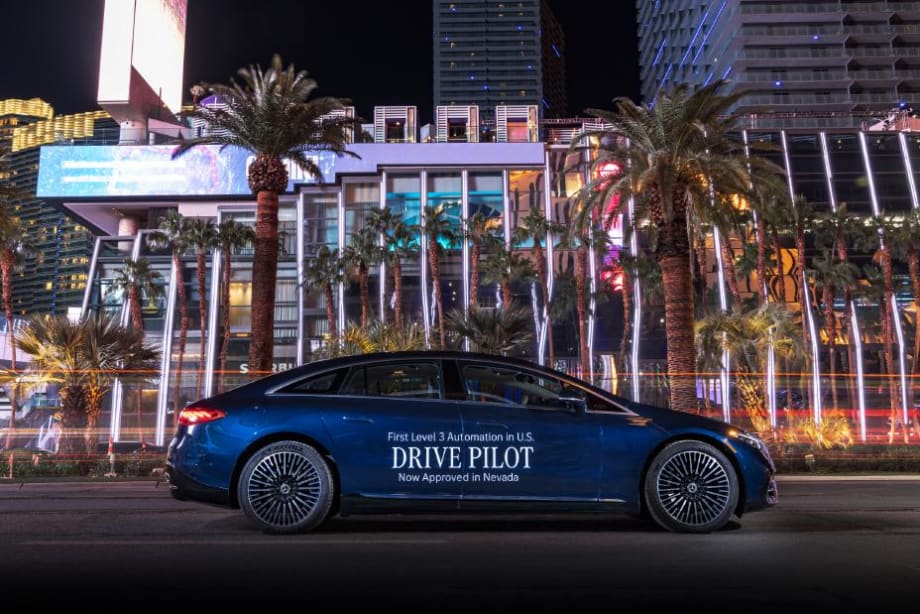
With the introduction of Drive Pilot, Mercedes-Benz is the first automaker to certify an SAE Level 3 system for the American market.
Photo: Mercedes-Benz
4 min to read
The path to bringing autonomous technologies to market today just got more interesting. Mercedes-Benz is the world's first automotive company to bring SAE Level 3 conditionally automated driving to the U.S. with its Drive Pilot system, according to the automaker. Moreover, Nevada is the first state to confirm the compliance of the system with state regulations.
Simply put, the Drive Pilot system is the first and only SAE Level 3 system in a standard-production vehicle authorized for use on U.S. public freeways. Drive Pilot will be available in the U.S. market as an option for model year 2024 Mercedes-Benz S-Class and EQS Sedan models, with the first cars delivered to customers in the second half of 2023.
It’s important to understand the definition of SAE Level 3. As the automaker puts it, SAE Level 3 means the automated driving function takes over certain driving tasks. However, a driver is still required. The driver must be ready to take control of the vehicle at all times when prompted to intervene by the vehicle.
Complying with the requirements of Nevada Chapter 482A for Autonomous Vehicles, Drive Pilot will allow the driver to hand over the dynamic driving task to the vehicle under certain conditions. Mercedes-Benz hopes to expand to California later this year with the certification documents already filed with state authorities.
It should be noted that the Drive Pilot system only works up to speeds of 40 mph and under specific circumstances — like on suitable freeway sections and where there is high traffic density.
Here’s how it works. When the driver activates Drive Pilot, the system controls the speed and distance, and guides the vehicle within its lane. The route profile, events occurring on the route, and traffic signs are correspondingly taken into consideration. The system also reacts to unexpected traffic situations and handles them independently, for example, with evasive maneuvers within the lane or by braking.
So while the driver is still behind the wheel — and may be prompted to take over control at any time — he or she could engage in other activities while Drive Pilot is in effect. In short, it’s easy to imagine drivers eating, texting, or even grooming behind the wheel if they become too reliant on Drive Pilot.
Safety First
The manufacturer says safety is its top priority as it introduces Drive Pilot. To that end, the system includes both LiDar sensors and redundant systems.
There is also a camera in the rear window and microphones for detecting emergency vehicles, as well as a road wetness sensor in the wheel well. A vehicle equipped with the optional Drive Pilot system also has redundant steering and braking actuators and a redundant on-board electrical system, so that it remains maneuverable even if one of these systems fails and a safe handover to the driver can be ensured.
Finally, if the driver fails to take back control even after increasingly urgent prompting, perhaps due to a severe health problem, the system brakes the vehicle to a standstill in a controlled manner while engaging the hazard warning lights. The Mercedes-Benz emergency call system is then activated, and the doors are unlocked to make the interior accessible for first responders.
Drive Pilot also includes a high-precision positioning system that is much more powerful than conventional GPS systems. In addition to the anonymized data collected by LiDAR, camera, radar and ultrasound sensors, a digital HD map provides a three-dimensional image of the road and the surroundings with information on road geometry, route characteristics, traffic signs, and special traffic events (e.g. accidents or road works). This is made available and updated via a backend connection.
While Mercedes-Benz is first out the gate for SAE Level 3 conditionally automated driving, the industry continues to roll out new advanced driver technologies.
Experts continue to evaluate the effectiveness and safety of these systems. Recently, Consumer Reports named Ford’s BlueCruise — a hands-free system — the best driver assistance system. The system can allow for hands-free driving on sections of premapped divided highways, automating the vehicle’s steering, acceleration, and braking for the driver. General Motors’ Super Cruise system — the winner in 2020, the last time CR conducted these tests — took second place. Tesla’s Autopilot fell from second place to seventh.
More Safety

Does Your Fleet's Culture Encourage Distracted Driving?
What happens when the people responsible for enforcing safety rules are the ones setting the wrong example? The answer may reveal why some of the biggest risks to fleet drivers have little to do with what's written in the employee handbook.
Read More →
Sponsored•October 1, 2026
Fleet Manager’s Ultimate Playbook: Navigating the New Standard in OEM Connectivity
Rising operating costs, driver safety concerns, and unplanned downtime are putting unprecedented pressure on modern fleets. Discover how fleet managers use embedded OEM connectivity and real-time vehicle data to cut TCO, prevent downtime, and protect drivers without aftermarket telematics hardware.
Read More →
From Driver Well-Being to EV Charging | AF News Recap
Mental health belongs in the fleet safety conversation. This week, we’re looking at five ways fleets can support employee well-being before a crisis, plus Holman’s expansion in Mexico, new one-day Fleet Forward passes, and why EV charging demand is outpacing infrastructure growth.
Read More →
Nexar-Nauto Merger Aims to Give Fleets Better Safety Intelligence Through Larger Driving Dataset
Stefan Heck tells Automotive Fleet that combining more than 10 billion miles of driving history with Nexar's AI models will give fleets deeper insights into driver risk and roadway conditions than either company could provide independently.
Read More →
Don't Wait for a Crisis: 5 Ways to Build Mental Health Into Your Fleet Safety Program
For Suicide Prevention Month, fleet and safety leaders have an opportunity to put mental health where it belongs: at the center of workplace safety.
Read More →
How Camera Data Can Strengthen a Fleet’s Insurance Renewal
Insights from a commercial insurance carrier and a broker show how fleets can turn video telematic data, driver coaching, and improved claims results into a stronger case at insurance renewal.
Read More →
The Safest Fleets Aren’t the Ones with the Most Technology
You’ve made the telematics investment. Here’s how to capture the other half of its value and build the safest fleet on the road.
Read More →
Sponsored•August 7, 2026
Hidden in Plain Sight: Fleet Compliance Risks
Fleet compliance isn't just about having policies — it's about consistently enforcing them. This practical guide reveals six hidden compliance risks common in public sector and shared fleet operations and outlines proven strategies to improve visibility, accountability, and audit readiness
Read More →
NETS Sets 2026 Fleet Safety Benchmark Conference for Indianapolis
The Sept. 15–17 program will feature fleet benchmarking data, case studies, emerging technologies, and implementation strategies while running alongside the NSC Safety Congress & Expo.
Read More →
Off-the-Job Crashes Account for 43% of Employers’ $61.7 Billion Crash Burden
NETS quantifies costs dispersed across fleet, risk, HR, and other departments while providing new per-crash benchmarks for employers.
Read More →