





The Two-Pronged Approach to Driver Safety Management Programs
Automakers Rapidly Update Seat Belt Reminders in Response to IIHS Ratings
With a new IIHS rating system and only 82% of rear-seat occupants wearing their seat belts, automakers are under pressure to upgrade reminders.
October 15, 2024
In 2022, about 92% of front-seat and 82% of rear-seat occupants were belted in the government’s on-road observational survey of seat belt use.
Photo: Automotive Fleet
3 min to read
In the newest model year vehicles, automakers are scrambling to install louder, more persistent seat belt reminders since the Insurance Institute for Highway Safety (IIHS) began rating the features in 2022.
Only 17% of new model vehicles tested in the first year earned a good rating, while 65% were rated marginal or poor. However, manufacturers have already flipped those numbers. Of the 2024 models tested, 62% are rated good, while only 24% are rated marginal or poor.
“Automakers can boost a vehicle’s performance in this test with just some small software changes,” IIHS President David Harkey said. “These easy tweaks can have a big impact on safety.”
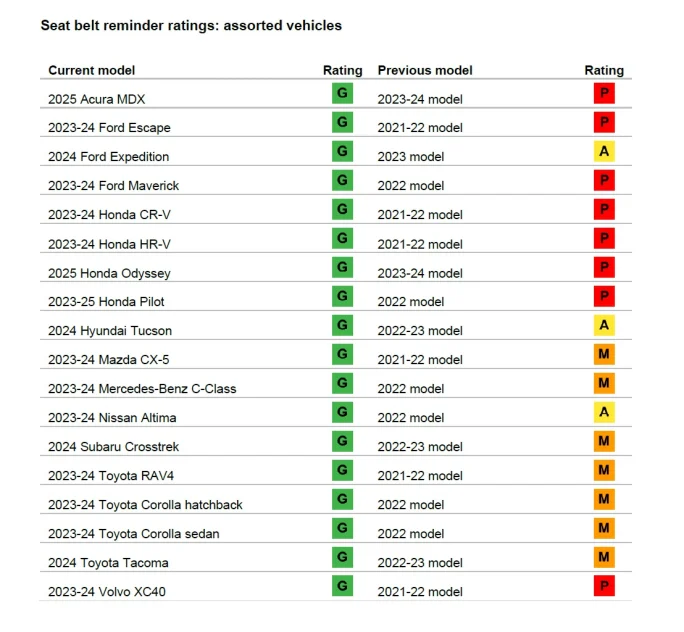
Eighteen vehicles with seat belt reminders that previously fell short recently earned good ratings from IIHS for their latest models.
For now, regulations specify only that seat belt reminders must include an audible signal lasting 4-8 seconds total and a visual alert lasting at least 60 seconds whenever the driver’s seat belt is unbuckled.
Source: Insurance Institute for Highway Safety
Eight models were previously rated poor, which means they only included a brief reminder for the driver seat. Seven more were rated marginal due to reminders that weren’t long or loud enough.
Three others were rated acceptable, including the 2023 Ford Expedition, 2022-23 Hyundai Tucson, and the 2022 Nissan Altima, which means they met the requirements for the front-row seating positions but not for the second row.
Why Are Reminders Better for Safety?
Failure to buckle up continues to play a significant role in crash deaths. In 2022, about 92% of front-seat and 82% of rear-seat occupants were belted in the government’s on-road observational survey of seat belt use.
A much smaller percentage of the vehicle occupants killed in crashes — half of those in the front seat and a quarter of those in the back — were belted during the crashes that killed them.
Many future crash victims could be saved with better seat belt reminders, IIHS research has found. While a few people still adamantly refuse to buckle up, many part-time seat belt users neglect to use them on short trips or forget.
An IIHS study found that a persistent reminder was much more effective at getting part-time users to buckle up than a minimal reminder and just as effective as a speed-limiting interlock that kept the vehicle speed under 15 mph unless the driver was buckled in.
“The math is pretty simple,” said David Kidd, the IIHS senior research scientist who led the research and development of the seat belt reminder rating program. “We found that an audible reminder that lasts at least 90 seconds increased belt use by around 30%. That means we could save almost 1,600 lives a year if every vehicle on the road was equipped with a good-rated system.”
Changing Standards in Seat Belt Reminder Systems
The National Highway Traffic Safety Administration (NHTSA) proposed tougher federal standards in 2023, but the proposed rule lacked several important components, such as an adequate volume requirement, and has not moved forward.
For now, regulations specify only that seat belt reminders must include an audible signal lasting 4-8 seconds total and a visual alert lasting at least 60 seconds whenever the driver’s seat belt is unbuckled.
In contrast, for a good rating from IIHS, vehicles have to have an audible reminder that lasts at least 90 seconds if any of the occupied front seats remain unbuckled and meet volume standards and other conditions. A visual and persistent audible reminder lasting at least 30 seconds that alerts the driver when a belted rear occupant unbuckles is also required.
Some automakers have gone even further, equipping vehicles with audible alerts that don’t stop until all the occupants are buckled in, no matter how long it takes, or adding reminders for third-row occupants.
“This rapid progress represents a big win,” Harkey said. “Making sure everybody uses their seat belt on every trip is a simple way to save lives.”
More Safety

What’s Next for Fleet? Safety, AI & Industry Recognition | AF News Recap
Could your company's culture be encouraging distracted driving? This week, we're exploring how workplace expectations affect driver safety, what AI, EVs, and autonomous vehicles could mean for the future of fleet management, and how fleet professionals can strengthen their award nominations.
Read More →
Does Your Fleet's Culture Encourage Distracted Driving?
What happens when the people responsible for enforcing safety rules are the ones setting the wrong example? The answer may reveal why some of the biggest risks to fleet drivers have little to do with what's written in the employee handbook.
Read More →
Sponsored•October 1, 2026
Fleet Manager’s Ultimate Playbook: Navigating the New Standard in OEM Connectivity
Rising operating costs, driver safety concerns, and unplanned downtime are putting unprecedented pressure on modern fleets. Discover how fleet managers use embedded OEM connectivity and real-time vehicle data to cut TCO, prevent downtime, and protect drivers without aftermarket telematics hardware.
Read More →
From Driver Well-Being to EV Charging | AF News Recap
Mental health belongs in the fleet safety conversation. This week, we’re looking at five ways fleets can support employee well-being before a crisis, plus Holman’s expansion in Mexico, new one-day Fleet Forward passes, and why EV charging demand is outpacing infrastructure growth.
Read More →
Nexar-Nauto Merger Aims to Give Fleets Better Safety Intelligence Through Larger Driving Dataset
Stefan Heck tells Automotive Fleet that combining more than 10 billion miles of driving history with Nexar's AI models will give fleets deeper insights into driver risk and roadway conditions than either company could provide independently.
Read More →
Don't Wait for a Crisis: 5 Ways to Build Mental Health Into Your Fleet Safety Program
For Suicide Prevention Month, fleet and safety leaders have an opportunity to put mental health where it belongs: at the center of workplace safety.
Read More →
How Camera Data Can Strengthen a Fleet’s Insurance Renewal
Insights from a commercial insurance carrier and a broker show how fleets can turn video telematic data, driver coaching, and improved claims results into a stronger case at insurance renewal.
Read More →
The Safest Fleets Aren’t the Ones with the Most Technology
You’ve made the telematics investment. Here’s how to capture the other half of its value and build the safest fleet on the road.
Read More →
Sponsored•August 7, 2026
Hidden in Plain Sight: Fleet Compliance Risks
Fleet compliance isn't just about having policies — it's about consistently enforcing them. This practical guide reveals six hidden compliance risks common in public sector and shared fleet operations and outlines proven strategies to improve visibility, accountability, and audit readiness
Read More →
NETS Sets 2026 Fleet Safety Benchmark Conference for Indianapolis
The Sept. 15–17 program will feature fleet benchmarking data, case studies, emerging technologies, and implementation strategies while running alongside the NSC Safety Congress & Expo.
Read More →