





Check Out:2024 IIHS Wrap-Up: 19 Vehicles Secure Top Safety Honors
Automakers Make Big Strides in Front Crash Prevention
The IIHS revealed automakers have improved AEB systems, but testing shows high-speed and motorcycle crash prevention still challenges some vehicles.
February 20, 2025
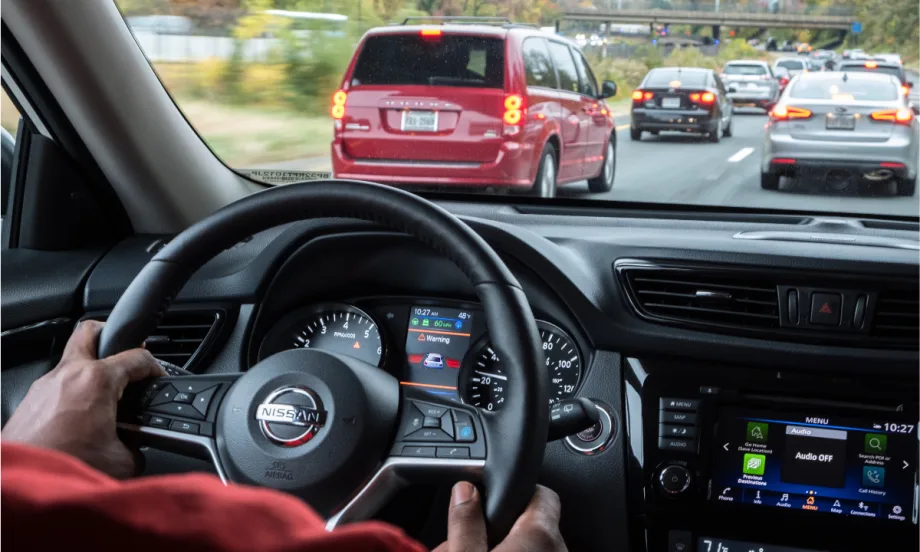
Twenty-two of the latest 30 vehicles evaluated by the IIHS earned a good or acceptable rating, which requires systems to prevent or substantially mitigate crashes at higher speeds.
Photo: Insurance Institute for Highway Safety
4 min to read
Automakers are delivering significant improvements in their automatic emergency braking (AEB) systems following the introduction of a more rigid front crash prevention evaluation by the Insurance Institute for Highway Safety (IIHS) last year.
“The rapid progress manufacturers have made to improve these vital crash avoidance systems is impressive,” IIHS President David Harkey said. “Vehicles that excel in this new test will save lives, as it addresses the most dangerous kinds of front-to-rear crashes.”
Twenty-two of the latest 30 vehicles evaluated earned a good or acceptable rating, which requires systems to prevent or substantially mitigate crashes at higher speeds. In April 2024, only three out of the first 10 small SUVs tested performed to that level.
The Acura ZDX, BMW X5, BMW X6, Cadillac Lyriq, Chevrolet Blazer EV, Genesis GV80, Honda Prologue, Hyundai Santa Fe, Kia EV9, Kia Sorento, Lexus NX, Subaru Forester, Toyota Camry, Toyota Crown Signia and Toyota Tacoma all earned good ratings for their standard systems. The Mercedes-Benz E-Class has an optional system that has earned a good rating.
The standard system on the E-Class and those on the Genesis G80, Honda HR-V, Hyundai Sonata, Jeep Wagoneer, and Mazda CX-50 are rated acceptable. An optional system available on the Acura MDX also earned an acceptable rating. Its standard system was not evaluated.
The Ford Expedition earned a marginal rating, while the Audi Q7, Audi Q8, Buick Envista, Chevrolet Tahoe, Chevrolet Trax, Kia Seltos, and Nissan Altima are rated poor.
Higher Speeds, Multiple Targets
The original vehicle-to-vehicle front crash prevention test was run at 12 and 25 mph (20 and 40 kph) with a passenger car target in the center of the travel lane. It was discontinued at the end of 2022, as all vehicles tested earned the top superior rating.
The updated test includes trials run at 31, 37, and 43 mph (50, 60, and 70 kph). In addition to a passenger car target, it examines performance with a motorcycle target and a semitrailer. Vehicles are tested with the semitrailer centered in the travel lane and with the car and motorcycle targets centered and offset to one side.
As a result, the new evaluation reflects a more significant proportion of police-reported front-to-rear crashes, including many that tend to result in serious injuries or fatalities. More than 400 people are killed annually in rear-end crashes with semitrailers, for example, while rear impacts account for more than 200 motorcyclist deaths per year.
Test speeds: 31 mph, 37 mph, and 43 mph
Passenger car target: Both warning and automatic braking are tested with the target in the center of the lane and offset to the right or left.
Motorcycle car target: Both warning and automatic braking are tested with the target in the center of the lane and offset to the right or left.
Semitrailer: Only the warning is tested. The trailer is always in the center of the lane.
The trials using targets evaluate both the systems’ forward collision warning and automatic braking capabilities. If the test vehicle fails to achieve a minimum speed reduction at the slower test speeds, only the forward collision warning system is evaluated in the higher-speed tests.
In all the test runs using the trailer, only the forward collision warning system is evaluated, and the test driver steers out of the lane to avoid a crash.
Points are awarded for warnings that occur at least 2.1 seconds before the projected time of impact and for substantial speed reductions in the AEB tests. Speed reductions account for two-thirds, and warnings account for one-third of the maximum possible score.
How the Vehicles Performed
The good-rated systems delivered timely forward collision warnings and came to a complete stop before impact in all the trials with the passenger car target. They also met those performance standards in most trials with the motorcycle target and provided timely warnings in all the trials with the semitrailer.
A few vehicles didn’t manage to stop before hitting the target in one or more of the motorcycle test scenarios, though they slowed substantially before impact. Several more were one- or two-tenths of a second late in delivering forward-collision warnings with the motorcycle target.
Motorcycle tests were the most common stumbling block for vehicles that did not rate as well.
Overall, the acceptable-rated systems brought the equipped vehicles to a complete stop before impact and delivered timely warnings in most trials.
However, their performance was subpar at higher speeds, especially with the motorcycle target. They all failed to prevent a collision with the motorcycle target in the 43 mph test scenarios, sometimes hitting the target at more than 25 mph speeds.
All the poor-rated vehicles hit the motorcycle target in the slowest, 31 mph, test with the target centered. Some barely reduced speed or did not issue timely warnings.
The poor-rated vehicles also struggled in the tests with the passenger car target. Most failed to slow enough in the 37 mph test with the target centered to qualify for additional AEB testing. However, in most trials with the passenger car and semitrailer, they delivered timely forward collision alerts.
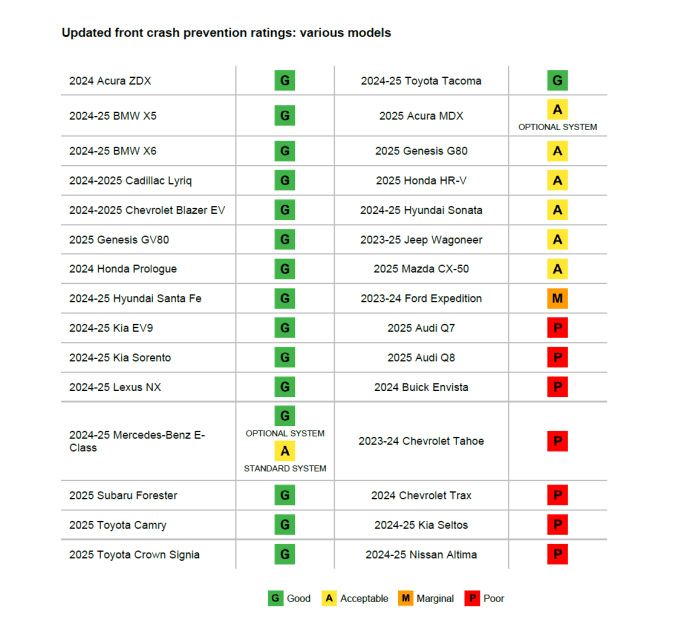
The acceptable-rated systems brought the equipped vehicles to a complete stop before impact and delivered timely warnings in most trials.
Source: Insurance Institute for Highway Safety
“These results indicate that preventing crashes at higher speeds, especially collisions with motorcycles, remains a challenge for some systems,” Harkey said. “Motorcycles are a special area of concern because, unlike passenger vehicle occupants, riders have little protection from crash injuries.”
More Safety

Sponsored•October 1, 2026
Fleet Manager’s Ultimate Playbook: Navigating the New Standard in OEM Connectivity
Rising operating costs, driver safety concerns, and unplanned downtime are putting unprecedented pressure on modern fleets. Discover how fleet managers use embedded OEM connectivity and real-time vehicle data to cut TCO, prevent downtime, and protect drivers without aftermarket telematics hardware.
Read More →
From Driver Well-Being to EV Charging | AF News Recap
Mental health belongs in the fleet safety conversation. This week, we’re looking at five ways fleets can support employee well-being before a crisis, plus Holman’s expansion in Mexico, new one-day Fleet Forward passes, and why EV charging demand is outpacing infrastructure growth.
Read More →
Nexar-Nauto Merger Aims to Give Fleets Better Safety Intelligence Through Larger Driving Dataset
Stefan Heck tells Automotive Fleet that combining more than 10 billion miles of driving history with Nexar's AI models will give fleets deeper insights into driver risk and roadway conditions than either company could provide independently.
Read More →
Don't Wait for a Crisis: 5 Ways to Build Mental Health Into Your Fleet Safety Program
For Suicide Prevention Month, fleet and safety leaders have an opportunity to put mental health where it belongs: at the center of workplace safety.
Read More →
How Camera Data Can Strengthen a Fleet’s Insurance Renewal
Insights from a commercial insurance carrier and a broker show how fleets can turn video telematic data, driver coaching, and improved claims results into a stronger case at insurance renewal.
Read More →
The Safest Fleets Aren’t the Ones with the Most Technology
You’ve made the telematics investment. Here’s how to capture the other half of its value and build the safest fleet on the road.
Read More →
Sponsored•August 7, 2026
Hidden in Plain Sight: Fleet Compliance Risks
Fleet compliance isn't just about having policies — it's about consistently enforcing them. This practical guide reveals six hidden compliance risks common in public sector and shared fleet operations and outlines proven strategies to improve visibility, accountability, and audit readiness
Read More →
NETS Sets 2026 Fleet Safety Benchmark Conference for Indianapolis
The Sept. 15–17 program will feature fleet benchmarking data, case studies, emerging technologies, and implementation strategies while running alongside the NSC Safety Congress & Expo.
Read More →
Off-the-Job Crashes Account for 43% of Employers’ $61.7 Billion Crash Burden
NETS quantifies costs dispersed across fleet, risk, HR, and other departments while providing new per-crash benchmarks for employers.
Read More →
Ram Recalls More Than 1.27 Million 1500 Pickups for Seat Belt Anchor Issue
The recall affects certain 2019-2026 Ram 1500 pickups that may have improperly attached second-row seat belt buckle anchors.
Read More →