




Amazon Unveils AI-Powered Vehicle Inspection Technology
The new Automated Vehicle Inspection (AVI) technology offers reassurance to fleet managers who previously had to rely solely on the human eye and manual inspections for daily safety rounds.

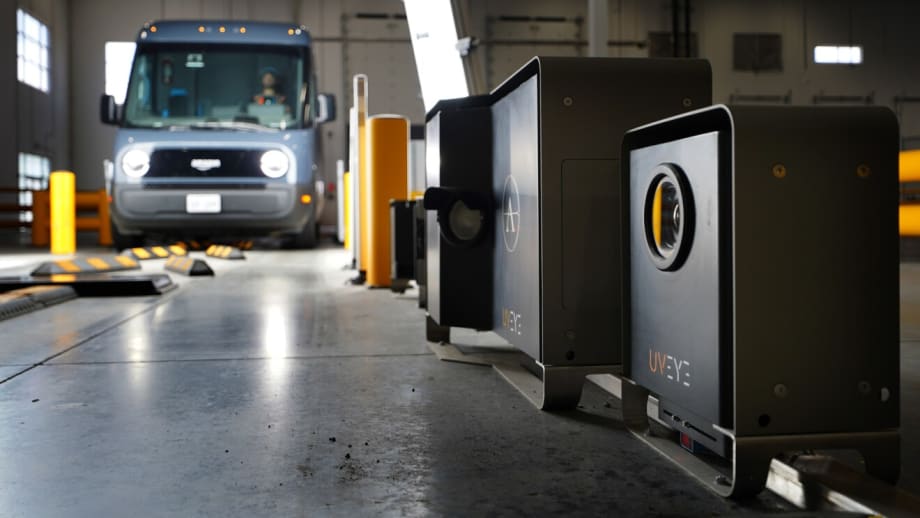
The improved safety of the nearly 280,000 drivers who help deliver packages to Amazon customers through Delivery Service Partners like Hart Road is one of the technology’s benefits.
Photo: Amazon
Amazon announced it has unveiled a new artificial intelligence (AI)-based technology that can spot anomalies in Amazon delivery vans before they become on-road problems.
The new Automated Vehicle Inspection (AVI) technology offers reassurance to fleet managers who previously had to rely solely on the human eye and manual inspections for daily safety rounds. Amazon is launching the AVI technology in partnership with tech startup UVeye in the U.S., Canada, Germany, and the UK.
“The last thing I want is for something preventable to happen—like a tire blowing out because we missed an imperceptible defect during our morning inspection,” said Bennett Hart, an Amazon Delivery Service Partner (DSP) who owns the logistics company Hart Road. “This technology improves the safety of our fleet.”
Benefits of Amazon's New Technology
The improved safety of the nearly 280,000 drivers who help deliver packages to Amazon customers through Delivery Service Partners like Hart Road is one of the technology’s benefits.
Another benefit is that AVI’s advantages can scale, which is helpful since DSP drivers deliver 20 million packages to customers every day.
“One exciting benefit of AVI is the totality of insights the technology gives fleet managers,” said Tom Chempananical, global fleet director at Amazon Logistics. “It can keep track of detected vehicle issues and see if they are repeatedly happening on particular routes."
How AVI Works
At the end of every workday, DSP drivers drive through an AVI archway and over a series of plates equipped with sensors and cameras.
"When you go to the doctor, you expect to see a scan; we kind of do the same thing but for vehicles,” said Amir Hever, UVeye’s CEO.
With the vehicle rolling at 5 mph, the AI system performs a full-vehicle scan in a few seconds, identifies problems, classifies them based on severity, and immediately sends the results to a computer. From there, a DSP can determine the fixes and services they need to perform to have well-maintained vehicles on the road the next day.
“It can catch everything,” Hart said. “And it’s essentially instantaneous.”
While the technology was originally invented to scan the underside of vehicles at borders and security checkpoints, it’s now using AI to seek more specific and minute details, such as vehicle damage.
AVI relies on machine “stereovision,” meaning that it uses two vantage points to construct a full 3D image, and deep learning, a subset of machine learning in which a layered neural network mimics the learning processes of the human brain.
AVI's Impact on Fleet Maintenance
AVI has already found hidden damage patterns. For example, 35% of all issues stem from tires. These issues include sidewall tears and debris and nails lodged in treads, issues not easily picked up by manual inspections previously.
With AVI, DSPs will receive notifications to replace tires before they turn into a bigger problem. Preventing a tire blowout or flat tire on the road improves safety and delivery experience for drivers, and ultimately, removes potential delays for Amazon customers.
“The beauty of AI is that each damage is then fed back to an API that can train models and improve detection accuracy. So, the more AVI is used, the better it gets,” Chempananical said.
The analytics are run through Amazon Web Services (AWS), where the terabytes of vehicle images and data are processed and stored, using Amazon Simple Storage Service (Amazon S3), AWS Lambda, Amazon Elastic Compute Cloud (Amazon EC2), and other services.
The output is processed in less than one minute and shared via the API. Amazon has integrated the output into the existing DSP experience using the Amazon Fleet Portal and shows fleet managers the detected issues along with photos and repair suggestions.
What’s Next for AVI?
Amazon outlined the future of the technology, as it could be used to support all sorts of delivery vehicles, from bikes to drones, and it could inspect not only the exterior but also the interior of the vehicles.
“The potential for AVI applications is huge,” Chempananical said. “It could also influence our routing and geolocation technology for when we notice repeated vehicle damage happening in the same location.”
Examining AI's Presence in Fleet
Amazon's partnership with UVeye is the most recent example of companies embracing AI.
In March 2023, a company executive at General Motors said it is exploring uses for generative artificial intelligence (AI) such as ChatGPT as part of its broader collaboration with Microsoft.
The chatbot could be used to access information on how to use vehicle features in an owner’s manual, program functions such as a garage door code, or integrate schedules from a calendar, said GM Vice President Scott Miller.
In August, GM and Google Cloud shared details on how the two companies collaborated to bring conversational AI technology into millions of GM vehicles.
Since its launch in 2022, GM’s OnStar Interactive Virtual Assistant (IVA), has been powered by intent-recognition algorithms that use Google Cloud’s conversational AI technologies, providing OnStar members with responses to common inquiries, as well as routing and navigation assistance.
Stellantis and Nauto also recently announced that Nauto's AI-powered vehicle safety solution is available for Stellantis commercial fleet customers in the U.S.
Stellantis said it aims to equip fleet owners with a vehicle safety solution that provides real-time alerts to help prevent collisions, promotes safer driving behaviors, and helps reduce collision losses.
More Safety

Fleet Manager’s Ultimate Playbook: Navigating the New Standard in OEM Connectivity
Rising operating costs, driver safety concerns, and unplanned downtime are putting unprecedented pressure on modern fleets. Discover how fleet managers use embedded OEM connectivity and real-time vehicle data to cut TCO, prevent downtime, and protect drivers without aftermarket telematics hardware.
Read More →
From Driver Well-Being to EV Charging | AF News Recap
Mental health belongs in the fleet safety conversation. This week, we’re looking at five ways fleets can support employee well-being before a crisis, plus Holman’s expansion in Mexico, new one-day Fleet Forward passes, and why EV charging demand is outpacing infrastructure growth.
Read More →
Nexar-Nauto Merger Aims to Give Fleets Better Safety Intelligence Through Larger Driving Dataset
Stefan Heck tells Automotive Fleet that combining more than 10 billion miles of driving history with Nexar's AI models will give fleets deeper insights into driver risk and roadway conditions than either company could provide independently.
Read More →
Don't Wait for a Crisis: 5 Ways to Build Mental Health Into Your Fleet Safety Program
For Suicide Prevention Month, fleet and safety leaders have an opportunity to put mental health where it belongs: at the center of workplace safety.
Read More →
How Camera Data Can Strengthen a Fleet’s Insurance Renewal
Insights from a commercial insurance carrier and a broker show how fleets can turn video telematic data, driver coaching, and improved claims results into a stronger case at insurance renewal.
Read More →
The Safest Fleets Aren’t the Ones with the Most Technology
You’ve made the telematics investment. Here’s how to capture the other half of its value and build the safest fleet on the road.
Read More →
Hidden in Plain Sight: Fleet Compliance Risks
Fleet compliance isn't just about having policies — it's about consistently enforcing them. This practical guide reveals six hidden compliance risks common in public sector and shared fleet operations and outlines proven strategies to improve visibility, accountability, and audit readiness
Read More →
NETS Sets 2026 Fleet Safety Benchmark Conference for Indianapolis
The Sept. 15–17 program will feature fleet benchmarking data, case studies, emerging technologies, and implementation strategies while running alongside the NSC Safety Congress & Expo.
Read More →
Off-the-Job Crashes Account for 43% of Employers’ $61.7 Billion Crash Burden
NETS quantifies costs dispersed across fleet, risk, HR, and other departments while providing new per-crash benchmarks for employers.
Read More →
Ram Recalls More Than 1.27 Million 1500 Pickups for Seat Belt Anchor Issue
The recall affects certain 2019-2026 Ram 1500 pickups that may have improperly attached second-row seat belt buckle anchors.
Read More →