




Acura TL, Volvo S60 Draw Top Ratings in New IIHS Frontal Crash Test
ARLINGTON, VA — Of the 11 vehicles that the Insurance Institute for Highway Safety recently subjected to its new frontal crash test, only the Acura TL and Volvo S60 drew the group’s highest rating.
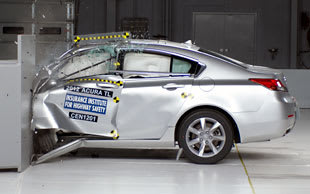
The 2012 Acura TL drew the top rating of “good” in the new IIHS small overlap frontal crash test.
ARLINGTON, VA — Of the 11 midsize luxury and near-luxury vehicles that the Insurance Institute for Highway Safety recently subjected to its new small overlap frontal crash test, only the Acura TL and Volvo S60 drew the group’s highest rating of “good,” IIHS said. All of the tested vehicles were 2012 models.
To learn how the other nine vehicles – the Infiniti G, Acura TSX, BMW 3 series, Lincoln MKZ, Volkswagen CC, Mercedes-Benz C-Class, Lexus IS 250/350, Audi A4 and Lexus ES 350 – fared in this test and other IIHS crash tests, click here.
In the newly developed small overlap frontal crash test, 25 percent of a car's front end on the driver side strikes a 5-foot-tall rigid barrier at 40 mph. A 50th percentile male Hybrid III dummy is belted in the driver seat. The test is designed to replicate what happens when the front corner of a car collides with another vehicle or an object like a tree or utility pole. Outside of some automakers' proving grounds, such a test isn't currently conducted anywhere else in the United States or Europe, the IIHS said.
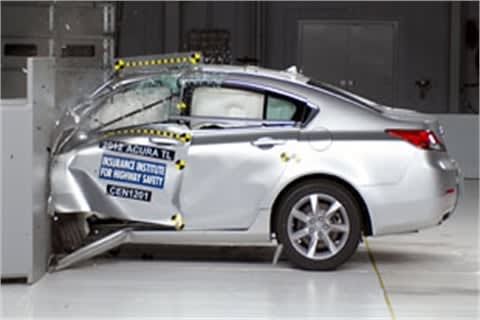
The 2012 Acura TL drew the top rating of “good” in the new IIHS small overlap frontal crash test.
"Nearly every new car performs well in other frontal crash tests conducted by the Institute and the federal government, but we still see more than 10,000 deaths in frontal crashes each year," Institute President Adrian Lund said. "Small overlap crashes are a major source of these fatalities. This new test program is based on years of analyzing real-world frontal crashes and then replicating them in our crash test facility to determine how people are being seriously injured and how cars can be designed to protect them better. We think this is the next step in improving frontal crash protection."
In NHTSA's frontal test, passenger vehicles crash at 35 mph into a rigid barrier covering the full width of the vehicle. In IIHS’s 40 mph offset frontal test, now called a moderate overlap frontal test, 40 percent of the total width of a vehicle strikes a deformable barrier on the driver side.
In a 2009 IIHS study of vehicles with “good” ratings for frontal crash protection, small overlap crashes accounted for nearly a quarter of the frontal crashes involving serious or fatal injury to front seat occupants. Another 24 percent of the frontal crashes were moderate overlap crashes, although they likely occurred at much higher speeds than the IIHS moderate overlap test. An additional 14 percent occurred when passenger vehicles under-rode large trucks, SUVs or other high-riding passenger vehicles.
The IIHS said it is exploring countermeasures for large truck under-ride crashes, and other research has found that the problem of crash incompatibility between cars and SUVs is being reduced.
The key to protection in any crash is a strong safety cage that resists deformation to maintain survival space for occupants. Then vehicle restraint systems can do their jobs to cushion and protect people.
"It's Packaging 101. If you ship a fragile item in a strong box, it's more likely to arrive at its destination without breaking,” Lund said. “In crashes, people are less vulnerable to injury if the occupant compartment remains intact."
Most modern cars have safety cages built to withstand head-on collisions and moderate overlap frontal crashes with little deformation. At the same time, crush zones help manage crash energy to reduce forces on the occupant compartment, the IIHS said. The main crush-zone structures are concentrated in the middle 50 percent of the front end. When a crash involves these structures, the occupant compartment is protected from intrusion, and front airbags and safety belts can effectively restrain and protect occupants.
But small overlap crashes are a different story, the IIHS said. These crashes primarily affect a car's outer edges, which aren't well protected by the crush-zone structures. Crash forces go directly into the front wheel, suspension system and firewall. It is not uncommon for the wheel to be forced rearward into the footwell, contributing to even more intrusion in the occupant compartment and resulting in serious leg and foot injuries. To provide effective protection in small overlap crashes, the safety cage needs to resist crash forces that aren't tempered by crush-zone structures. Widening these front-end structures also would help, according to the IIHS.
"These are severe crashes, and our new test reflects that," Lund said. "Most automakers design their vehicles to ace our moderate overlap frontal test and NHTSA's full-width frontal test, but the problem of small overlap crashes hasn't been addressed. We hope our new rating program will change that."
Luxury and near-luxury cars were the first to undergo the test because these models typically get advanced safety features sooner than other vehicles, Lund said.
Structurally, the Volvo S60 was best, IIHS said. With only a few inches of intrusion, the occupant compartment looked much the same as it did in a moderate overlap test. Reinforcement of the S60's upper rails and a steel cross member below the instrument panel helped to keep the safety cage intact. Volvo has performed similar small overlap tests as part of its vehicle safety development process since the late 1980s, taking the results into account when designing new models.
To view an IIHS video about the test, click here.
More Safety

Nexar-Nauto Merger Aims to Give Fleets Better Safety Intelligence Through Larger Driving Dataset
Stefan Heck tells Automotive Fleet that combining more than 10 billion miles of driving history with Nexar's AI models will give fleets deeper insights into driver risk and roadway conditions than either company could provide independently.
Read More →
Don't Wait for a Crisis: 5 Ways to Build Mental Health Into Your Fleet Safety Program
For Suicide Prevention Month, fleet and safety leaders have an opportunity to put mental health where it belongs: at the center of workplace safety.
Read More →
How Camera Data Can Strengthen a Fleet’s Insurance Renewal
Insights from a commercial insurance carrier and a broker show how fleets can turn video telematic data, driver coaching, and improved claims results into a stronger case at insurance renewal.
Read More →
The Safest Fleets Aren’t the Ones with the Most Technology
You’ve made the telematics investment. Here’s how to capture the other half of its value and build the safest fleet on the road.
Read More →
Hidden in Plain Sight: Fleet Compliance Risks
Fleet compliance isn't just about having policies — it's about consistently enforcing them. This practical guide reveals six hidden compliance risks common in public sector and shared fleet operations and outlines proven strategies to improve visibility, accountability, and audit readiness
Read More →
NETS Sets 2026 Fleet Safety Benchmark Conference for Indianapolis
The Sept. 15–17 program will feature fleet benchmarking data, case studies, emerging technologies, and implementation strategies while running alongside the NSC Safety Congress & Expo.
Read More →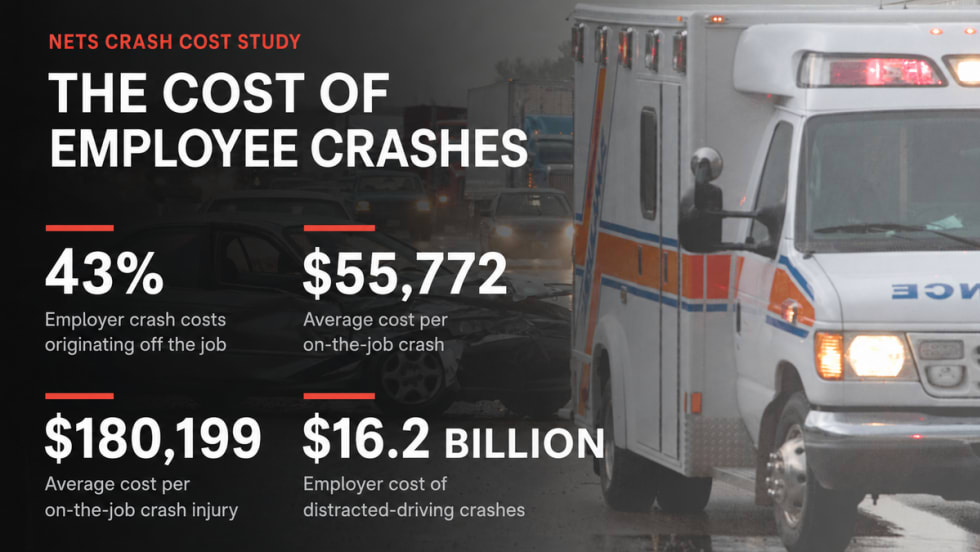
Off-the-Job Crashes Account for 43% of Employers’ $61.7 Billion Crash Burden
NETS quantifies costs dispersed across fleet, risk, HR, and other departments while providing new per-crash benchmarks for employers.
Read More →
Ram Recalls More Than 1.27 Million 1500 Pickups for Seat Belt Anchor Issue
The recall affects certain 2019-2026 Ram 1500 pickups that may have improperly attached second-row seat belt buckle anchors.
Read More →
How Better Visibility Cut Speeding Violations by 48%
Fleet leaders don't need more data, they need clearer visibility into what the data is saying. This case study explores how one utility replaced speeding-event counts with a single metric — miles driven in violation — to strengthen safety and significantly reduce speeding violations.
Read More →
Operation Safe Driver Week: Why the Industry's Oldest Safety Campaign Still Matters to Fleets
A look at how a 2007 enforcement initiative became one of the most consequential weeks on the fleet safety calendar, and what it means for your drivers in 2026.
Read More →