




Acura RL, Kia Amanti and Volvo S80 Deemed Best Performers in Latest Crash Tests
ARLINGTON, Va. --— Three of six large car models earned the top rating of "good," but one was judged "marginal" in recent side impact crash tests conducted by the Insurance Institute for Highway Safety.
ARLINGTON, Va. --— Three of six large car models earned the top rating of "good," but one was judged "marginal" in recent side impact crash tests conducted by the Insurance Institute for Highway Safety. Results show a range of performance in how well large cars are designed to protect people in serious side crashes, the institute said. Ratings of "good," "acceptable," "marginal," or "poor" are based on a crash test in which a barrier designed to replicate the front end of a typical SUV or pickup truck strikes the tested vehicle in the side at 31 mph. The best performers in the institute's latest round of tests were the Acura RL, Kia Amanti and Volvo S80, all 2007 models. The S80 also earned the institute's 2007 Top Safety Pick award for superior overall crash protection. The S80 qualified because it's rated "good" in the institute's front, side and rear tests and has electronic stability control as standard equipment. The 2007 Cadillac STS and Mercedes E class drew "acceptable" ratings in the latest round of side tests. The 2008 BMW 5 series was judged "marginal" for side impact protection, the institute said. All six cars are equipped with standard side airbags that protect the heads of people in front and rear seats. Side impacts are the second most common fatal crash type after frontal crashes. About 9,200 people in passenger vehicles were killed in side impacts in 2005. In crashes with other passenger vehicles during 2004-05, 49 percent of driver deaths in one to three-year-old cars and minivans occurred in side impacts, up from 31 percent in 1980-81. During the same time, the proportion of driver deaths in frontal crashes declined from 61 to 46 percent. "These changes are attributable to two effects," said Institute President Adrian Lund. "There have been significant improvements in frontal crash protection --- standard airbags, improved structural designs, and increased use of safety belts, for example. At the same time, growing sales of SUVs and pickups have exacerbated height mismatches among passenger vehicles, thereby increasing the risks to occupants of many vehicles struck in the side." The lowest priced vehicle in the group the institute recently tested, the Amanti, was one of the best performers. "The Amanti shows that you don't have to buy an expensive car to get good protection in crashes with SUVs and pickup trucks," Lund pointed out. The side structure of the Amanti allowed more intrusion than in the other cars in this group, but all of the injury measures recorded on the dummies were low. The standard head curtain airbags for front- and back-seat occupants kept the dummies' heads from hitting any hard structures including the intruding crash test barrier. The head-protecting airbags in the BMW 5 series are tubular structures that differ from the curtain airbags in the Amanti but also are effective. However, torso protection is rated "poor" for the driver dummy in the 5 series, even though it has separate airbags designed to protect the chests and abdomens of front-seat occupants. The Mercedes E class was re-engineered for 2007 with an emphasis on improving occupant protection in side crashes. When the institute tested an early production model in 2007, the car earned an "acceptable" rating mainly because of high forces recorded on the driver dummy's torso. Mercedes changed the front door trim panels on cars built after May 2007 to try to fix the problem and asked the institute to test the revised car. The result was a slight improvement but not enough to change this car's rating, the institute said. "The E class earns the institute's top rating of 'good' for front and rear crash protection. If this manufacturer can improve side impact protection, this car will earn Top Safety Pick," Lund said. General Motors made changes to the Cadillac STS including reinforcing the B-pillars, changing front door trim panels, and modifying the side torso airbags. The car with these changes earned the second highest rating of "acceptable." The side impact test is only one aspect used to evaluate vehicle crashworthiness. The institute also conducts 40 mph frontal offset crash tests and evaluates vehicles' seat/head restraint designs for protection in rear crashes. Nearly every passenger vehicle, including all of the cars in this group, has earned the highest rating of "good" for frontal crash protection. However, side and rear evaluations vary widely. A vehicle's side evaluation is based on performance in a crash test in which the side of the vehicle is struck by a barrier moving at 31 mph. The barrier represents the front end of a pickup or SUV. Overall ratings reflect injury measures recorded on two instrumented SID-IIs dummies, assessment of head protection countermeasures, and the vehicle's structural performance during the test. Injury measures obtained from the two dummies, one in the driver seat and the other in the back seat behind the driver, are used to determine the likelihood that a driver and/or passenger in a real-world crash would sustain serious injury to various body regions. The movements and contacts of the dummies' heads during the test also are evaluated. Structural performance is based on measurements indicating the amount of B-pillar intrusion into the occupant compartment, the institute said.
More Safety
The Safest Fleets Aren’t the Ones with the Most Technology
You’ve made the telematics investment. Here’s how to capture the other half of its value and build the safest fleet on the road.
Read More →
Hidden in Plain Sight: Fleet Compliance Risks
Fleet compliance isn't just about having policies — it's about consistently enforcing them. This practical guide reveals six hidden compliance risks common in public sector and shared fleet operations and outlines proven strategies to improve visibility, accountability, and audit readiness
Read More →
NETS Sets 2026 Fleet Safety Benchmark Conference for Indianapolis
The Sept. 15–17 program will feature fleet benchmarking data, case studies, emerging technologies, and implementation strategies while running alongside the NSC Safety Congress & Expo.
Read More →
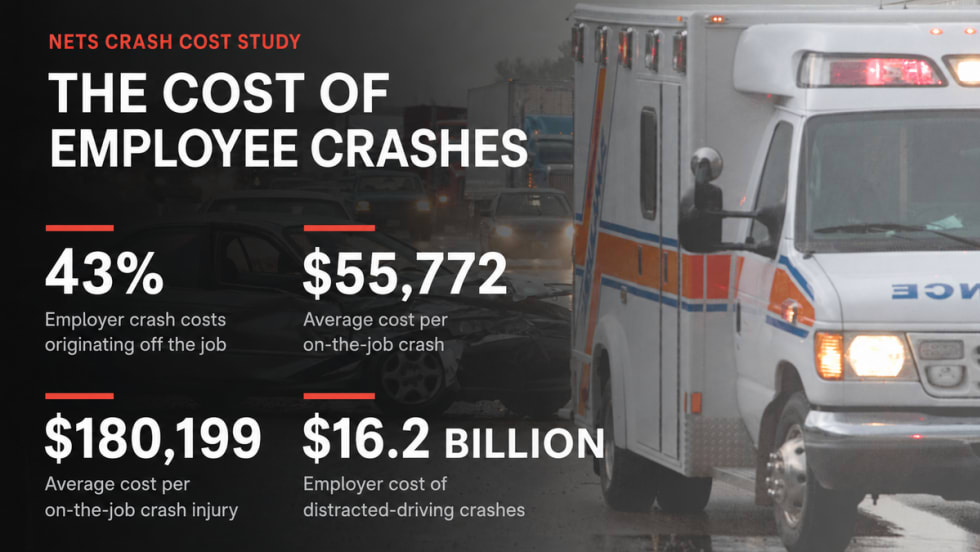
Off-the-Job Crashes Account for 43% of Employers’ $61.7 Billion Crash Burden
NETS quantifies costs dispersed across fleet, risk, HR, and other departments while providing new per-crash benchmarks for employers.
Read More →
Ram Recalls More Than 1.27 Million 1500 Pickups for Seat Belt Anchor Issue
The recall affects certain 2019-2026 Ram 1500 pickups that may have improperly attached second-row seat belt buckle anchors.
Read More →
How Better Visibility Cut Speeding Violations by 48%
Fleet leaders don't need more data, they need clearer visibility into what the data is saying. This case study explores how one utility replaced speeding-event counts with a single metric — miles driven in violation — to strengthen safety and significantly reduce speeding violations.
Read More →
Operation Safe Driver Week: Why the Industry's Oldest Safety Campaign Still Matters to Fleets
A look at how a 2007 enforcement initiative became one of the most consequential weeks on the fleet safety calendar, and what it means for your drivers in 2026.
Read More →
Nexar-Nauto Merger Aims to Give Fleets Better Safety Intelligence Through Larger Driving Dataset
Stefan Heck tells Automotive Fleet that combining more than 10 billion miles of driving history with Nexar's AI models will give fleets deeper insights into driver risk and roadway conditions than either company could provide independently.
Read More →
From Silos to Solutions: Relationship Management for Safer Fleets
From telematics adoption and driver accountability to policy consistency and risk mitigation, this episode breaks down what it really takes to build a safer fleet culture without slowing business down.
Read More →
IIHS Launches First Commercial Vehicle Safety Evaluations
The Insurance Institute for Highway Safety has begun evaluating heavy-duty pickups and cargo vans for driver protection. Which models earned top marks?
Read More →