




For more information on all the happenings at the Fleet Forward Conference, click here.
Safety Leadership Is the New Fleet Management
Safety and leadership expert Bill Sims Jr. demonstrates how fleet managers can cultivate safer, stronger teams by leading with positive reinforcement and fostering cultural change.
by Jeanny Roa & Chris Brown
August 28, 2025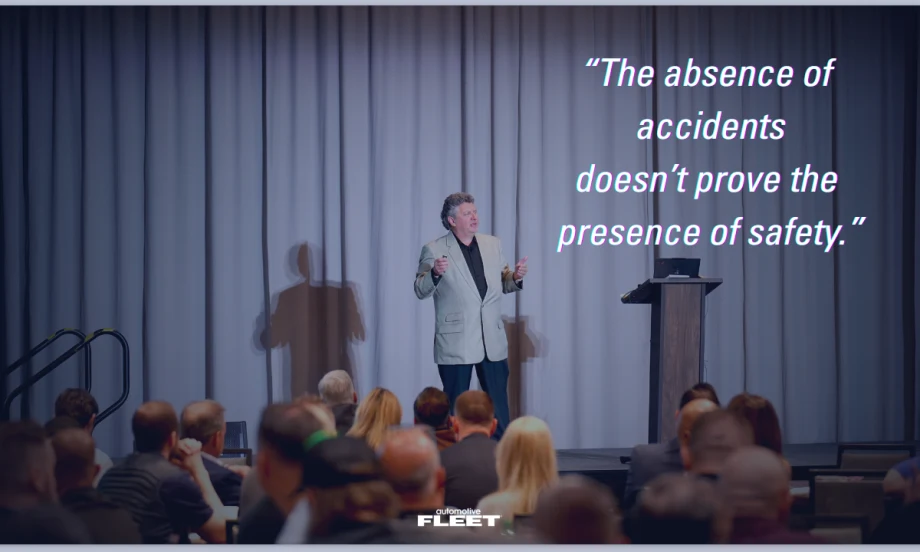
Delivering the fleet safety keynote at the 2025 Fleet Forward Conference, Bill Sims emphasizes that lasting safety improvements start with leadership, not lagging indicators.
Photo: Chadwick Self/Automotive Fleet
5 min to read
Ever since automobiles were first used for work, safety strategies have centered on one singular goal: zero crashes and zero injuries. However, according to Bill Sims Jr., a leadership and safety expert and author of Green Beans & Ice Cream, that thinking was deeply flawed.
“Zero injuries were never your goal and never should have been,” Sims said. “The absence of accidents doesn’t prove the presence of safety.”
Instead, Sims argues for a complete reset: a shift away from relying on lagging metrics and punitive programs, and toward proactive leadership, employee engagement, and a deeper understanding of the conditions that drive minor incidents to catastrophic crashes.
Drawing from decades of experience and real-world examples, Sims outlined for Automotive Fleet a path to transform safety cultures that connects leadership behavior, profitability, and employee trust.
Leadership Drives Culture and Culture Drives Safety
Underlying Sims’ philosophy is a principle supported by behavioral science: leadership behavior drives culture, and culture drives results.
Sims explained that employees contribute “discretionary energy” — the extra effort they give when they feel valued and respected. He emphasized that when employees believe leadership genuinely cares about their safety and well-being, they are far more likely to speak up about hazards, follow best practices, and look out for one another.
Treating people with dignity inspires them to “go the extra mile” in helping prevent accidents and improving safety outcomes.
Sims pointed to Paul O’Neill’s turnaround of Alcoa as proof. In the 1980s, O’Neill made worker safety his first priority. Skeptics and Wall Street scoffed, and stock prices plummeted after his first shareholder speech.
However, within eight years, O’Neill’s initiatives reduced injuries from 1.86 to 0.13 per 100 workers, while increasing Alcoa’s market value from $40 billion to $280 billion.
O’Neill went on to serve as the 72nd United States Secretary of the Treasury during President George W. Bush’s first term.

"In the seven years of zero crashes, zero injuries, did they truly have the presence of safety on that rig, or were they relying on the absence of accidents?” -Bill Sims Jr.
Photo: Chadwick Self
Why Safety 1.0 Falls Short and Safety 2.0 Works Better
Most fleets still operate under what Sims calls “Safety 1.0,” which measures success through lagging indicators, such as OSHA incident rates, crash counts, and “days without injury.” But this approach could create a false sense of security.
Sims highlighted the BP Texas City refinery explosion in 2005 as a tragic example. The refinery had celebrated years of strong safety metrics. Still, leadership decisions and unaddressed risks were setting the stage for an explosion that killed 15 workers and caused over $1 billion in damages.
These decisions set the stage for his concept of “Safety 2.0,” which focuses on preventing serious injuries and fatalities rather than obsessing over minor incidents. A back injury or scraped knee is not the same as a distracted-driving crash that claims a life. “Preventing minor injuries and preventing fatalities are two different games,” Sims explained.
He used the pothole vs. freight train analogy: minor oversights, like ignoring a cracked tire or skipping a maintenance check, could have fatal consequences if left unaddressed.
How Fleets Unknowingly Rehearse for Fatalities
One of Sims’ strongest messages is that fleets unknowingly rehearse for fatalities every day. These “rehearsals” included shortcuts, ignored warning signs, and normalized unsafe practices.
He cited the 2010 SeaWorld tragedy, where trainers repeatedly raised concerns about a whale acting erratically. Management ignored the warnings, and after two previous deaths, the same orca whale killed a third trainer. Eventually, rehearsals lead to catastrophe.
In fleets, these rehearsals often resemble texting behind the wheel; managers pressuring drivers to meet unrealistic schedules, skipping vehicle inspections to save time, and ignoring telematics data that indicates fatigue or high-risk driving.
When Management Decisions Put Drivers at Risk
Sims challenged one of the most deeply held beliefs in fleet safety — that crashes are primarily the result of driver behavior.
In reality, management decisions were often the hidden driver of catastrophic incidents. Deferring maintenance, cutting safety budgets, and reducing training programs all raise risk.
“Can spreadsheets kill people? Absolutely,” Sims said, explaining that when management decisions like cutting safety budgets or delaying maintenance end up compromising risk controls, the chances of tragedy rise sharply.
Fleet managers, he argues, must advocate for safety investments not as compliance requirements, but as business imperatives. He pointed to real-world data showing that the most profitable divisions in companies were consistently the safest ones.
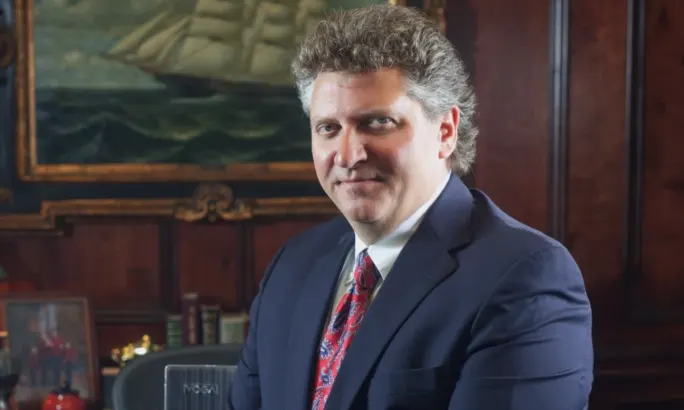
“If people can say, I'm treated with dignity and respect, a down payment on that is nobody ever gets hurt here because we care about our own commitment to our safety, and we care about the people we work with. It swells up into everything you do and creates a sense of pride about the organization you're involved in.” -Bill Sims Jr.
Photo: Chadwick Self
The Power of Positive Reinforcement in Fleet Leadership
Perhaps Sims’ most powerful insight was the role of positive reinforcement in creating safer, stronger fleets. Unlike punitive safety programs that focus on punishing failure, positive reinforcement builds trust, engagement, and accountability.
“Too many managers think writing someone up changes behavior — it doesn’t,” Sims said. “Recognize the behaviors you want, and you’ll get more of them.”
Sims explained that fleets adopting behavior-based recognition programs have seen notable reductions in crashes and safety incidents. Even simple actions, such as thanking drivers for reporting vehicle issues or acknowledging consistent safe driving, can transform safety cultures.
“Positive reinforcement is the single most powerful tool a leader has,” Sims said. “But most organizations don’t know how to use it effectively.”
Using the SEAL Framework to Build Stronger Safety Cultures
Sims tied his approach together in his own SEAL framework: Safety, Engagement, and Servant Leadership. This concept integrates leadership, employee engagement, and culture into a unified model.
Safety: Build systems that proactively identify and address risk.
Engagement: Unlock discretionary energy by respecting and valuing employees.
Servant Leadership: Lead by serving, not policing, your teams.
Sims explained that great leaders focus on creating commitment rather than compliance. When employees believe leadership genuinely cares about their well-being, they bring more energy and focus to their work, which ultimately strengthens safety, quality, and profitability.
Stronger Leadership Creates Safer Fleets
For Sims, fleet safety isn’t primarily about eliminating every incident or enforcing rigid rules. It’s about fostering a culture where employees genuinely care about safety because their leaders genuinely care about them.
“When leaders create commitment instead of compliance, everything changes,” he said. “People bring their best energy to work, and that’s when safety, quality, and profits all improve.”
Sims to Deliver Fleet Safety Keynote at FFC2025
Bill Sims Jr. will deliver the fleet safety keynote at the 2025 Fleet Forward Conference, taking place October 21–23 at the Sheraton San Diego Resort.
Sims’ keynote “What Makes a Great Leader Great?” is scheduled for Thursday, October 23, from 8:15 to 9:00 am.
Subscribe to Our Newsletter
More Safety

Sponsored•October 1, 2026
Fleet Manager’s Ultimate Playbook: Navigating the New Standard in OEM Connectivity
Rising operating costs, driver safety concerns, and unplanned downtime are putting unprecedented pressure on modern fleets. Discover how fleet managers use embedded OEM connectivity and real-time vehicle data to cut TCO, prevent downtime, and protect drivers without aftermarket telematics hardware.
Read More →
From Driver Well-Being to EV Charging | AF News Recap
Mental health belongs in the fleet safety conversation. This week, we’re looking at five ways fleets can support employee well-being before a crisis, plus Holman’s expansion in Mexico, new one-day Fleet Forward passes, and why EV charging demand is outpacing infrastructure growth.
Read More →
Nexar-Nauto Merger Aims to Give Fleets Better Safety Intelligence Through Larger Driving Dataset
Stefan Heck tells Automotive Fleet that combining more than 10 billion miles of driving history with Nexar's AI models will give fleets deeper insights into driver risk and roadway conditions than either company could provide independently.
Read More →
Don't Wait for a Crisis: 5 Ways to Build Mental Health Into Your Fleet Safety Program
For Suicide Prevention Month, fleet and safety leaders have an opportunity to put mental health where it belongs: at the center of workplace safety.
Read More →
How Camera Data Can Strengthen a Fleet’s Insurance Renewal
Insights from a commercial insurance carrier and a broker show how fleets can turn video telematic data, driver coaching, and improved claims results into a stronger case at insurance renewal.
Read More →
The Safest Fleets Aren’t the Ones with the Most Technology
You’ve made the telematics investment. Here’s how to capture the other half of its value and build the safest fleet on the road.
Read More →
Sponsored•August 7, 2026
Hidden in Plain Sight: Fleet Compliance Risks
Fleet compliance isn't just about having policies — it's about consistently enforcing them. This practical guide reveals six hidden compliance risks common in public sector and shared fleet operations and outlines proven strategies to improve visibility, accountability, and audit readiness
Read More →
NETS Sets 2026 Fleet Safety Benchmark Conference for Indianapolis
The Sept. 15–17 program will feature fleet benchmarking data, case studies, emerging technologies, and implementation strategies while running alongside the NSC Safety Congress & Expo.
Read More →
Off-the-Job Crashes Account for 43% of Employers’ $61.7 Billion Crash Burden
NETS quantifies costs dispersed across fleet, risk, HR, and other departments while providing new per-crash benchmarks for employers.
Read More →
Ram Recalls More Than 1.27 Million 1500 Pickups for Seat Belt Anchor Issue
The recall affects certain 2019-2026 Ram 1500 pickups that may have improperly attached second-row seat belt buckle anchors.
Read More →