




A VIN for All: New Tool Documents Vehicle Data Security Levels
The service from Privacy4Cars gives consumers as well as fleets and remarketing operations an instant account of a vehicle’s data security and privacy history.

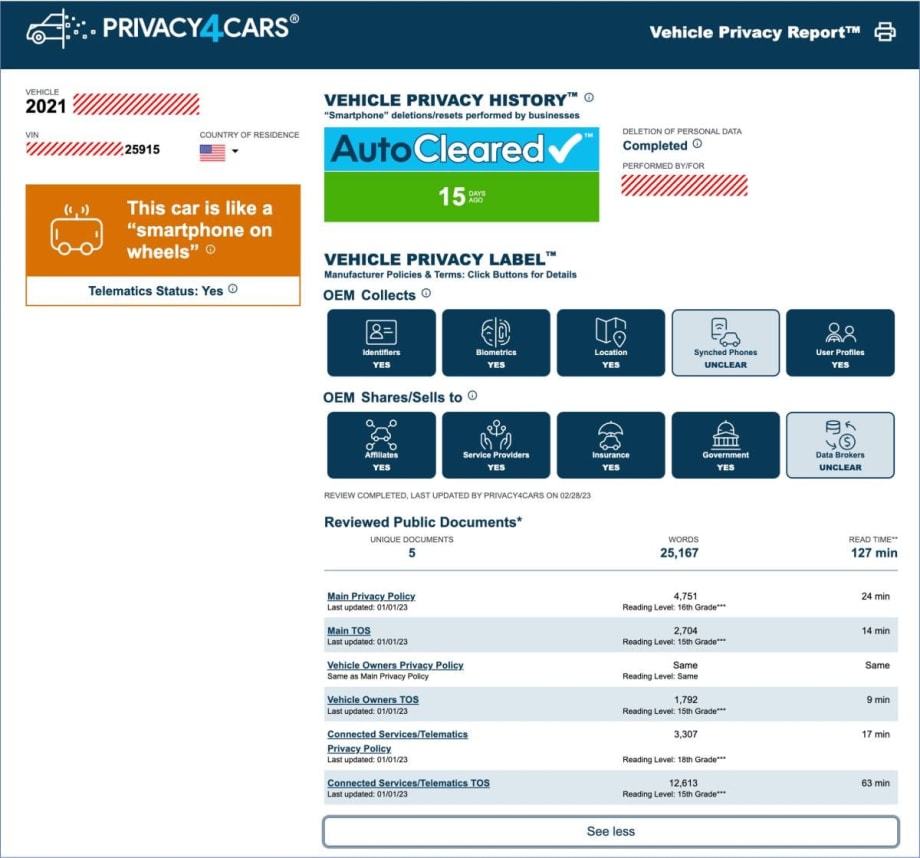
Through the Vehicle Privacy Report, a vehicle owner or buyer can see exactly when and where a dealership or company transacting the vehicle deleted persona data to protect previous owners and users.
Photo: Privacy4Cars
Privacy4Cars, a data privacy-tech company that focuses on protecting personal data left on vehicles, launched a new tool May 2, called Vehicle Privacy Report, that widens access to the security information of most vehicles on the road.
Vehicle owners and users can quickly see key privacy facts about a vehicle, including personal information (PI) the manufacturer collects, shares, and sells the information to by entering a vehicle’s VIN number at vehicleprivacyreport.com.
Contents of Vehicle Privacy Report
The report portal offers two main components:
A vehicle’s privacy label that offers 10 standard clickable icons that describe how vehicle data is sold, shared, collected, and possibly left behind by vehicle manufacturers;
A vehicle’s history of actions that businesses involved in the buying and selling of vehicles have taken to protect the personal data of owners.
A vehicle owner or buyer can see exactly when and where a dealership or company transacting the vehicle deleted persona data to protect previous owners and users, said Andrea Amico, the founder and CEO of Privacy4Cars, in an interview with Automotive Fleet and Vehicle Remarketing.
The service is free to consumers. Business-to-business (B2B) users such as fleet operations, rental card companies, consignors, auctions, and auto dealers will pay a licensing fee to apply the Vehicle Privacy Report to their internal processes, Amico said.
Data security information has become a critical function of vehicles as they are built with more onboard digital and interactive technologies that collect or track the personal data of drivers and passengers who connect and sync their smartphones and electronic devices in the vehicle. They also often enter personal information into the OEM-provided equipment, such as home addresses in GPS navigation.
“It is important to put the information out there and start the journey for consumers and companies to offer a higher level of transparency in transactions, and before many transactions happen,” Amico said. “A buyer should know what [data terms and practices] they are buying, and a seller should know what they are selling.”
Increasing Awareness About Vehicle Data Security
While the reporting tool does not cover all 273 million vehicles in circulation in the U.S., it comes close to 100%, Amico said. Privacy4Cars plans to release versions of the reporting tool in Canada, Europe, and other regions, which all have different data agreements and disclosures. “There’s a lot of localization of content that needs to be done,” Amico said.
Privacy4Cars beta tested the Vehicle Privacy Report tool with select fleet operations and banking institutions.
The Vehicle Privacy Report tool evolved after Privacy4Cars sent consumers to “mystery shop” at over 150 dealerships between 2020-2023. The research found that less than 5% of salespeople correctly communicated that cars collect personal information and that manufacturers have the rights to share and sell it. No dealership was able to explain the data differences between two different vehicles mystery shoppers were test driving.
Finding and accessing the full scope of data security information can take consumers, owners, renters and passengers hours of research and reading through complex legal documents, rendering most unable to fully understand a vehicle’s data privacy picture before purchasing.
“If you are financing a vehicle, it’s not just a piece of metal as an asset, but one that comes with a data agreement,” Amico said. “We believe we will see auto finance companies, insurance companies and dealerships use it. It’s a trust-building content service they can put in front of their customers while making their disclosures.”
More Safety

Fleet Manager’s Ultimate Playbook: Navigating the New Standard in OEM Connectivity
Rising operating costs, driver safety concerns, and unplanned downtime are putting unprecedented pressure on modern fleets. Discover how fleet managers use embedded OEM connectivity and real-time vehicle data to cut TCO, prevent downtime, and protect drivers without aftermarket telematics hardware.
Read More →
From Driver Well-Being to EV Charging | AF News Recap
Mental health belongs in the fleet safety conversation. This week, we’re looking at five ways fleets can support employee well-being before a crisis, plus Holman’s expansion in Mexico, new one-day Fleet Forward passes, and why EV charging demand is outpacing infrastructure growth.
Read More →
Nexar-Nauto Merger Aims to Give Fleets Better Safety Intelligence Through Larger Driving Dataset
Stefan Heck tells Automotive Fleet that combining more than 10 billion miles of driving history with Nexar's AI models will give fleets deeper insights into driver risk and roadway conditions than either company could provide independently.
Read More →
Don't Wait for a Crisis: 5 Ways to Build Mental Health Into Your Fleet Safety Program
For Suicide Prevention Month, fleet and safety leaders have an opportunity to put mental health where it belongs: at the center of workplace safety.
Read More →
How Camera Data Can Strengthen a Fleet’s Insurance Renewal
Insights from a commercial insurance carrier and a broker show how fleets can turn video telematic data, driver coaching, and improved claims results into a stronger case at insurance renewal.
Read More →
The Safest Fleets Aren’t the Ones with the Most Technology
You’ve made the telematics investment. Here’s how to capture the other half of its value and build the safest fleet on the road.
Read More →
Hidden in Plain Sight: Fleet Compliance Risks
Fleet compliance isn't just about having policies — it's about consistently enforcing them. This practical guide reveals six hidden compliance risks common in public sector and shared fleet operations and outlines proven strategies to improve visibility, accountability, and audit readiness
Read More →
NETS Sets 2026 Fleet Safety Benchmark Conference for Indianapolis
The Sept. 15–17 program will feature fleet benchmarking data, case studies, emerging technologies, and implementation strategies while running alongside the NSC Safety Congress & Expo.
Read More →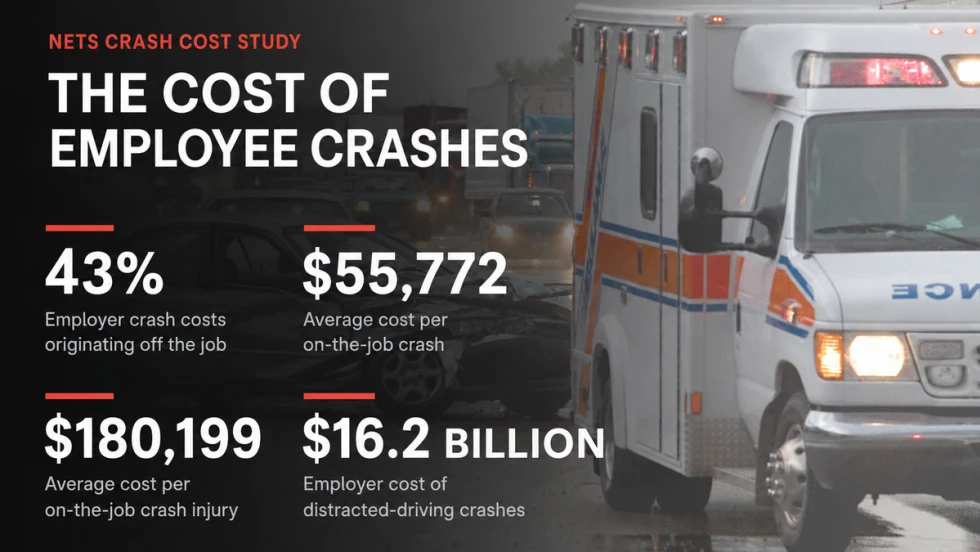
Off-the-Job Crashes Account for 43% of Employers’ $61.7 Billion Crash Burden
NETS quantifies costs dispersed across fleet, risk, HR, and other departments while providing new per-crash benchmarks for employers.
Read More →
Ram Recalls More Than 1.27 Million 1500 Pickups for Seat Belt Anchor Issue
The recall affects certain 2019-2026 Ram 1500 pickups that may have improperly attached second-row seat belt buckle anchors.
Read More →