





Related: Ongoing Strong Economy to Bolster 2020-MY Fleet Orders
Work Trucks Vulnerable to Delivery Delays: How to Minimize Upfit Lead Time
For the past several model years, order-to-delivery times for high-volume work trucks and vans have increased due to strong demand. Vocational trucks are vulnerable to OTD delays because fleet orders are usually concentrated among a handful of models.
September 27, 2019
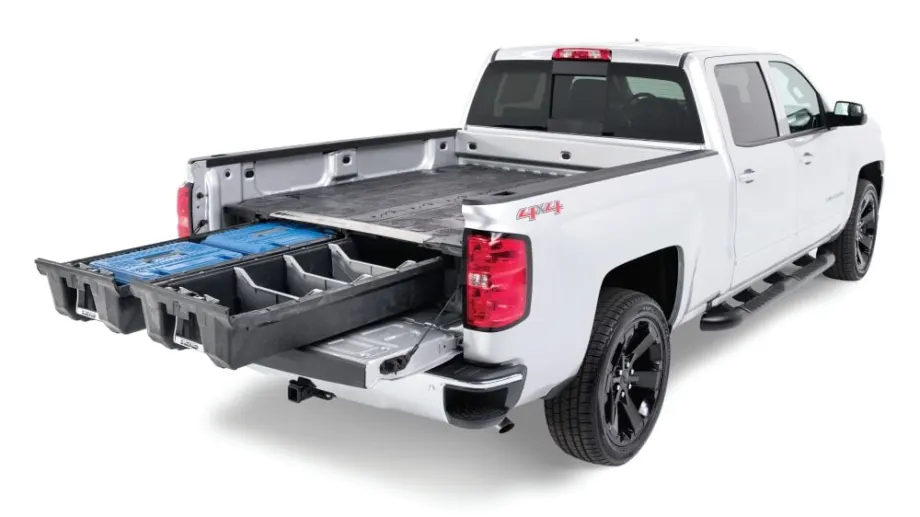
There are a multitude of specialized fleet applications that require the installation of auxiliary equipment on a truck or in a van. What complicates planning is that there are as many ways to upfit a truck as there are truck and body configurations.
Photo courtesy of DECKED.
4 min to read
For the past several model-years, order-to-delivery (OTD) times for high-volume work trucks and vans have increased due to strong demand in both the fleet and retail markets. Vocational trucks are vulnerable to OTD delays because fleet orders are usually concentrated among a handful of models with limited secondary choices. With truck assembly plants running at near capacity, lead times can increase for a variety of reasons, such as component constraints, quality holds, or transportation bottlenecks. Likewise, with upfitters operating at capacity with a backlog of jobs, fleet managers need to be extra careful when planning upfit specifications because any after-the-fact engineering change will further delay OTD.
Ways to Minimize Upfit Lead Times
Typically, senior management does not understand the length of time needed to transport the chassis to the upfitter, wait in line for the build, complete the upfit, and then wait in line for delivery to the end-user. Despite this, there are many actions that can improve OTD for vehicles requiring upfits.
Advance Planning is Crucial: There are a multitude of specialized fleet applications that require the installation of auxiliary equipment on a truck or in a van. What complicates planning is that there are as many ways to upfit a truck as there are truck and body configurations. Since no two fleets are alike, auxiliary equipment needs will vary depending on the application. Planning is critical because each fleet is specialized to its own needs, and what works for one may not work for another. There are many moving parts in upfitting a vehicle, which makes early planning essential for completing an upfit in a timely manner.
Order as Early as Possible: Fleet managers should place new vehicle orders as early as possible to buffer against possible production or transportation delays. In addition, OEM production timeframes will vary especially around start-up and build-out dates. Sometimes, OEMs will move build-out dates forward. This can result in the inability to place needed orders, leading to delays as you search for out-of-stock units.
Anticipate Lead Time: Lead times for add-on equipment and bodies can be very long and they need to be coordinated with anticipated chassis deliveries to an upfitter. One good practice is to order service bodies at the time the chassis is ordered or in transit when scheduling upfits. Use of a bailment pool is another alternative when deployment of the upfitted asset is time-sensitive.
When Possible, Standardize Upfits: Standardization increases operational efficiencies, helps expedite order-to-delivery times, and enhances employee familiarity with equipment, which can translate into increased safety. In addition, standardization allows for volume price discounting from the manufacturer — not just to the vehicle, but in volume discounts for every upfit component — as well as reduced lead times, improved quality, and a more consistent build. Standardization also supports the quality assurance and minimizes the need for individual inspections and quality control. In addition, the ability to stock equipment at the installer can shorten upfit lead time, provide flexibility if a vehicle needs to be transferred between branch locations, and facilitates quicker new-hire training.
Despite these benefits, many fleets continue to use too many specs or options, which needlessly complicates fleet ordering and operations. Without a certain degree of equipment standardization, the ability to move vehicles from location to location without impacting operations becomes more difficult. When possible, it should be a priority for vocational fleet managers to focus on standardizing upfit packages. When a fleet manager conducts a detailed examination of equipment used across the fleet, it will usually yield a set of specifications that can fulfill the work application in all but a few circumstances.
Advance Planning and Early Ordering are Key to OTD
Upfitting a vehicle to perform a specific task is one of the more complicated aspects of fleet management. As such, it is an area fraught with pitfalls to make mistakes and delay deliveries. It is essential that fleet managers and all suppliers collaborate on upfits to ensure the job can be efficiently completed. It is important to start the planning cycle early to leave adequate time for production, upfitting, and transportation. Upfitting a vehicle is a process that requires thought and consideration. In the final analysis, the most effective strategies to expedite the upfitting OTD process are advance planning and early ordering.
Let me know what you think.
Subscribe to Our Newsletter
More Blog Posts

Fleets Want Trust Restored with Suppliers
During this period of ongoing supply constraints, the trust that fleet managers had with OEMs, upfitters, and dealers has been strained. Fleet managers say they have had too many experiences over the past three years coping with erroneous information, adjusting to multiple price increases, and feeling betrayed by inadequate transparency from suppliers.
Read More →
Scheduled Replacement Cycles Are Becoming a Distant Memory
The ongoing difficulty in sourcing replacement vehicles is forcing companies to extend the service lives of vehicles that are unable to be replaced, which, inevitably, increases unscheduled maintenance expenses.
Read More →
Fleet Simplification is the Antidote to Asset Variability
Fleet simplification identifies asset functions to uncover commonality among the equipment and assets. Simplification increases operational efficiency as end-users become accustomed to the controls, displays, and operation of less diverse units.
Read More →
The Dangers of Static Fleet Policies
A fleet policy is a living document, flexible enough to adapt to evolving business priorities, developing industry trends, and changing industry best practices and standards.
Read More →
Short-Term vs. Long-Term Cost Reductions
Corporate procurement staff are often driven by short-term, immediate cost reductions. However, a longer perspective to soft cost savings is critical because fixating on short-term results will hurt a company in the long run.
Read More →
Uptick in Unscheduled Maintenance Increasing Vehicle Downtime
Fleet data analysis can identify recurring downtime issues. It’s important to determine the root causes of downtime so procedures can be developed to minimize such problems.
Read More →
Eliminate Needless Curb Weight to Maximize ICE & EV Efficiencies
Vehicle weight relates directly to fuel economy. In today’s era of electrification, there is also a direct correlation between vehicle weight and battery range.
Read More →
Tech Dependence Risks Dumbing Down Fleet Manager Expertise
The line between creative thinking and problem solving and doing what the data indicates is thin. To lead in fleet management, you need to balance understanding the fundamentals and embracing what smart technology offers.
Read More →
Leverage the Synergy of Safe Driving to Achieve Sustainability and Cost Goals
Safe driving, emission reductions, and cost containment can all be achieved at the same time.
Read More →
The Playbook for Fleet Manager Success
There are many paths to success — most of them involve being flexible, open-minded, and willing to learn.
Read More →