




Remarketing Déjà Vu: Will the Resale Market of 2016 be a Repeat of 2002?
Many of the dynamics in today’s market are eerily familiar to the resale value softness that occurred in the last decade, which ultimately peaked in 2002. At that time, year-over-year increases of off-lease vehicles entering the wholesale market exerted downward pressure on resale prices. It appears that we are on the same trajectory, with off-lease volumes peaking in 2016. What are you doing to prepare for these different market dynamics?

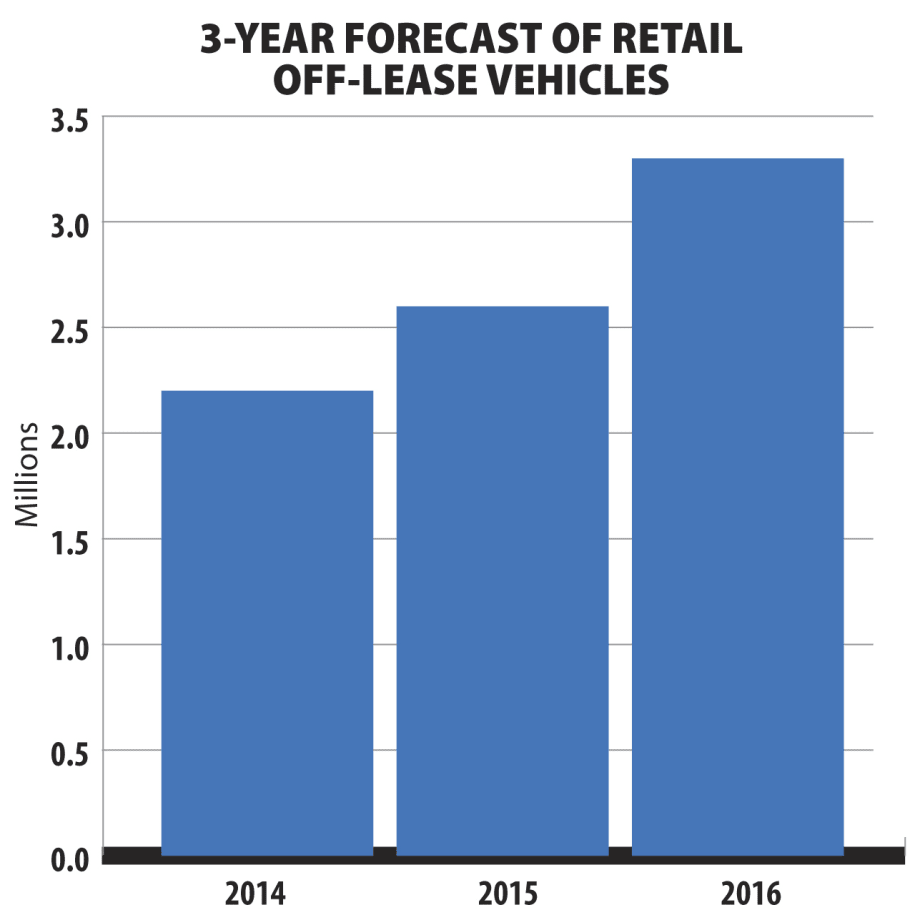
Year-over-year increases in off-lease vehicles will exert downward pressure on resale prices.
Source: J.D. Power & Manheim Consulting
"Those who cannot remember the past are condemned to repeat it," wrote the philosopher George Santayana. This quote rings true on many levels and an analogy can be found in vehicle remarketing trends that are currently percolating in the wholesale market. Many of the dynamics in today’s market are eerily familiar to the resale value softness that occurred in the last decade, which ultimately peaked in 2002. At that time, year-over-year increases of off-lease vehicles entering the wholesale market exerted downward pressure on resale prices. For the sake of this discussion, off-lease returns are defined as those vehicles not purchased by the retail lessee or by the grounding dealer. Historically, this represents approximately 50 percent of all lease originations.
Change is Sometimes Cyclical
Year-over-year increases in off-lease vehicles will exert downward pressure on resale prices.
Source: J.D. Power & Manheim Consulting
Let’s examine in more detail the similarities between 2002 and what we anticipate for 2016. Today, retail leasing is in the midst of a dramatic resurgence. Lease originations have grown significantly, from only 1.1 million units in 2009 to nearly 3.2 million in 2013. Manheim Consulting projects 2.1 million off-lease units will enter the wholesale market in 2014, which will grow to 2.5 million in 2015 and 3 million in 2016. Fueling this growth are some OEMs offering aggressive lease incentives, such as inflated residual values, lower lease calculation rates, the absorption of negative equity in the lease calculation, and lower qualifications for credit approval. Although much of the forthcoming growth in wholesale inventory will be due to higher off-lease volumes, there will also be growth in the number of rental, repossessions, and dealer trade-in units.
As wholesale inventory swells, it will produce downward pressure on wholesale pricing, since it is not anticipated that there will be a corresponding increase in dealer demand. As Tom Webb, Manheim’s chief economist points out, 2016 is shaping up to be a challenging year for remarketers. In fact, there is no guarantee the 2016 market will be a straight-line progression from today’s robust market. As history shows, we operate in a cyclical industry influenced by macro-events that are often beyond our control.
While 2016 may seem far off, this is the wholesale market in which many fleet managers will be remarketing today’s 2013 and 2014 model vehicles. Many variables in the 2016 market are already baked into the forecasts, but many unpredictable variables exist that may mitigate these downward pricing pressures. Some remarketing experts downplay concerns that used-vehicle pricing may be heading for a pricing correction with the spike in the availability of used vehicles. They argue that used-vehicle supplies will continue to remain below historic levels, and with the improving economy, pent-up demand among consumers to replace aging vehicles will drive strong demand for both new and used vehicles in future years. Also, there has been a surge in the export of used vehicles to emerging international markets, which will help expand buyer demand for this expanded inventory.
Similarly, many off-lease vehicles are cherry-picked by OEMs for their certified pre-owned programs. In 2002, according to NADA, the certified-used vehicle market was less than 40 percent the size of total off-lease volume; however, in 2013, the CPO market was 23-percent bigger than total off-lease volume. The argument is that today’s CPO market can absorb a much larger portion of off-lease vehicles than in the past. Very few doubt the ability of the wholesale market to absorb the increased volume of off-lease vehicles. The question is how much adjustment will remarketers need to make to prices to facilitate these wholesale transactions.
A Multi-Pronged Remarketing Strategy
Today, used-vehicle resale values continue to remain strong as dealer demand scoops up existing wholesale inventory of good-quality used vehicles. It is important to remember that the higher-than-normal resale values we have experienced in recent years are an anomaly caused by the low used-vehicle inventory in the wholesale market, resulting from the extremely low sales of new vehicles during the 2009-2011 time frame. For instance, in 2009, annual new-vehicle sales fell to 10.3 million units from 16.9 million the preceding year. As a rule of thumb, 60 percent of new-vehicle sales result in a trade-in. The sizeable contraction in new-vehicle sales resulted in a significant drop in used-vehicle trade-ins, along with fewer off-lease units and a substantially lower volume of rental cars being remarketed at wholesale auctions.
This will soon change as trend lines point to a multi-year swelling of used-vehicle inventory in the wholesale market. The forthcoming off-lease volume is not a secret – the remarketing industry knows it’s coming. What are you doing to prepare for these different market dynamics? Fleet managers must optimize remarketing processes to ensure out-of-service fleet units are exposed to the most potential buyers. This requires a multipronged remarketing strategy to reinvigorate employee sales, promote sales to grounding dealers, aggressively using upstream online remarketing channels, and implement greater creativity in remarketing units at physical auctions in order to stand out from the crowd.
Let me know what you think.
More Blog Posts

Fleets Want Trust Restored with Suppliers
During this period of ongoing supply constraints, the trust that fleet managers had with OEMs, upfitters, and dealers has been strained. Fleet managers say they have had too many experiences over the past three years coping with erroneous information, adjusting to multiple price increases, and feeling betrayed by inadequate transparency from suppliers.
Read More →
Scheduled Replacement Cycles Are Becoming a Distant Memory
The ongoing difficulty in sourcing replacement vehicles is forcing companies to extend the service lives of vehicles that are unable to be replaced, which, inevitably, increases unscheduled maintenance expenses.
Read More →
Fleet Simplification is the Antidote to Asset Variability
Fleet simplification identifies asset functions to uncover commonality among the equipment and assets. Simplification increases operational efficiency as end-users become accustomed to the controls, displays, and operation of less diverse units.
Read More →
The Dangers of Static Fleet Policies
A fleet policy is a living document, flexible enough to adapt to evolving business priorities, developing industry trends, and changing industry best practices and standards.
Read More →
Short-Term vs. Long-Term Cost Reductions
Corporate procurement staff are often driven by short-term, immediate cost reductions. However, a longer perspective to soft cost savings is critical because fixating on short-term results will hurt a company in the long run.
Read More →
Uptick in Unscheduled Maintenance Increasing Vehicle Downtime
Fleet data analysis can identify recurring downtime issues. It’s important to determine the root causes of downtime so procedures can be developed to minimize such problems.
Read More →
Eliminate Needless Curb Weight to Maximize ICE & EV Efficiencies
Vehicle weight relates directly to fuel economy. In today’s era of electrification, there is also a direct correlation between vehicle weight and battery range.
Read More →
Tech Dependence Risks Dumbing Down Fleet Manager Expertise
The line between creative thinking and problem solving and doing what the data indicates is thin. To lead in fleet management, you need to balance understanding the fundamentals and embracing what smart technology offers.
Read More →
Leverage the Synergy of Safe Driving to Achieve Sustainability and Cost Goals
Safe driving, emission reductions, and cost containment can all be achieved at the same time.
Read More →
The Playbook for Fleet Manager Success
There are many paths to success — most of them involve being flexible, open-minded, and willing to learn.
Read More →