




How Fleets Can Avoid Staged Accidents
Blog: Vocational trucks are susceptible to being targeted for staged accidents, which involves maneuvering an unsuspecting employee driver into an intentional crash in order to make a false insurance claim or to file a lawsuit against the driver’s employer.

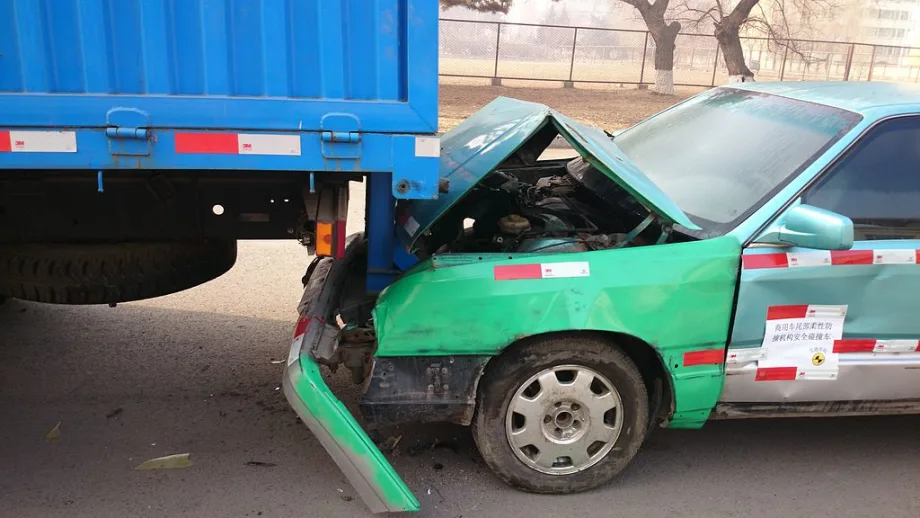
Instruct your drivers to use their phone to immediately photograph all damage done to the alleged fraudster’s vehicle, as well as everyone who was in the vehicle.
Photo via Own Work/Wikimedia.
Vocational trucks are susceptible to being targeted for staged accidents, which involves maneuvering an unsuspecting employee driver into an intentional crash in order to make a false insurance claim or to file a lawsuit against the driver’s employer.
Staged crashes first emerged in the in the U.S. in the 1990s when Hispanic immigrants were recruited, sometimes for as little as $100, to drive a vehicle that suddenly brakes in front of a moving commercial vehicle, resulting in a crash. This insurance fraud scheme came to light when one such driver, Jose Luis Lopez Perez, died in a staged accident. Upon investigation of Perez’s death, it was discovered that he was part of a massive and widespread insurance fraud scheme that intentionally staged vehicle accidents.
A favorite target for staged accidents is commercial vehicles. For instance, AutoZone decided in 2008 to remove branding from its light-duty fleet to make them less conspicuous as commercial vehicles. According to Clay Gaudet, fleet manager for AutoZone, this decision reduced accident claims by millions of dollars.
Staged accidents continue to be an ongoing issue in the U.S. and have since migrated to other countries. Referred to elsewhere in the world as “crash for cash,” this type of insurance fraud is now a huge problem in many other countries, such as the U.K., Russia, Australia, and Singapore, to name a few.
Perpetrators of staged accidents seek to make money by submitting fraudulent insurance claims or filing a lawsuit against a company. While some staged accidents are amateur affairs, most are carefully planned and practiced in advance of the actual incident. Often, these criminals target commercial vehicles because they believe the monetary settlement will be much larger than crashing into the vehicle belonging to a private individual. A logo or company name on the side of a commercial vehicle will increase the potential for a staged crash to occur.
In a perverse rationalization, these criminals view work vehicles as a victimless crime because the company’s insurance will cover the expenses. Insurance fraud against these vehicles is more lucrative because criminals know a company vehicle will be insured, or if it is self-insured, accomplice attorneys know most companies will often settle out of court once a lawsuit has been filed. For a vocational business operating only a few vehicles, it will typically, on average, carry a minimum of $1 million in liability insurance.
While staged accidents happen throughout the country, most incidents occur in states with no-fault laws, such as Florida. No-fault laws require insurers to reimburse policyholders for medical expenses regardless of who is at fault. According to the National Insurance Crime Bureau (NICB), the top five staged accident states are Florida, New York, California, Texas, and Illinois. The five cities with the most staged accident claims are New York City, Tampa, Miami, Orlando, and Houston.
Types of Staged Accidents
The NICB identifies six situations where there is a high risk of a staged accident occurring:
T-Bone Accident: In this scenario, a criminal will wait for a company vehicle to proceed through an intersection and then accelerate to T-bone it. When the police arrive, accomplice witnesses, known as “shady helpers,” will claim the company vehicle ran the stop sign or traffic signal.
The Wave: In this fraud, the criminal driver will notice an attempt to switch lanes and subsequently wave the company driver ahead. As the driver maneuvers into the lane, the criminal driver will accelerate, colliding with the fleet vehicle. When the police arrive, the criminal driver will deny giving a courtesy wave to proceed forward and will fault the company driver for the collision.
Dual Turning Lanes Sideswipe: A criminal driver in the outer lane of the dual turning lanes rams or sideswipes the company vehicle while they are simultaneously making the turn.
Swoop and Stop: A criminal vehicle will suddenly pull in front of the company vehicle and abruptly brakes to cause a rear-end collision. Another accomplice vehicle will simultaneously pull up alongside the company vehicle, blocking it from swerving to avoid an accident.
Phony Injuries: In any fraudulent accident, your company may find yourself liable for injuries your driver didn’t cause. The criminal and accomplice passengers may collaborate with an unscrupulous physician or chiropractor to file personal injury claims for non-existent injuries. Some criminals visit legitimate doctors and claim whiplash or other difficult to detect soft tissue injuries.
Jump-ins: This occurs when people suddenly appear and jump into the criminal’s vehicle claiming they were passengers.
How to Deal with Staged Accidents
The best defense against staged accidents is to drive carefully and be vigilant of your surroundings. Do not tailgate to prevent the “swoop and stop” scenario. Many companies install dash cams to combat against staged accident so it isn’t the driver’s word against the perpetrator’s word. Dash cams are small video cameras that attach to a vehicle’s dashboard and records what occurs immediately before an accident.
Instruct your drivers to use their phone to immediately photograph all damage done to the alleged fraudster’s vehicle, as well as everyone who was in the vehicle. Doing this will limit their ability to exaggerate the damage done to their vehicle. Pay special attention to the number of people in the other car and record each individual’s contact information.
Snap photos from every angle of the involved vehicles, with a special focus on the damage. Also, capture on camera the license plate of the other vehicle. It is important to always call the police, even if the damage is minimal to generate an official police report.
Let me know what you think.
More Blog Posts

Fleets Want Trust Restored with Suppliers
During this period of ongoing supply constraints, the trust that fleet managers had with OEMs, upfitters, and dealers has been strained. Fleet managers say they have had too many experiences over the past three years coping with erroneous information, adjusting to multiple price increases, and feeling betrayed by inadequate transparency from suppliers.
Read More →
Scheduled Replacement Cycles Are Becoming a Distant Memory
The ongoing difficulty in sourcing replacement vehicles is forcing companies to extend the service lives of vehicles that are unable to be replaced, which, inevitably, increases unscheduled maintenance expenses.
Read More →
Fleet Simplification is the Antidote to Asset Variability
Fleet simplification identifies asset functions to uncover commonality among the equipment and assets. Simplification increases operational efficiency as end-users become accustomed to the controls, displays, and operation of less diverse units.
Read More →
The Dangers of Static Fleet Policies
A fleet policy is a living document, flexible enough to adapt to evolving business priorities, developing industry trends, and changing industry best practices and standards.
Read More →
Short-Term vs. Long-Term Cost Reductions
Corporate procurement staff are often driven by short-term, immediate cost reductions. However, a longer perspective to soft cost savings is critical because fixating on short-term results will hurt a company in the long run.
Read More →
Uptick in Unscheduled Maintenance Increasing Vehicle Downtime
Fleet data analysis can identify recurring downtime issues. It’s important to determine the root causes of downtime so procedures can be developed to minimize such problems.
Read More →
Eliminate Needless Curb Weight to Maximize ICE & EV Efficiencies
Vehicle weight relates directly to fuel economy. In today’s era of electrification, there is also a direct correlation between vehicle weight and battery range.
Read More →
Tech Dependence Risks Dumbing Down Fleet Manager Expertise
The line between creative thinking and problem solving and doing what the data indicates is thin. To lead in fleet management, you need to balance understanding the fundamentals and embracing what smart technology offers.
Read More →
Leverage the Synergy of Safe Driving to Achieve Sustainability and Cost Goals
Safe driving, emission reductions, and cost containment can all be achieved at the same time.
Read More →
The Playbook for Fleet Manager Success
There are many paths to success — most of them involve being flexible, open-minded, and willing to learn.
Read More →