




Addressing the EV Learning Gap
While the great majority of fleets are just beginning to electrify, we also must realize that we’re at stage one of an ongoing mission to disseminate the training, grant opportunities, and behind-the-wheel education to foster the process. Human interaction from those with EV experience is crucial.

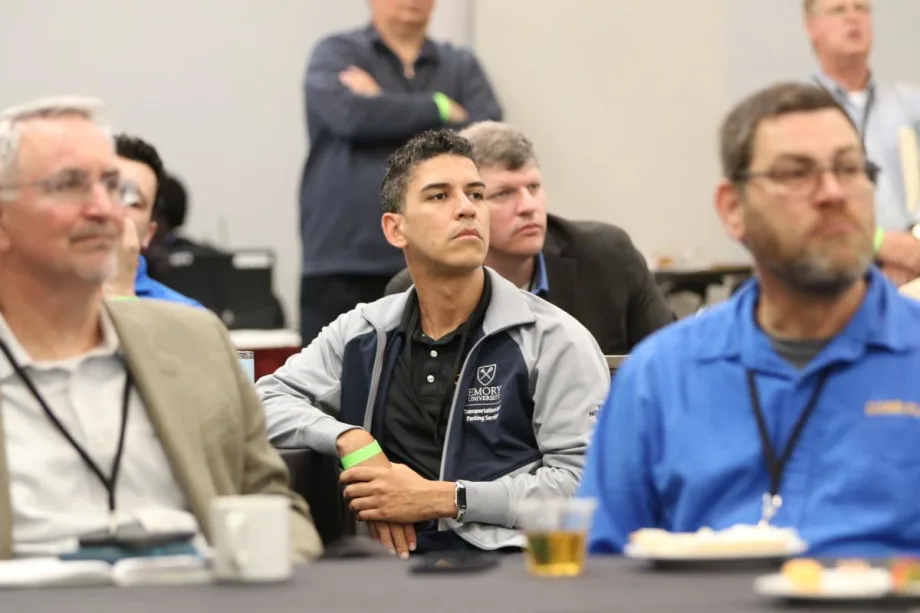
Fleet managers learning from other fleet managers who have gone through the electrification process will foster education in ways website tutorials can't.
Photo: Robb Cohen
The weather forecast called for rain some two weeks before the event, and — just as predicted — it rained in the early morning last Thursday. But the clouds parted by the start of the event. You worry about these things, when it’s the first of anything; and as it’s free for fleets, rain might be an excuse to stay home.
But show up they did to our first Fleet Forward: The Tour stop in Atlanta.
Fleet operators from government, corporate, commercial, and rental fleets made it out to Peachtree Corners, 20 miles north of downtown Atlanta and dubbed “Silicon Orchard” for its concentration of tech companies and mobility testing. They came from municipal fleet departments, state universities, pharmaceutical companies, police departments, sales-and-service fleets, and vocational organizations such as construction, pest control, and waste disposal, as well as car rental operators from major franchise networks and smaller independents.
Tour stops are regional offshoots of the annual Fleet Forward Conference (FFC). They’re one-day events in which fleet operators can take in educational programming, get behind the wheel of electric vehicles, and discover other new technologies such as the city’s autonomous shuttle, which gave rides in hotel the parking lot.
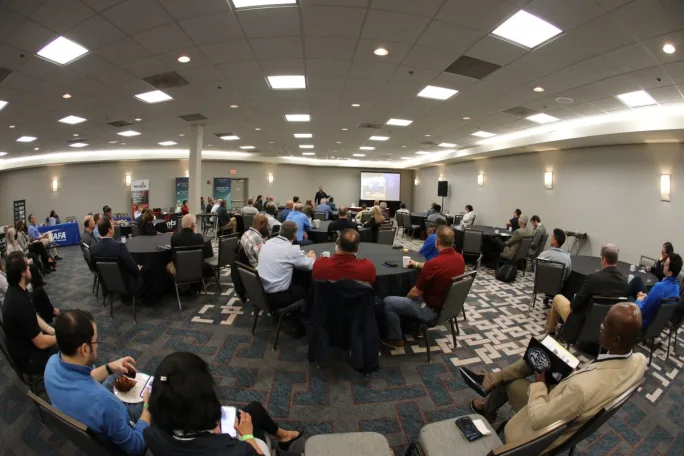
A varied group of fleet operators made it out to the first-ever Fleet Forward: The Tour in suburban Atlanta. They came from municipal fleet departments, state universities, pharmaceutical companies, police departments, sales-and-service fleets, car rental companies, and vocational organizations.
Photo: Robb Cohen
This was also the event’s first foray out of Silicon Valley, where the larger Fleet Forward Conference had been held since 2018. The intent of The Tour stops (Chicago is June 16, then Dallas Sept. 15) is to bring Fleet Forward education to fleet operators who might not consider a three-day pilgrimage to the Bay Area — or not yet, anyway.
There was a lot of energy in the room, and a lot of questions. And by the nature of those questions, it struck me that this group was different from attendees to the FFC in Silicon Valley, who are more on the bleeding edge of electrification and other new tech implementations that are just making their way into fleets.
Travis Haggard, equipment manager Cathcart Construction Company, drove up the night before from Orlando. He manages a fleet of about 100 on-road vehicles for a contractor that builds public infrastructure and underground water projects. Haggard encapsulated this mindset:
“I still have a long way to go before I could make a confident decision to begin a transition to electric vehicles in a fleet that operates the way mine does. I see the benefits of electric vehicles for a fleet, and I foresee my company transitioning, at least partially, within the next three years. However, due to the nature of the way my fleet operates, either there are practical solutions in place that I have yet to learn about or the technology has not yet reached a point that would effectively facilitate our needs. I look forward to the next gathering and I hope that I can be a part of shaping the future of the automotive industry.”
Said Kris Bush, VP of product management for LeasePlan USA: “Most end users are in the very tactical, step-by-step stage to implement EVs while many of the suppliers are thinking several stages ahead. You want to be cognizant of the different needs of the audiences and engage both.”
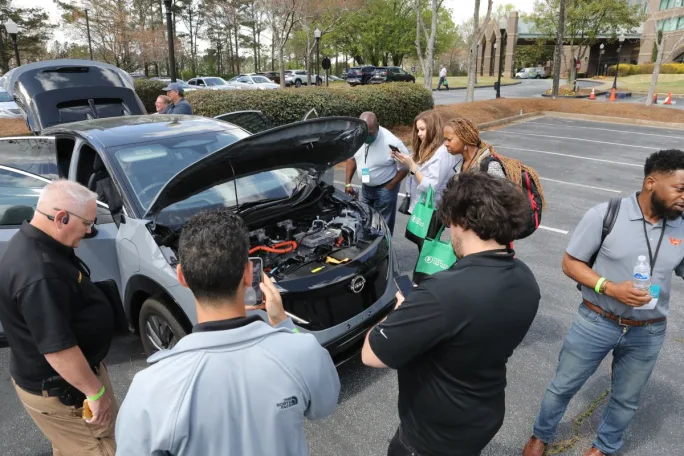
Hands-on interaction with electric vehicles are a key part of the education process.
Photo: Robb Cohen
Yes, the great majority of fleets are just beginning to electrify. But we also need to realize that we’re at stage one of an ongoing process to disseminate the right training, grant opportunities, and behind-the-wheel education. Human interaction in every step is crucial.
In his presentation, Frank Morris, executive director of Clean Cities-Georgia, asked attendees to raise their hands if they knew about the Georgia Power Program, which has “make ready” grants to fund infrastructure up to the charger itself and then money to install chargers in areas that will be accessible to fleets and the public. Only a few raised their hands.
“Almost everywhere there is a wealth of financial and informational support available at the state and national levels. But there are, indeed, so many varied and upcoming programs, and, frankly, a maze of bureaucracy to access it, that it’s almost unreachable,” said John Possumato of Driveitaway.
Enter Al Curtis, director of fleet management for Cobb County, Georgia. He bought his fleet’s first electric vehicles — 16 Nissan LEAFs — eight years ago. At the time, “People were really apprehensive about electric vehicles, they didn't think they would work; the duty cycle wouldn’t work,” said Curtis during his presentation.
While those first-generation LEAFs only got 90 real-world miles of range, Curtis was able to figure out that his fleet users only did 50 to 70 miles of daily travel anyway. Those LEAFs are still in the fleet. “Our electric fleet has traveled over 150,000 miles in those eight years, and we haven't changed the brakes on one yet,” said Curtis, offering a real-world perspective that was more valuable stats on a page.
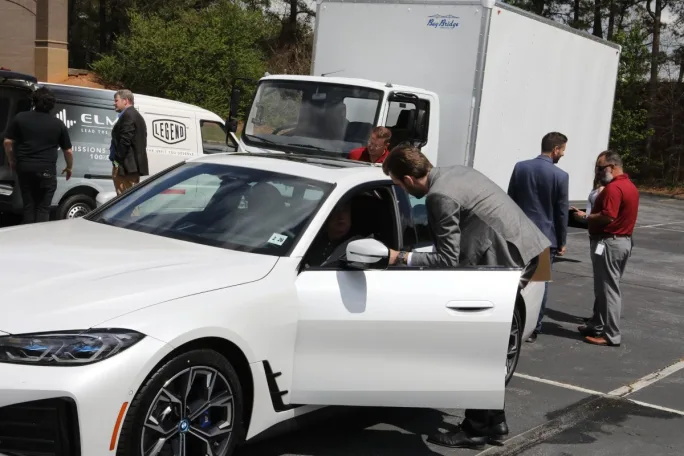
Attendees to the March 31st event got to drive and experience both passenger car and commercial EVs.
Photo: Robb Cohen
As well, Curtis was able to give real-world insight into battery efficacy. Eight years ago, fleets thought EV batteries would need to be replaced at $10,000 a pop. The Cobb County LEAFs are still on those original batteries.
“The information in this whole area (of electrification), at least for me, just doesn’t work on a static informational website,” continued Possumato. “The web is nowhere near as helpful as getting to know face-to-face the people who can help to get you through the maze of support available.”
Curtis went on to clarify how technicians will interact with electric motors and batteries. “Are your technicians going to be messing with electrical components? The answer is no,” he said, adding that automakers are equipping and training their dealers for this type of service. This allows fleets to redeploy internal technician resources — but he also stressed that fleets need to make sure they have a good understanding of third-party maintenance costs on EVs.
In addition to vendors on stage as subject matter experts, an integral part of the process will be fleet managers teaching other fleet managers. Outside, Scott Misico of Cobb County set up a display of an actual electric motor and battery and engaged attendees one-on-one on proper handling of electric components.
At the end of Al Curtis’s presentation, Muffi Ghadiali, head of Ford Pro Charging, asked Curtis what surprised him the most about his journey to electrify his fleet. “You can throw data at some people and that’s enough for them,” Curtis replied. “But in other areas of the South, like Cobb County in Georgia, a lot of times data isn’t as important.”
Curtis mentioned his lead mechanic would drive the LEAF. The sight of the mechanic, who is 6’ 4” and 275 lbs., successfully operating the EV every day did more to drive adoption with other departments. “It was less about me saying, ‘I can save you money and this is going to be a lower cost of ownership,’ and more about human socialization that pushed the point,” he said.
Data is absolutely necessary for EV sustainability in fleets, as Ghadiali pointed out in his talk to kick off the day. Data is necessary to measure EVs’ charge status, hourly utility rates, public charging fees, driver behaviors, vehicle performance, and ownership costs. Improper management of data will raise costs and sink electrification efforts. But the human element is equal, if not more important.
The day concluded with two hours of interacting and driving electric vehicles, with commercial EVs from Cenntro, Lightning eMotors, and ELMs, and passenger electric cars from Volvo, Polestar, Volkswagen, BMW, Nissan, and Tesla.
Along with other fleet managers, Haggard got behind the wheel of many EV models. He’ll take his notes back to the office, but his reaction — a grin and a simple “Wow” — will go a lot further to foster electric vehicles in fleets.
More Blog Posts

How to Win a Fleet Manager Award: Make Your Nomination Count
Strong fleet accomplishments can go unrecognized when the nomination doesn’t make the case. Here’s what judges need to see.
Read More →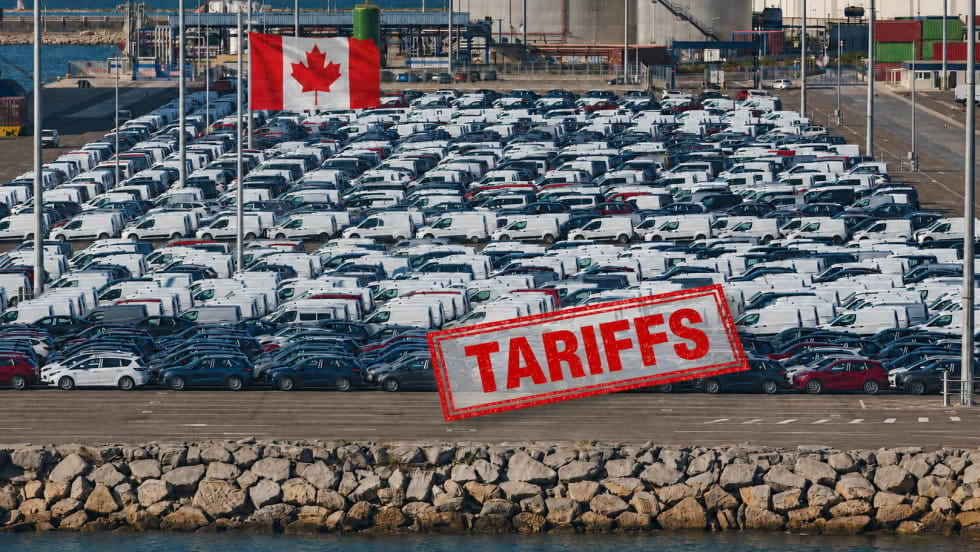
The Only Certainty with the New Tariff Threat Is Uncertainty
Trump’s Canadian tariff threat will not move production overnight, but the uncertainty could influence ordering and pricing now. Longer term, forces beyond tariffs may determine which North American plants survive.
Read More →
What Does It Mean to Embody the Spirit of Fleet?
Presented alongside Fleet Manager of the Year, Fleet Visionary, and Fleet Hall of Fame at AFLA, the new Mike Antich Spirit of Fleet Award is unique in that it recognizes service to the overall profession. Just like Mike.
Read More →
What Separates Great Fleet Managers From Everyone Else?
What do Visionary candidates with fewer than 10 years of experience have in common with Hall of Fame nominees with a lifetime under their belts?
Read More →
The Next Fleet War Won't Be Won on Specs Alone
The 2026 Stellantis Pro One Fleet Preview was less about vehicles and more about what happens after you buy them.
Read More →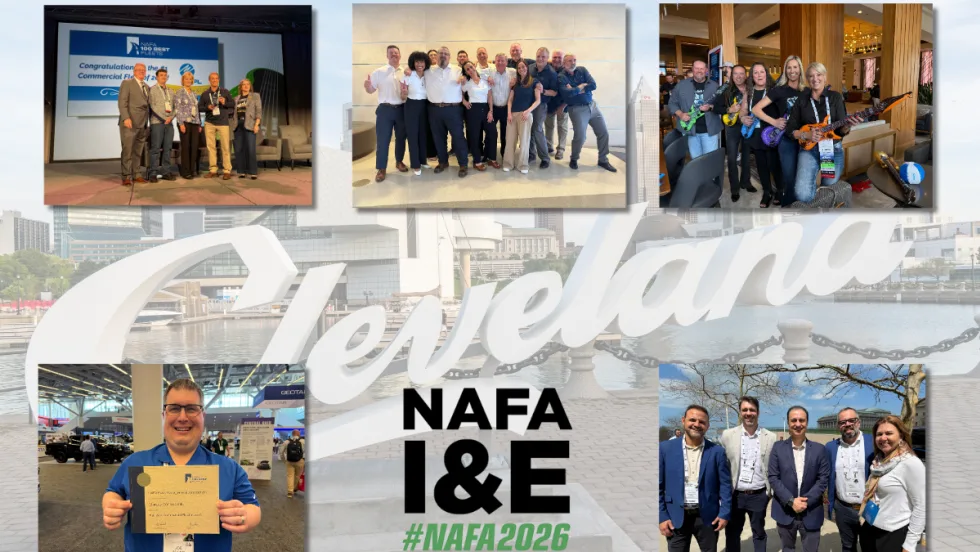
Navigating Brundlefly and Fleet AI at 2026 NAFA I&E
AI is becoming the operating layer for fleets. In Cleveland, the buzz was about harnessing AI in an increasingly complex, permanently disrupted environment.
Read More →
8 Trends: Work Truck Week 2026 Reveals a Fleet Industry in Reset Mode
Walking the show floor this year, the new focus was around “practical innovation” and pragmatic solutions. And oh yeah, a new small van.
Read More →
The Moment AI Became Operational
“AI isn’t assisting us anymore. It’s doing the work,” said CEO Neil Cawse at Geotab Connect 2026. What does this mean for fleet managers?
Read More →
For Mike Antich, it Was Always About the People
He stood tall in the industry in so many ways, but he measured success by the people he served.
Read More →
Solving the Flexible-Lean Fleet Paradox
The lean fleets of yesterday are the fragile fleets of today. Where do we find the balance?
Read More →