




The 'Safe Way' to Go Green
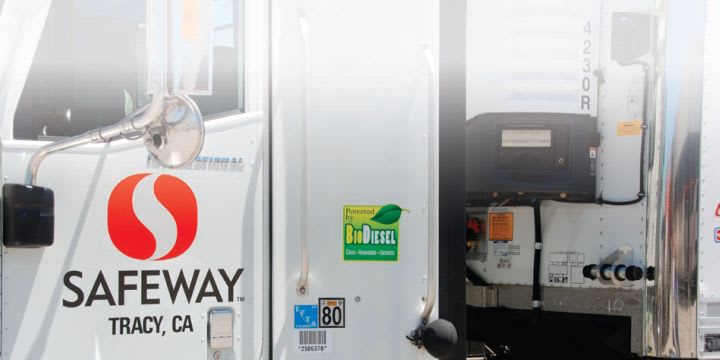
By converting the entire Safeway supermarket truck fleet to biodiesel, the grocery retailer has reduced carbon dioxide emissions by 34,000 metric tons.

The local Safeway store in Dublin, Calif., doesn’t appear any different from the other 1,738 Safeway supermarkets throughout the United States and Canada. However, this store — and 23 other Safeway locations — operate on solar energy, a feat few retail stores in North America can boast. Converting these stores to solar energy will help remove 10.4 million lbs. of carbon dioxide from the air — the equivalent of taking 1,000 cars off the road every year.
Given the supermarket giant’s commitment to alternative energy and the environment, it’s no surprise Pleasanton, Calif.-based Safeway, Inc., is the first major retailer in the U.S. to convert its entire delivery truck fleet to biodiesel fuel.
Safeway’s fleet consists primarily of:
International 9400s with Cummins ISX, CAT 13, and CAT 15 engines.
International Prostars with Cummins ISXERG engines.
Freightliner Columbias with MBE 4000 engines.
In all, the company operates more than 1,000 big rigs to deliver product to stores across the nation. These delivery trucks now use B-20 biodiesel, a blend of 20-percent biodiesel and 80-percent conventional diesel.
Each truck will display a sticker stating the vehicle is operated on cleaner-burning biodiesel. Safeway hopes to create awareness about environmental issues.
“Our overall greenhouse gas reduction initiative goal is to reduce our carbon footprint and operate a greener, more sustainable business,” said Joe Pettus, Safeway’s senior vice president of energy operations. “The benefits to the environment are substantial. By changing to biodiesel, we are reducing carbon dioxide emissions by 34,000 metric tons, the equivalent of taking more than 7,500 passenger vehicles off the road for one year.”
Pettus said the transition hasn’t had any drawbacks. The financial outlay is reasonable, particularly for the benefits the public and the environment see. “We made a financial investment into going green with our truck fleet. However, the cost is manageable and sustainable,” he said.
Pettus said Safeway customers won’t see any changes as a result of the transition to biodiesel. “We have received positive feedback from our drivers and from the community,” he said.
Converting its entire delivery fleet to biodiesel is only one effort in Safeway’s commitment to the environment. The company continues to work toward managing its carbon footprint, addressing climate change, reducing air pollution by utilizing alternative power sources such as solar and wind power, implementing environmentally sound construction strategies, and operating a massive recycling effort that recycles 500,000 tons of materials each year — the equivalent of filling six football fields stacked 35 feet high.
Safeway has been recognized nationally for its commitment to environmentally advantageous business models.
“Safeway is the first and only retailer to join the Chicago Climate Exchange (CCX), the world’s first — and North America’s only — voluntary, legally binding GHG emissions reduction, registry, and trading program,” Pettus said. “CCX membership commits Safeway to reducing its carbon footprint from the base year 2000 by 390,000 tons of CO2.”
Safeway also participates in the U.S. Environmental Protection Agency’s SmartWay Transportation Partnership. As a Smartway Partner, the company is committed to establishing minimum fuel efficiency for its fleet vehicles, as well as purchasing large-capacity trailers. These efforts have saved more than 6.5 million gallons of diesel fuel and reduced carbon emissions by 73,000 tons each year.
More Green Fleet
New Propane Autogas Program Offers Fleet Compensation
Qualified commercial fleets can receive $7,500 per eligible propane autogas vehicle and up to $10,000 for new refueling site prep. Learn how the program works and see whether your fleet qualifies.
Read More →
EV Charging Use Is Outpacing Infrastructure Growth
ChargePoint’s 2026 Charging Forward Report points to rising charger use, higher-powered charging, commercial vehicle electrification, and energy-management technology. Here’s what fleets should know.
Read More →
Merchants Fleet Reports 290M EV Miles as Fleets Navigate Changing Electrification Market
From millions in operating savings to hundreds of millions of EV miles, Merchants Fleet’s latest report reveals what’s working and what’s changing in fleet electrification.
Read More →

The EV Breakdown Nobody's Talking About: Why Most Electric Vehicle Roadside Calls Aren't Mechanical Failures
Here's why EV breakdowns are widely misunderstood.
Read More →
ChargePoint Now Available in Energy Pass
ChargePoint and additional planned charging network integrations were added to GM's Energy Pass.
Read More →

First Look: Slate Auto's Electric Fleet Pickup
Could an affordable, modular EV pickup make electrification more practical for fleets?
Read More →
Slate Debuts Colorful, Unique EV Models
A recent media and client event, studded with electric vehicles dressed up on platforms, planted a new position for the manufacturer in the wider EV market. Fleets will find cost-saving advantages.
Read More →
Slate Electric SUV, Pickup Switchable Model Aims For Light-Duty Fleets
Everything about this EV is counterintuitive and understated, making it stand out from the crowd.
Read More →
Inspiration Mobility Acquires Key Electrada Assets
Inspiration Mobility Group has acquired select assets of Electrada, adding the fleet electrification provider's team, technology, and charging infrastructure development capabilities to its energy management business.
Read More →