




The Future of Fleet is Growth Through Change
David Madrigal, executive vice president for Element Fleet Management, spoke with Automotive Fleet to discuss the fleet industry's current challenges during the COVID-19 pandemic and what the future may hold post-COVID.


David Madrigal, executive vice president for Element Fleet Management.
Credit: Element Fleet Management
David Madrigal is executive vice president and chief commercial officer for the U.S. and Canada for Element Fleet Management, a global fleet management company. He leads Element’s growth strategy, focusing on developing new client relationships and the success of existing clients.
Madrigal is also Element’s executive sponsor of the Element-Arval Global Alliance, guiding global initiatives in more than 50 countries.
With 20 years in fleet management and commercial finance, Madrigal’s experience spans sales, risk, marketing, operations, project management, and business development. He holds a bachelor’s degree in industrial engineering from Universidad Iberoamericana and an MBA from Universidad Panamericana IPADE Business School.
Recently, Automotive Fleet spoke with Madrigal about fleet management in a pandemic environment and future industry trends. The following are excerpts from that interview.
AF: What do your customers say are the key challenges and opportunities facing their businesses?
MADRIGAL: Top of mind from clients is the uncertainty about the pandemic, the uncertainty about the resumption of when people will return to work, how this change impacts overall fleet usage, and the current disconnected resumption at the state level in the U.S., and comparing and contrasting Canada versus the U.S.
Probably the hottest topic today is the worldwide microchip shortage and its impact on the ability to replace vehicles.
The surprise at the beginning of the 2021 calendar year concerned vehicle ordering and the number and types of vehicles available. These are key top-of-mind concerns.
Another thing starting to bubble in Europe, Latin America, and the U.S. and Canada is electric vehicles.
EVs weren’t such a hot topic in the last four to five years, but now it’s top of the list. Many companies are setting CO2 targets or becoming net neutral by “X” date. Having those conversations with clients has been very interesting – they set these targets and ask us, “How can you help us achieve them? What’s the best path?”
Those are the top issues I see happening within our client base.
AF: Will the work-from-home business model in a virtual sales environment make company cars less essential to fulfilling the job requirements? Could this new reality result in fleet cutbacks as marginal drivers fall below the minimum business mileage threshold? What is your opinion?
MADRIGAL: It’s too soon to say. Even if some fleets will reduce, other fleets (such as last-mile delivery fleets) will grow more. There will be offsets, depending on the industry and the sector.
I use the example of a particular company whose business model and product was delivering at-home medical devices to people who need them. In the past, they would load the device in a van, drive it to the person, and demonstrate how to use the equipment.
But now, because of the pandemic, they ship the equipment to the people. Instead of having someone in their home demonstrating its use, they do it virtually. As a fleet manager or senior manager, I must ask myself: “Do we really need that car if our business has changed that way?”
Since company vehicles are part of the corporate image, however, and an extension of the company, you want to keep driving that consistency.
Beyond cost analysis of miles driven, does it make sense to reimburse employees using their personal vehicles? There are underlying issues, such as safety or corporate sustainability goals, for example. If your employees are driving cars over 10 years old, is that a sound practice by not taking advantage of the safety features found in new vehicles?
Here’s another example: EVs. If you’re planning to meet your CO2 targets, does a reimbursement policy mean CO2 emissions from those employees don’t count, even though they’re driving their emission-emitting vehicles for work?
AF: As chief commercial officer, where do you see growth opportunities for Element and for the fleet management industry in general?
MADRIGAL: Part of our growth strategy relies on tapping into that unaddressed market that we call self-managed fleets.
Some companies have always managed their fleets in-house because they consider fleet critical for their operations. But as organizations evolve, they think:“Why am I doing this internally when someone else can be managing it?” From light- to heavy-duty vehicles, as they become more advanced, it’s probably harder for some of these organizations to manage those fleets internally.
Another growth segment is our existing portfolio and client base. We never had 100% of the market or the share of products or services, or even their fleets. Our growth opportunities here involve continuing to work with our clients and understanding how we can add value. We need to determine why we’re either not managing a segment of their fleet or not providing them some of those products and understand how we can bridge that gap to provide them those services.The most traditional growth strategy is going up against our competition. When fleets go through their normal RFP cycles, we participate and present our solutions on how we can better service them.
So, we have these three levers of opportunity: tapping into self-managed fleets; expanding our existing portfolio; and continuing our efforts to gain market share.To do so, we realigned our commercial organization in North America, focusing one portion on hunting and going after new business. Another portion of our commercial organization focuses more on nurturing and growing the existing client base.
AF: One new enhancement within Element Fleet Management is its new fleet ordering system. Can you provide more details?
MADRIGAL: This is very exciting for us because we are rebuilding our ordering platform scratch. This new technology will feature state-of-the-art intuitive functionalities to meet our clients’ ordering needs.
A material difference between the U.S. and Canada is the U.S. ordering cycle that procures vehicles directly from the OEMs and how that value chain is integrated from the OEM all the way to vehicle delivery, including the upfitting process when required.
Our new platform will now manage that complete cycle and enable clients to determine the location of each asset throughout the process. Everything is integrated within the same flow. The new technology streamlines the processes, provides substantially more visibility and reporting capabilities to our clients, and approval levels. The system capabilities are fantastic.
We’re deploying that platform throughout this year in different stages. Customization for each client will depend on the client’s complexity and ordering habits.
AF: Is this new platform just for U.S. and Canada or elsewhere within the Element global organization?
MADRIGAL: It is just for the U.S. and Canada. In Mexico, we have an ordering tool that provides different visibility. In Mexico, all vehicles are stock-ordered, not factory-ordered. You can negotiate with the OEM, but you must always go through a dealer. The dealer delivers the vehicle, then it goes through upfitting. Processing orders is different in Mexico versus Canada and the U.S.
AF: How long will it take to have widespread electrification in the fleet industry? How is Element positioning itself to help clients accomplish this goal?
MADRIGAL: One of my executive colleagues, Chris Gittens, has been appointed to lead our electrification strategy. When we think about electrification, it’s looking holistically at the whole process.
For us, an electric vehicle is not just the vehicle per se. It’s everything around it, from the future of a fuel card to the charging stations to consulting services.
Fortunately, we are a few steps ahead because of our colleagues in Australia and New Zealand who are well advanced in electrification. We have some very good real-world examples in New Zealand and in Australia where governments and companies are electrifying their fleets while we provide the solutions for issues such as charging stations to the fuel cards.
We can leverage what we’ve learned there and bring it over here. There’s also best-practice sharing and learning from our Arval colleagues in Europe and in other regions. We benefit from what’s being done in other geographies. We will bring that to developments in the U.S. and Canada markets.
Many clients in the U.S. and Canada have an electrification target for 2025 or 2030. That’s the ambition. I think now the biggest question is EV availability. Conversations will focus on what EV vehicles are available.
One client has substantially different vehicles in Europe, Latin America, and the U.S. I asked him if the job was substantially different. And the answer was “No.” The question then is why do they need a large pickup truck in North America when in Mexico they drive the small delivery vehicle, and in Europe still another type?
It’s more than simply what type of vehicles employees are used to driving. Sometimes it’s driving that change within your employee base, telling them that an electric pickup truck will satisfy the asset need with the new required powertrains. It’s very important to have EV availability of the vehicle types required for North America.
The second part is that everyone needs to be prepared for the electrification infrastructure on whether charging stations should be put in office buildings or employees’ homes and solving for all of that.
Is full electrification achievable 10 years down the road? That’s a big question we’re all trying to solve. In looking at companies setting those targets by 2025 or by 2030, we need to start running towards those goals.
AF: A vibrant used-vehicle market is critical in getting widespread electrification and popularizing EVs with retail buyers. What kind of a used-vehicle market will there be for electric vehicles?
MADRIGAL: I agree. But again, I think there are also a lot of unknowns because we haven’t reached that cycle.
Maybe a good way to get a pulse on it is to examine the used-vehicle market in Europe, particularly in countries spearheading the effort, such as Norway or Germany. This allows us to understand how EVs have disrupted the secondary market for internal combustion vehicles. Europe is undeniably three to five years ahead of what’s going on in the U.S. and Canada.
AF: The other significant change in fleet is the transition to using Big Data and data analytics. The tools to capture this data are telematic devices. What technology investments has Element made in the telematics space, and how Do these investments help your clients better manage their fleets?
MADRIGAL: Telematics is a service we provide. For me, the heart of telematics is the data, what we do with that data, and how we provide analysis to our clients.
The core value of telematics is how we help our clients make their fleets more effective through that information, for example, data that provides predictive analytics to reduce fuel consumption and to monitor driving behaviors to increase safety.
You can use that data for a wide range of proactive initiatives. Without telematics, some decisions are made after one or two reporting cycles. With telematics, you can be a lot more proactive.
Now, that market has evolved. Many players now offer telematic services. OEMs also try to provide it with their own devices. The heart of the equation is the data and your capacity to understand and analyze it, and then create value for your clients through that data.
AF: All this data requires someone capable of analyzing it by performing the data analytics.
MADRIGAL: We had a discussion with a client the other day. The client was using their own data analytics team. They were trying to use some of their data. But in the end, these are isolated analyses — you’re basically comparing yourself to your own data. We have more than a million vehicles with which we can leverage data. With that scale of information, we can benchmark, crisscross it, and do whatever we want with it. Then we can provide so much more value than a company trying to do it by themselves. They will never have that benchmarking or computer strength to process all the data and deliver the appropriate insights.
AF: What is your vision of the future of the fleet management sector? How do you envision the industry changing in the coming years? What trends are you following?

Credit: Element Fleet Management
MADRIGAL: I think for the fleet sector, it’s focused on changes in technology. By technology, I mean engine types, technology of the cars, of the data, and everything in fleet impacted by technology.
How can we as fleet management companies help our clients navigate through that change?
That’s why I think there’s an opportunity for growth. Again, many of these companies that are self-managed are trying to adapt to new technologies by themselves. It’s hard and getting harder all the time. Imagine the challenge of electrifying your fleet by yourself, without support. You will need to learn by yourself rather than have help from somebody who has already walked that path.
In the future of fleet management, there’s room for all of us to grow because of how the whole industry’s changing and that will bring more opportunity for all of us. For me, the future is about growth, about change that’s coming, as well as the change coming out of the COVID pandemic.
All these new automotive brands, in essence, are disruptions. How do we adapt to support our clients? Today you have a client buying cars from Tesla and General Motors—a completely different process. We make it seamless. For them, the process hasn’t changed, but for us it has. We make it simpler for our clients. Somebody not using a fleet management company will have to navigate those different processes by themselves.
More Global Fleet
Holman Takes Full Ownership of ARIZA in Mexico
Holman is bringing its Mexican fleet management operation fully under its own brand after more than 30 years as a joint venture. The change gives multinational fleet customers a single Holman operation across the U.S., Canada, and Mexico.
Read More →
Proven Ways to Reduce Work Truck Downtime
The age-old problem of downtime will always be a reality, but with new strategies at hand, fleets have more ways to keep trucks on the road longer.
Read More →



Cameras, Safety and Insurance: From Reactive Claims to Real-Time Prevention (Part 2 of 2)
Part Two: Commercial auto remains one of the most challenging and costly lines of coverage for fleet operators and insurers alike. Continue learning more about how to effectively address these issues from Onur Aksan, Enterprise Business Development Executive, Geotab
Read More →
Cameras, Safety and Insurance: From Reactive Claims to Real-time Prevention
Commercial auto remains one of the most challenging and costly lines of coverage for fleet operators and insurers alike. Learn more about how to effectively address these issues from Onur Aksan, Enterprise Business Development Executive, Geotab.
Read More →
Fleet Costs Are Rising: Here’s How Leaders Are Responding
Fleet leaders are under pressure to reduce costs, adapt to economic uncertainty, and make smarter decisions. See how peers across North America are responding with real data, proven strategies, and forward-looking insights. Download the 2026 Market Pulse Report to benchmark your strategy and uncover where you can gain an edge.
Read More →
Enterprise Fleet Management Surpasses 900,000 Vehicles in U.S. & Canada
Enterprise Mobility connects with mobility solutions around the globe
Read More →
Automotive Fleet's Guide to Fleet Electrification
Unlock the secrets to a successful transition to electric fleets with Automotive Fleet's comprehensive Fleet Electrification Guide!
Read More →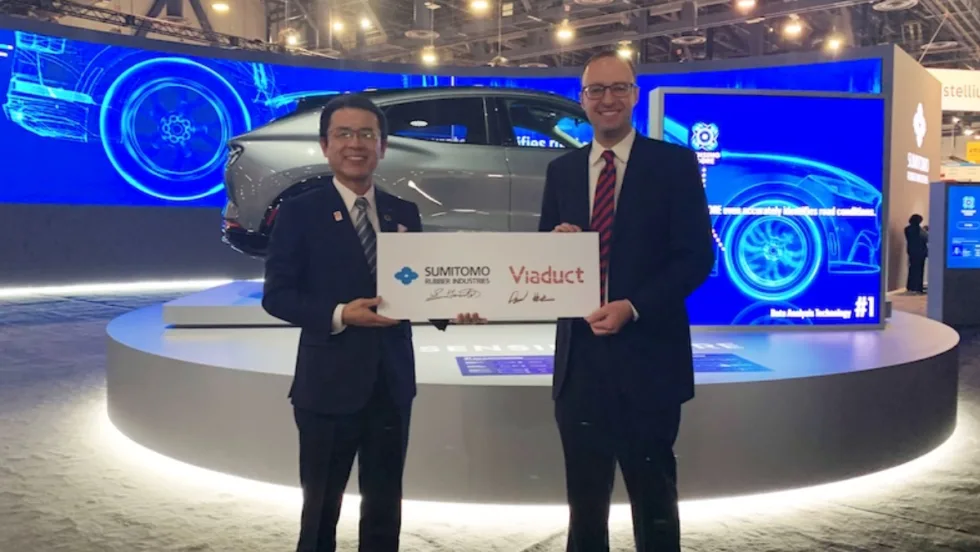
Sumitomo Rubber Industries to Acquire Viaduct
Viaduct will join Sumitomo as an independent subsidiary. Partnership strengthens global reach and accelerates AI-driven innovation for fleets and manufacturing.
Read More →