




The Evolution of Winter Tires
A better understanding of winter tires, including what makes a snow tire, will help fleet managers choose the right tire for vehicles that operate in inclement conditions.
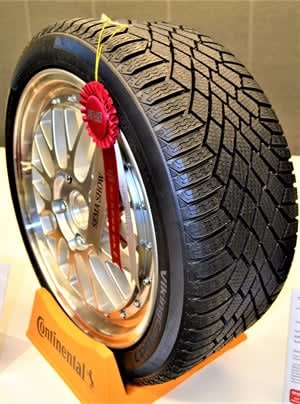
Continental's VikingContact 7 winter tire
Photo via MTD.
True or false: A tire with the 3-Peak Mountain Snowflake symbol stamped on the sidewall is always a winter tire. The answer is false: A winter tire must be branded with the symbol, but that alone doesn't make it a winter tire.
True or false: The 3-Peak Mountain Snowflake symbol is a better indication of winter performance than the M+S designation. The answer is true: The 3-Peak Mountain Snowflake symbol is a performance standard, while the M&S designation is a visual standard.
To better understand these answers is the first step in defining a winter tire that's suitable for wintery conditions.
Mud and Snow
The M&S designation developed in the 1970s as a way of distinguishing tires with aggressive tread patterns from bias-ply tires with the more traditional ribbed patterns, according to Woody Rogers, tire information specialist at The Tire Rack Inc.
"At the time, aggressive tread is where they achieved better traction," Rogers said. "Of course, they changed the compounding a little bit, too."
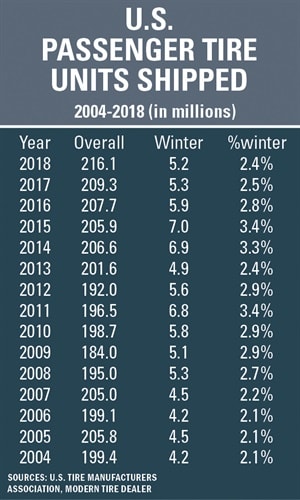
Shipments of winter tires have fallen from a 2015 peak to 5.2 million in 2018.
"But M+S isn't a performance standard," he said. "It is merely a visual standard. The tread pattern has to have at least 25% open space from a two-dimensional standpoint. And it has to have a ½-inch notch in one shoulder every so often.
"That's it. You could take a 1965 bias rib tire, open it up just a little bit, put a notch in one shoulder, and that is an M+S tire. It has nothing to do with how much traction it actually has in the mud or on snow."
Here is the Tire Information Service Bulletin (Vol. 10, No. 7) that defines snow tire definitions for passenger and light truck tires, courtesy of the U.S. Tire Manufacturers Association (USTMA):
Passenger and light truck tires meeting the following criteria are marked on at least one sidewall with the letters "M" and "S" (e.g., MS, M/S, M&S, M+S, etc.). These tires have been designed to provide better starting, stopping, and driving performance in snow conditions than non-M&S tires, and have the following general characteristics:
The new tire tread shall have multiple pockets or slots in at least one tread edge that meet the following requirements based on mold dimensions:
Extend toward the tread center at least 1/2 inch from the footprint edge, measured perpendicularly to the tread centerline.
A mimimum cross-sectional width of 1/16 inch.
Edges of pockets or slots at angles between 35 and 90 degrees from the direction of travel.
The new tire tread contact surface void area will be a minimum of 25% based on mold dimensions. (USTMA)
In 1999 USTMA (formerly the Rubber Manufacturers Association) and Rubber Association of Canada (RAC) jointly defined tires for use in severe snow conditions.
3-Peak Mountain Snowflake
The mountain snowflake symbol doesn't replace the M+S designation, it just adds to it. Here is the Tire Information Service Bulletin (Vol 37, No. 5) that defines passenger and light truck tires for use in severe snow conditions:
Tires designed for use in severe snow conditions generally have tread patterns, structure, and materials to give superior performance in snow over tires meeting the USTMA Snow Tire Definition.
Tires designed for use in severe snow conditions are recognized by manufacturers to attain a traction index equal to or greater than 110 (Snow Grip Index of 1.10) compared to the ASTM E1136 Standard Reference Test Tire when using ASTM F1805-06 snow traction test with medium packed snow surface and equivalent percentage loads. Other test methods and reference tires developed by standardizing bodies may be used provided proper correlations are demonstrated.
Tires designed for use in severe snow conditions that meet the performance criteria above qualify for marking on at least one sidewall with the letters "M" and "S" (e.g., MS, M/S, M&S, M+S, etc.) plus a pictograph of a mountain with a snowflake. The mountain profile shall have a minimum base of 15 mm and a minimum height of 15 mm and shall contain three peaks with the middle peak being the tallest. Inside the mountain there shall be a six-sided snowflake having a minimum height of one-half the tallest peak." — (USTMA/RAC)
"The 3-Peak Mountain Snowflake symbol brought a performance standard, albeit a very narrow one, to tire ratings," says Rogers. "Unlike M+S, the 3-Peak Mountain Snowflake is like a merit badge. You've actually accomplished something."
Rogers says the standard reference test tire (SRTT) mentioned in the severe snow conditions bulletin is the Uniroyal Tiger Paw, which has a fixed specification for how it's made and how it's compounded.
"Its performance hasn't really changed while it's been the SRTT."
Winter vs. Snow Tires
Over the last 20 years, snow tires have transformed into "winter" tires because they can grip not only on snow and ice, but also on dry and wet road surfaces in low temperatures.
They have evolved so much that the 3-Peak Mountain Snowflake symbol isn't synonymous with what the manufacturers refer to as winter tires.
When the Canadian Province of Quebec made driving on winter tires mandatory during the 2008-2009 winter season, the tires only were required to meet the 3-Peak Mountain Snowflake performance standards, which includes branding the symbol onto the sidewall.
In the last 10 years, USTMA and its members have helped define winter tires more accurately. Joe Maher, product manager for Continental Tire the Americas LLC's passenger and winter tires in the U.S., says the overall tire market is divided into four classifications:
Summer, a tire that doesn't have an M+S symbol and is especially designed for summertime use;
All-season, which does not feature the 3-Peak Mountain Snowflake symbol;
All-weather, an all-season tire with the 3-Peak Mountain Snowflake symbol and marketed for year-round use; and
Winter, or tires that feature the 3-Peak Mountain Snowflake and are marketed for use in the winter season only.
Maher says there are three types of dedicated winter tires.
"There's studdable winter tires, which have holes for studs in them. Some actually have studs already in, while some get studs installed by dealers.
"Then you have what's commonly termed a performance winter tire. Performance winter tires are sometimes referred to as middle-European tires. They have a heavy focus on wet traction, not as much on snow and ice.
"And then you have studless winter tires, which are also called Nordic or soft compound winter tires."
Maher says Continental's new VikingContact 7 falls into the studless category.
"The best overall performer is a studless tire. Not quite as good as a studded tire on ice, but it's still the better overall performer."
Four tire companies have introduced dedicated winter tires since the beginning of the year: Bridgestone Americas Tire Operations LLC (Blizzak WS90), Nokian Tires Plc (Hakkapelliitta LT3), Continental (VikingContact 7) and Goodyear Tire & Rubber Co. (WinterCommand. It's actually five if you count Goodyear's Kelly WinterAccess.
Editor's note: This article first appeared on ModernTireDealer.com, a companion website also published by Bobit Business Media.
More Maintenance

Fleet Manager’s Ultimate Playbook: Navigating the New Standard in OEM Connectivity
Rising operating costs, driver safety concerns, and unplanned downtime are putting unprecedented pressure on modern fleets. Discover how fleet managers use embedded OEM connectivity and real-time vehicle data to cut TCO, prevent downtime, and protect drivers without aftermarket telematics hardware.
Read More →
How Can Fleet Managers Tell Which Repairs Require Closer Review?
Fleetio’s Brianna Perry demonstrates how Service Advisor evaluates maintenance requests, identifies pricing anomalies, and provides the context fleet managers need to focus their attention on potential problems.
Read More →
Why Roadside Assistance Belongs in a Fleet Risk Strategy
Roadside assistance is more than a tow. See how the right partner can protect drivers, uncover fleet trends, and strengthen your risk strategy.
Read More →
Hidden in Plain Sight: Fleet Compliance Risks
Fleet compliance isn't just about having policies — it's about consistently enforcing them. This practical guide reveals six hidden compliance risks common in public sector and shared fleet operations and outlines proven strategies to improve visibility, accountability, and audit readiness
Read More →
How Maintenance Costs Compare Across 27 Fleet Vehicles
Vincentric’s three-year, 60,000-mile projections reveal wide differences for both scheduled and unscheduled maintenance among selected vehicle categories. Projected maintenance visits also play a factor.
Read More →
The EV Breakdown Nobody's Talking About: Why Most Electric Vehicle Roadside Calls Aren't Mechanical Failures
Here's why EV breakdowns are widely misunderstood.
Read More →
How Stellantis Plans to Get Ahead of Fleet Downtime
Keeping fleet vehicles on the road has become as important as buying them. Darren Bradshaw of Mopar North America explains how connected vehicle data, AI, and proactive service strategies are helping Stellantis reduce downtime and move closer to predictive maintenance.
Read More →
Merchants Fleet Expands Maintenance Network with Pep Boys
Merchants Fleet has expanded its relationship with Pep Boys, increasing the service provider's role within its national maintenance network. The move is intended to enhance maintenance coordination and support commercial fleets through Pep Boys' nationwide footprint.
Read More →
The Two Biggest Summer Downtime Threats for Fleets
A conversation with a maintenance expert reveals the two most common summer maintenance pains and how to prevent them.
Read More →
From Marine Corps Motor Pool to Managing 460 Fleet Vehicles
Cesar Ayala of O’Connell Landscape Maintenance shares how he transitioned from the Marine Corps to managing a 460-vehicle fleet—and the real-world challenges of maintenance, compliance, and driver management in California.
Read More →