




Stable Fuel Spend Keeps Lid on Overall Operating Costs
The stability of fuel pricing has been the No. 1 factor contributing to keeping operating costs flat in calendar-year 2017. Since fuel makes up the largest portion of fleet operating costs, it has helped keep a lid on overall fleet spend.



Editors note: This article is part of a five-part package dealing with operating costs in 2017. Read related articles that offer and in depth look at tire prices, fleet maintenance, and preventative maintenance, as well as an overview of operating costs in 2017.
The stability of fuel prices over the past 30 months has been the No. 1 factor contributing to keeping fleet operating costs flat.
“For the most part, the market in 2017 continued to remain relatively steady although prices have been creeping up slowly, especially compared to the low prices seen in the first quarter of 2016,” said Andy Hall, assistant manager, fuel & GMS for ARI. “In September 2017, the International Energy Agency revised its 2017 growth estimates for the third time in as many months and global oil demand is set to accelerate faster than anticipated this year. Similarly, the U.S. Energy Information Administration’s September petroleum supply report showed year-over-year growth in gasoline product supplied, which essentially is an indicator for U.S. gasoline consumption.”
Since fuel costs make up the largest portion of fleet operating spend, flat fuel prices have resulted in stable fleet operating expense.
“Gasoline and diesel prices continued to be low throughout 2017,” said Emily Candib, assistant director, product management for Merchants Fleet Management. “Increase and decrease in spend is not significant enough and cost still remains relatively flat across both operating areas.”
Offering another perspective on current fuel spend is Mark Atchley, senior supply chain manager for Enterprise Fleet Management.
“After bottoming out in late 2015, gasoline and diesel prices have made some moderate gains. However, prices are still running at the low end of the five-year average,” said Atchley.
It is well documented that fuel prices influence vehicle acquisition decisions. New- and used-vehicle markets tend to react to fluctuations in fuel prices. When prices are low, consumers may be more willing to consider larger, less fuel-efficient vehicles.
“Vehicle selection plays an important role in mitigating fuel costs. Without expert advice, is it easy to make the mistake of purchasing more vehicle than a job requires. Enterprise Fleet Management analyzes the composition of our customers’ fleets to determine if the vehicle specifications are appropriate for the vehicle use. We advise our customers when we identify opportunities to right-size their fleets,” said Atchley of Enterprise Fleet Management.
Fuel prices are impossible to forecast with certainty, but will be a function of economic growth, supply/demand, and currency fluctuations. As a result, most fleet management companies use the EIA forecasts for internal planning and external fuel price forecast dissemination.
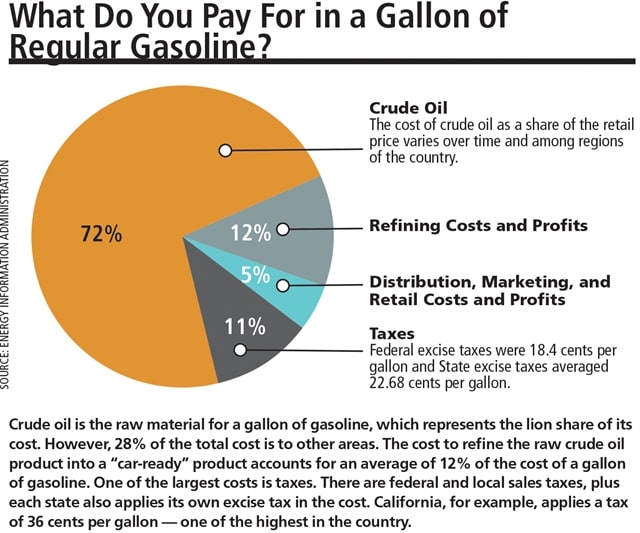
Chart courtesy of Energy Information Administration
“Donlen generally follows forecasts provided by the EIA, which currently predicts fuel prices in 2018 will average $2.35 compared to $2.36 for 2017. We don’t expect much of a shift in fuel costs in 2018 at this time,” said Scott Underhill, business intelligence team lead at Donlen.
Another indicator used to forecast future fuel prices is the oil futures market, where investors buy future oil contracts based on anticipated prices as a form of hedging or as an investment to sell at a future date if actual prices are higher. The oil futures market seems to reinforce the contention that oil prices will continue to remain flat. A key indicator is that the global inventory of oil continues to exceed current user demand.
“Most forecasts predict moderate fuel prices for the next few years, with limited movement up or down,” said Atchley of Enterprise Fleet Management.
The forecast of modestly rising fuel prices will be a factor influencing 2017 and 2018 model-year acquisition decisions. Since fuel cost is still one of the top contributors to the overall operating cost per mile, fuel economy for internal combustion engine vehicles remains a top focus during the vehicle selection process.
“Furthermore, analysts predict that 2018 U.S. oil production will reach 9.9 million barrels/day, which would mark the highest annual average production in U.S. history, surpassing the previous record of 9.6 million in 1970,” said Mark Donahue, manager, fleet analytics for EMKAY.
In recent years, lower fuel costs created an upward trend in truck and compact SUV resale values, resulting in a lower cost per mile and making these vehicle classifications more affordable to operate.
“Fuel costs is one of the highest operating expenses for a fleet, and therefore, vehicle mpg is a large factor in the vehicle selection process. As OEMs continue to increase mpg with every new model-year, many compact, and even midsize SUVs, now have mpg ratings that were only available on sedans even just a few years ago,” said Becky Langmandel, vice president, analytics, consulting & transformation for LeasePlan USA. “With the increased mpg on these SUV models, fleets are now able to add SUVs to their selectors, as driver preference continues to shift, without a great impact on their fuel costs and greenhouse gas emissions.”
Another emerging fuel-related development has been the growing migration away from diesels to gasoline engines.
“Calendar-year 2017 saw a continuing trend of fleet vehicles moving to less diesel use and more regular gas fuel vehicles. From 2016 to 2017, the percent of gasoline fuel spend for vehicles on Donlen’s fuel program increased from about 82.5% to 83.3% while the percent of diesel spend fell from about 9.3% to 8.8%, and ‘other’ fuel spend fell from about 8.2% to 7.9%. This has been a continuing trend since Q4 of 2013,” said Underhill of Donlen.
The consensus is that this shift away from diesel will continue into the next model-year. “Expect a continued trend from diesel to increased gasoline usage,” said John Wuich, vice president, business analytics at Donlen.
Another trend in 2017, which started in 2016, has been an uptick in fuel card fraud.
“Since last year, we have seen a rise in activity from fuel fraudsters. It’s critical that fleets monitor their fuel spend regularly and question anything that looks outside the norm. If something does slip through, it could affect fuel costs. At LeasePlan, we’re monitoring for fraud as well, and have even realigned our team to account for the increase in activity. In fact, just today we had a team member identify nearly $600 in fraudulent charges for a client,” said Steve Donckers, service center manager for LeasePlan USA. “The best-in-class fleets have a way to monitor fuel spend and mitigate against fraud, which is unfortunately on the rise. Having a fraud prevention strategy can help.”
Fleets are spec’ing their vehicle selectors to take advantage of fuel-efficient technologies, weight reduction measures, higher-speed transmissions, and appropriate drivetrains to meet their business necessity.
Since fuel cost is still one of the top contributors to the overall operating cost-per-mile, fuel economy for internal combustion engine vehicles remains a top focus during the vehicle selection process. For most light-duty vehicles, fuel ranks behind depreciation as the top expense category.
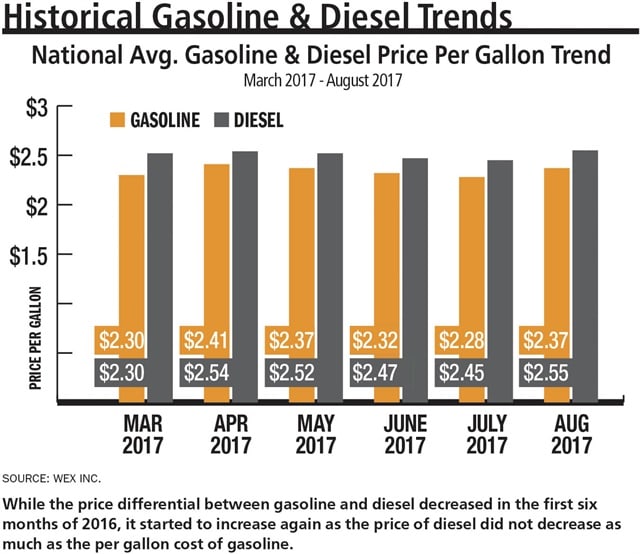
Charts courtesy of Wex Inc.
“Fleet managers consistently look for opportunities to reduce their expenditures ranging from right-sizing, route optimization, telematics, personal use, driver behavior training, etc.,” said Donahue of EMKAY.
A key factor moderating fuel spend is the overall increase in vehicle fuel economy. As fleets continue to replenish their portfolios with newer assets, those assets are more fuel-efficient which serves as a natural hedge if fuel prices rise. Some fleets have taken advantage of lower operating expenses to cycle out older vehicles with the additional capital from reduced fuel spend.
In addition, as vehicles are kept in service for longer periods, higher mileage vehicles have lowered fuel economy.
“Compact and intermediate cars under 48,000 miles have seen a decrease this year in dollars per month spend while cars above the 48,000-mile mark have increased their spend,” said Candib of Merchants Fleet Management.
The biggest danger to today’s lower fuel prices is complacency, on the part of both drivers and fleet managers, and the mistaken belief that fuel reduction initiatives do not require the same emphasis as in the past.
“All in all, while prices have not reached the levels we saw in 2014, there remains to be factors that can and will affect the price of both gasoline and diesel,” said Hall of ARI. "Smart fleets will look to implement strategies that help them to better manage fuel consumption. This includes implementing and enforcing a clear, well-communicated fuel policy; effectively using Big Data to evaluate your fleet’s fuel data and find opportunities for efficiency; and offering training for drivers around safe driving techniques, which also help to conserve fuel.”
There is a limit as to how much fuel savings a fleet can wring from the types of vehicles acquired without impacting the fleet application. One of the best ways to control fuel expenditures is to control driver behavior.
“Overall, and while fuel price remains low nationwide, attention seems largely focused on spend in other fleet areas. In fact, average fleet mpg has actually declined slightly year-over-year as customers have moved in some cases to larger and less fuel efficient vehicles,” said Wuich of Donlen. “For example, a downsize in compact segments has led to an increase in mid-size sedans. Also, there is continued interest in SUVs and light trucks versus sedans.”
“That being said, there are pockets of fleets focused on mitigating fuel spend and/or reducing carbon footprint. Steps that have been taken include shifting to hybrid use, using telematics to improve driver behavior, reducing mileage accrued and idle time, maintaining tire pressure, and using fuel apps,” said Wuich of Donlen.
Fuel Price Forecast for 2018
All fleet management companies base their fuel price forecasts on those projected by the EIA.
“The Energy Information Administration forecasts that Brent crude oil prices will average $52 per barrel in 2017 and $54 per barrel in 2018. Fuel prices will continue to decline the remainder of this calendar year as U.S. refinery capacity and gasoline production continue to rebound following the devastation of Hurricane Harvey. Forecasts suggest that U.S. regular gasoline will retail at approximately $2.40 per gallon in 2018, while diesel estimates will average approximately $2.79 per gallon,” said Donahue of EMKAY.
In the final analysis, the price of fuel is governed by global supply and demand, which is especially true since the emergence of the mega-economies in China and India.
“Global demand is likely to continue to remain strong and possibly increase. However, the EIA is forecasting that in 2018 U.S. crude oil production will reach an average of 9.9 million barrels per day which would eclipse the previous record of 9.6 million barrels per day hit in 1970,” said Hall of ARI. “Overall global supply is expected to remain relatively strong but is contingent on multiple factors including OPEC’s success in constraining supply.”
In addition, as fuel prices rise, they will impact the resale values of less fuel-efficient vehicles. As fuel prices begin to rise, the secondary used-vehicle markets will begin to adjust accordingly.
“Fleets will continue to leverage steps to mitigate and offset their fuel costs through technology, exception reporting and modifications to driver behavior,” said Candib of Merchants Fleet Management.
One way to mitigate fuel costs is by alerting drivers to low-cost fuel providers. “In 2017, Donlen saw increasing use by its customers of apps that can identify the best fuel choice. That is, the best fuel option based on pump price and distance to the pump. As fuel prices rise, tools such as these will continue to play a prominent role in managing spend,” said Wuich of Donlen.
Weather-Related Disruptions to the Fuel Supply Chain
One variable influencing fuel prices are weather-related disruption in the fuel supply chain, such as Hurricane Harvey, which temporarily disrupted oil refining in southeastern Texas.
“Weather has certainly been the unpredictable variable in 2017. Hurricane Harvey in Texas shut down many refineries in the Houston and Corpus Christi areas, resulting in short-term spikes in pricing. These weather-related incidents are becoming more and more common and can adversely affect even the best of fleet budgets,” said Mark Ackerman, director of maintenance & repair management for LeasePlan USA.
Agreeing is Hall of ARI. “Fleets should also be sensitive to the potential for natural disasters, which have the potential to disrupt the supply chain and thus drive up fuel prices. This was seen throughout the late summer and early fall in 207, when Hurricanes Harvey and Irma hit the U.S.,” said Hall. “Having a fuel management plan in place can help manage these kinds of periodic disruptions and fluctuations.”
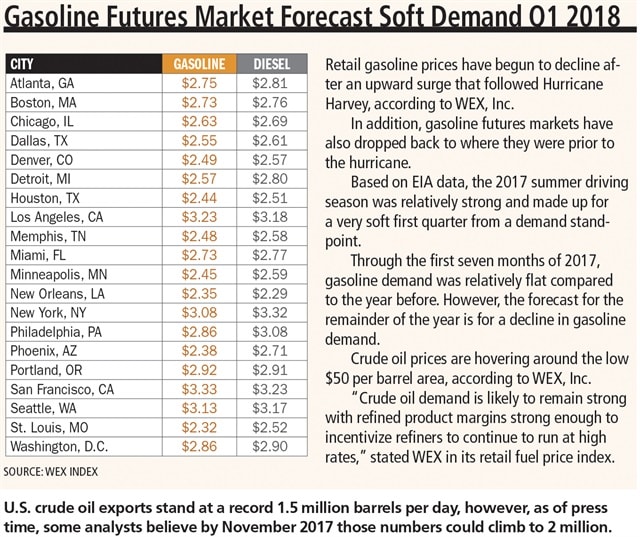
Charts courtesy of Wex Index
Langmandel of LeasePlan USA also cited the impact of the recent hurricanes.
“Fuel prices had an uptick due to Hurricane Harvey, which because of the location of landfall impacted the infrastructure of oil refineries and fuel distribution,” said Langmandel. "Forecasts project that fuel prices will return to pre-Harvey prices in 2018, with a continued decrease in prices through the end of the year. The EIA short-term energy outlook currently reports a projection of an average $2.23 per gallon in December 2017.”
Despite the weather-related disruptions, the fuel supply chain was able to quickly regain equilibrium.
“While there were price increases for several months due to these natural disasters, fuel prices have begun falling again towards the end of the year. We see fuel prices, overall, remaining flat and unaffected during the 2018 calendar-year,” said Candib of Merchants Fleet Management.
One variable that makes predicting future fuel prices so difficult is weather, as recently witnessed with three hurricanes occurring in a short period of time.
Sustainability Initiatives
Lower fuel prices have traditionally impacted the sales of hybrids and alternative-fueled vehicles. But, with the multitude of announcements from OEMs about future hybrid products, there has been an increased interest in hybrids by fleet managers.
“Hybrid acquisitions are trending up slightly in 2017 over 2016 and there is more interest shown in hybrids based on tool usage to compare vehicles,” said Wuich of Donlen.
Sustainability initiatives at multinational companies also plays a factor in corporate fuel initiatives. Since higher fuel efficiency translates into lower emissions, sustainability mandates encourage acquisition decisions to focus on smaller displacement, more efficient engines.
“From a global perspective, there is a major focus on sustainability and reducing CO2 emissions, especially coming out of Europe, where LeasePlan is headquartered. Here, we know that transportation accounts for 20% of CO2 emissions in the EU alone. This is why we have committed to being a founding partner of EV100, a new major global transport initiative designed to fast-track the uptake of electric vehicles among corporate companies,” said Heidi DiAngelo, senior vice president – international at LeasePlan. “We don’t want to ask our customers to do anything that we aren’t already doing ourselves – so we’re committed to converting our own fleet to electric wherever possible.”
More Fuel
Fuel Prices Surge in September | September Fuel Update
September brought major fuel price swings, including diesel crossing $6 a gallon. Here’s how gas and diesel prices changed throughout the month, and where they stood heading into October.
Read More →
Turning Fleet Payment Data into Executive Insights
Ramel Lindsay of U.S. Bank Voyager discusses how fleets can transform payment and transaction data into actionable intelligence to reduce costs, improve oversight, and support executive decision-making.
Read More →
Why the IRS Raised Its Mileage Rate in the Middle of 2026
Fuel-price volatility drove the rare increase to 76 cents per mile, the fifth midyear adjustment since 2000.
Read More →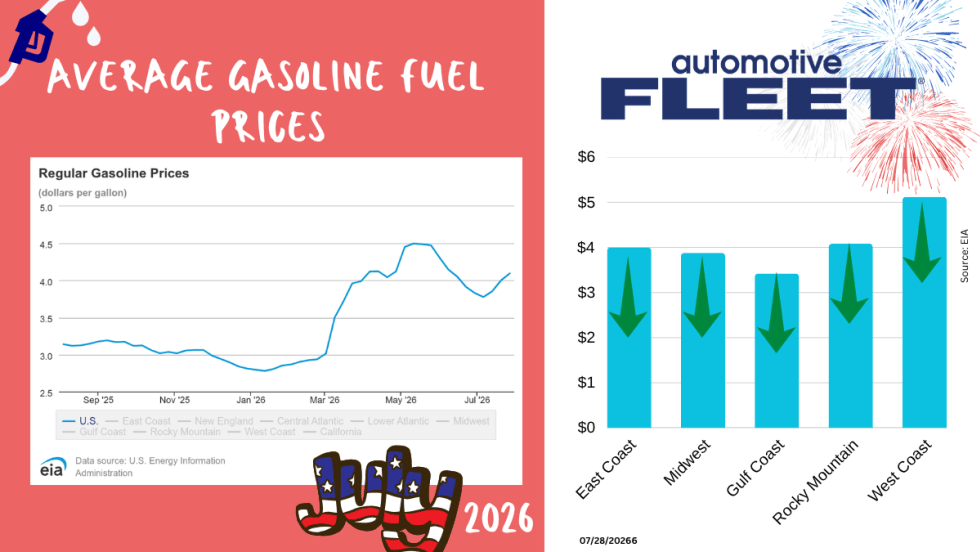
July Fuel Update: Prices Keep Rising in Light of More Conflict
Gas prices continue to rise as more and more conflicts do, too.
Read More →
Bob Adamsky on Fuel Volatility: "Don't Panic, Have a Plan."
When it comes to up and down fuel prices, Adamsky has a message for fleets: “Don’t panic.”
Read More →
How Fleets Can Gain Control of Non-Fuel Spend
Fuel often gets the spotlight, but non-fuel expenses can have a major impact on fleet costs. Ramel Lindsay of U.S. Bank Voyager discusses how fleets can gain better visibility and control over these often-overlooked expenditures.
Read More →
Fuel is Just the Start: How Middle East Tensions are Driving Up Fleet Maintenance Costs
The Middle East conflict is doing more than pushing up fuel prices. It’s also raising the cost of key maintenance products your fleet depends on, from motor oil to tires to windshield wipers. Here’s what you need to know about this budget-busting situation.
Read More →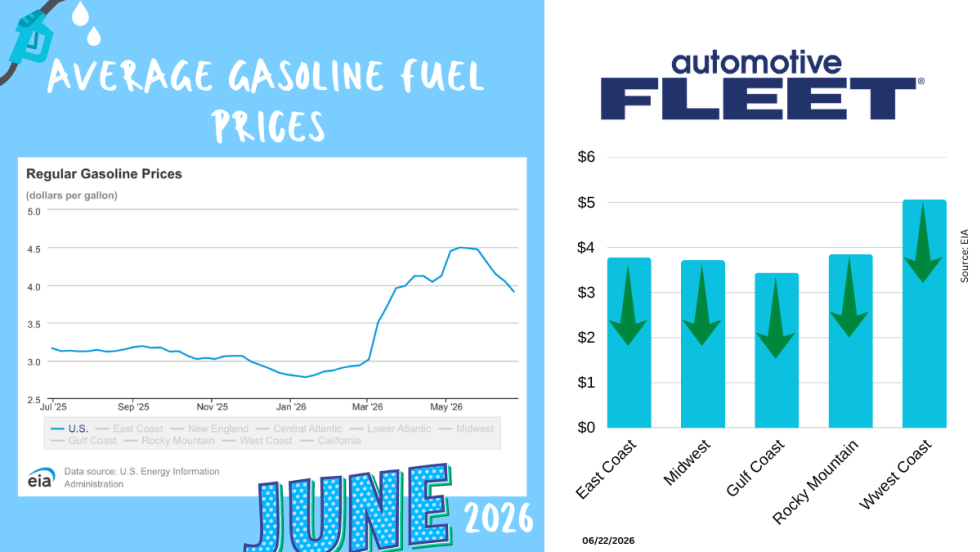
June Fuel Update: Prices Fall Below $4
Drivers are finally getting some relief at the pump. The national average gas price has dropped below $4 a gallon for the first time in months, with prices falling in 47 states as oil markets react to developments in U.S.-Iran negotiations.
Read More →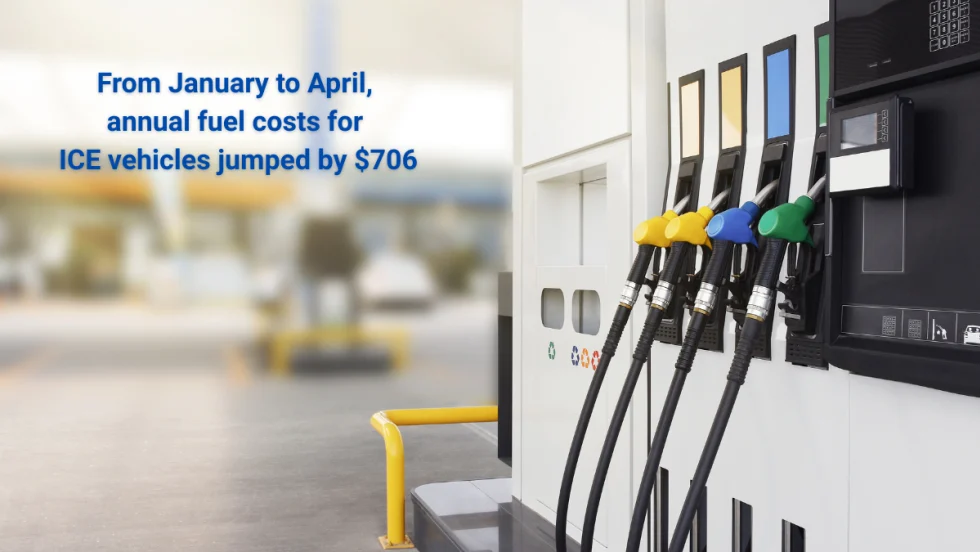
Study: How 2026's Gas Price Hikes Affect Different Vehicle Types
New data from iSeeCars reveals how rising fuel costs have affected different vehicle segments as gasoline prices climbed nearly 46% over the past four months.
Read More →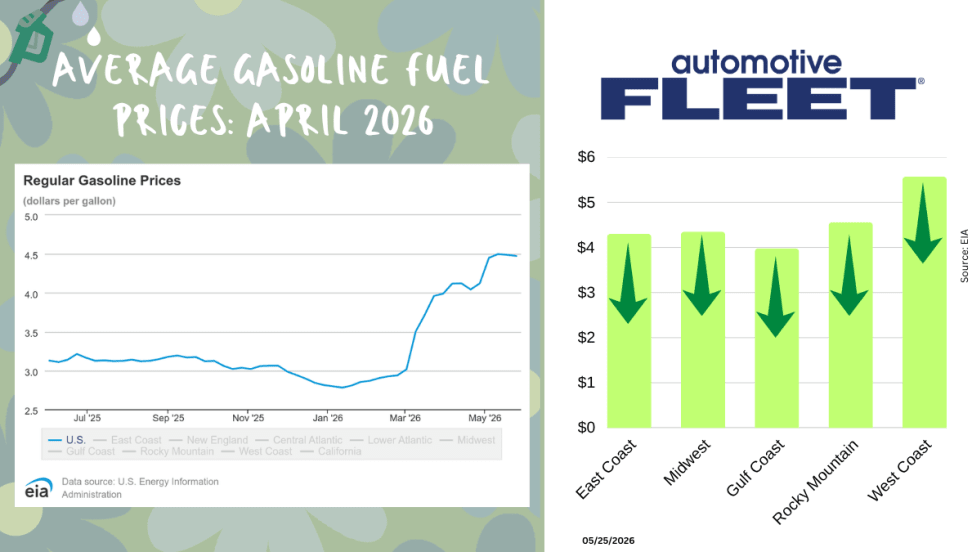
May Fuel Update: All Regions Experience Declines
Gas prices are finally easing in much of the country, but experts warn global tensions could quickly reverse the trend as the national average remains well above last month’s levels.
Read More →