Operating Costs Remain Flat for Fifth Consecutive Year
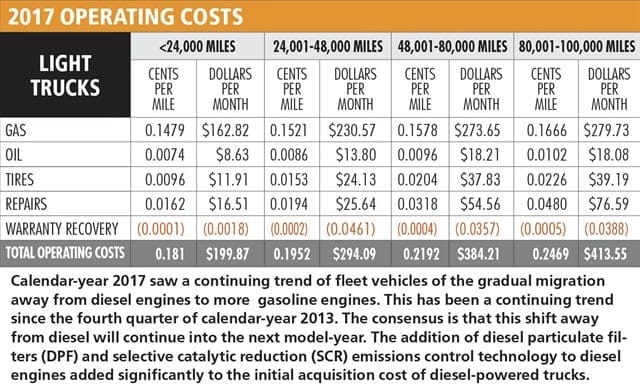
Fleet operating costs remained stable in CY-2017, primarily due to the lower volatility of fuel prices. But, there is upward pressure on maintenance labor rates and higher commodity prices that will impact the cost of replacement tires.
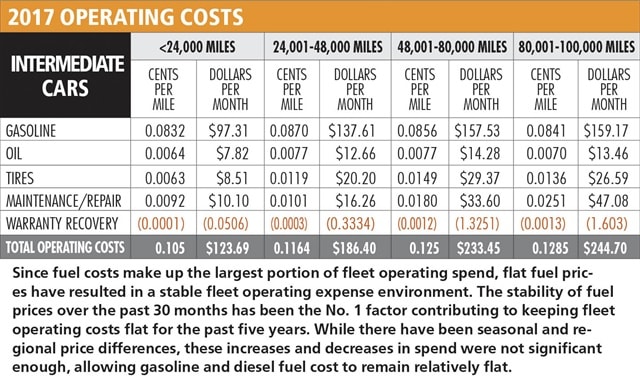
Calendar-year 2017 marks the fifth consecutive year that fleet operating costs have remained flat, primarily due to the continuation of stable gasoline and diesel prices, which offset higher maintenance labor costs and price increases for replacement tires.
Ad Loading...
This, along with other findings, are revealed in Automotive Fleet’s 26th annual operating cost survey, and are based on data provided by eight survey partners including ARI, Donlen, Element Fleet Management, EMKAY, Enterprise Fleet Management, LeasePlan USA, Merchants Fleet Management, and Wheels Inc.
This year’s survey, which had the largest-ever industry participation, is based on the analysis of actual operating costs incurred by 1,441,842 vehicles operated by commercial fleets, which are managed by these eight fleet management companies.
Chart courtesy of Automotive Fleet
At A Glance
Calendar-year 2017 marks the fifth consecutive year that fleet operating costs have remained flat, primarily due to the continuation of stable gasoline and diesel prices.
Fuel represents approximately 60% of a fleet’s total operating costs, so the lower price per gallon of fuel has had a dramatic impact on overall fleet costs by offsetting other increases in operating costs occurring elsewhere.
Replacement tire prices remain stable, but are starting to experience upward pricing pressures due to higher prices for the commodities used to manufacture tires, in particular, natural rubber.
Fleet maintenance costs have remained flat over the past 12 months, with the primary factor being increased overall vehicle quality.
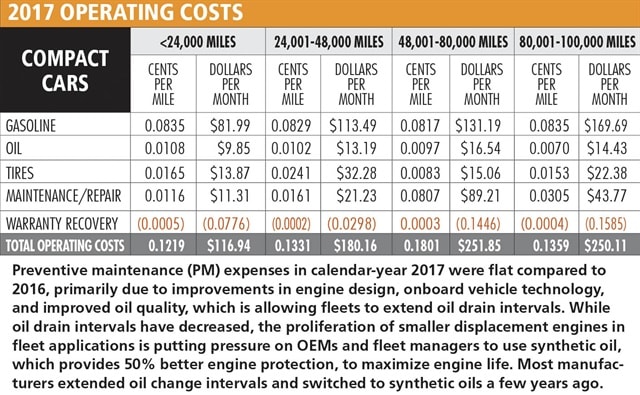
Preventive maintenance (PM) expenses in calendar-year 2017 were flat because of extended oil drain intervals.
Ongoing Stability of Fuel Prices
The stability of fuel pricing over the past 30 months has been the No. 1 factor contributing to keeping fleet operating costs flat. Fuel represents approximately 60% of a fleet’s total operating costs, so the lower price per gallon of fuel has had a dramatic impact on overall fleet costs by offsetting other increases in operating costs occurring elsewhere.
Fleets are rightsizing their vehicle selectors to take advantage of fuel-efficient technologies, weight reduction measures, higher-speed transmissions, and appropriate drivetrains to meet their business necessities. The focus continues to be to acquire the most fuel-efficient models that can fulfill the fleet requirement. In addition, new-model vehicles tend to have higher mpg ratings than predecessor models. Also, the increased implementation of telematics systems has also resulted in improved route optimization and easier identification of drivers who are engaging in driving behaviors that decrease mpg.
Lower fuel prices also allow fleets to acquire larger vehicles without negatively impacting overall operating costs due to their reduced depreciation and lower fuel costs.
Ad Loading...
“From a depreciation perspective, we are seeing nearly identical depreciation costs for the intermediate sedans and light trucks, even given the higher capitalized costs for the light trucks,” said Michael Singer, strategic consultant for Merchants Fleet Management. “The primary reason for this is the sustained period of low fuel prices, which are driving the higher resale values for the light trucks.”
However, lower fuel prices are not beneficial to all fleets. “Fleets in the oil industry, have been even more focused on cost reduction due to lower crude oil prices, which impacts overall corporate revenues” said Chad Christensen, senior strategic consultant for Element Fleet Management.
What is the forecast for per gallon fuel prices in calendar-year 2018? As many have learned through experience, fuel prices are impossible to forecast with certainty, and are influenced by a number of external variables, such as macroeconomic activity, geopolitical dynamics, and domestic supply/demand.
Chart courtesy of Automotive Fleet
Most fleet management companies use the U.S. Energy Information Administration (EIA) of the U.S. Department of Energy forecasts for internal planning and external fuel price forecast dissemination. The EIA projects fuel costs to rise modestly over the next 12 months.
The forecast for CY-2018 also predicts that global supply and demand for oil will remain at today’s levels, which will help exert downward pressure on fuel prices. In addition, the percentage of imported oil continues to decline with the increase in U.S. domestically sourced oil. This has helped to lower price volatility that in the past was caused by political instability in foreign oil-producing regions.
Ad Loading...
Chart courtesy of Automotive Fleet
Tire Prices to Remain Stable
Replacement tire prices remain stable, but are starting to experience upward pricing pressures due to higher prices for the commodities used to manufacture tires, in particular, natural rubber. Raw material prices increased 5% to 10% year-to-date in calendar-year 2017.
Another factor exerting upward pressure on replacement tire costs is the ongoing trend to larger, more expensive, diameter tires and unique tire sizes. With the larger tire sizes on vehicles, the wheels are more prone to damage from pot holes and other road hazards. The trend to larger diameter tires was started in the retail market by consumers who wanted a better look for their vehicle by having a larger tire/wheel assembly to fill their wheel well.
The trajectory for replacement tire prices in 2018 is upward due to forecast of ongoing higher commodity pricing, which exert pressure on tire OEMs to maintain margins as their production costs increase.
Chart courtesy of Automotive Fleet
Maintenance Costs Remain Flat
Fleet maintenance costs have remained flat over the past 12 months, with the primary factor being increased overall vehicle quality. In addition, extended preventive maintenance (PM) intervals have contributed to lower maintenance costs for fleets.
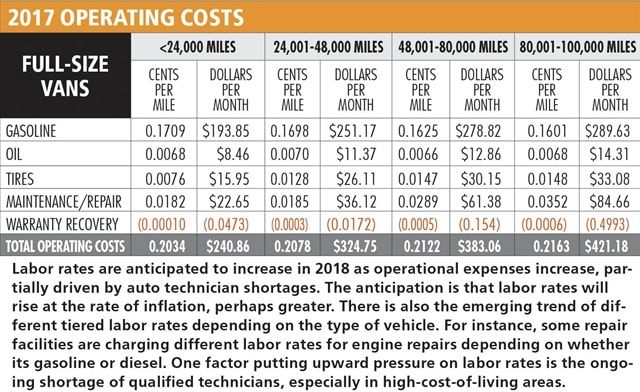
But other areas in the fleet maintenance spectrum are exerting upward pricing pressures, such as rising labor rates, especially in high cost-of-living markets. But, maintenance still represents a relatively small segment of overall operating costs; representing just 10% of total operating costs. In order for higher maintenance costs to have a dramatic impact on total operating costs, it would require far more significant increases than what is anticipated in 2018.
Ad Loading...
Chart courtesy of Automotive Fleet
PM Cost Trends
Preventive maintenance (PM) expenses in calendar-year 2017 were flat compared to 2016, primarily due to improvements in engine design, onboard vehicle technology, and improved oil quality, which is allowing fleets to extend oil drain intervals.
Most subject-matter experts anticipate that PM costs will continue to remain flat in 2018. Continued stability related to the cost of oil, along with increasing drain intervals, and the continued acceptance of synthetics will help keep PM costs stable.
Chart courtesy of Automotive Fleet
One concern on the horizon is the potential impact of higher labor rates and whether these increased overhead costs will be passed on to fleet customers.
The following four articles provide an in-depth examination of 2017 operating cost trends and a forecast of expenses for the 2018 calendar-year.
Neology’s neoFleet platform will manage toll transactions and toll-authority operations for vehicles across Avis, Budget, Payless, Budget Truck and Zipcar.
Nearly eight in 10 surveyed fleets allow personal use of company vehicles, while just over half of respondents report charging employees for the privilege.
Could developments overseas offer a preview of what’s coming for U.S. fleets? This week, we’re looking at the future of AI, autonomy, and electrification, plus Ford Pro’s new certified pre-owned program, smarter vehicle offboarding, and a new way for fleets to manage toll expenses.
Rising operating costs, driver safety concerns, and unplanned downtime are putting unprecedented pressure on modern fleets. Discover how fleet managers use embedded OEM connectivity and real-time vehicle data to cut TCO, prevent downtime, and protect drivers without aftermarket telematics hardware.
ADAS-equipped vehicles may crash less often, but they can cost more when they do. This week, we’re breaking down what that tradeoff means for fleets, plus Subaru’s first Forester Wilderness Hybrid, Nissan’s new e-POWER Rogue, and why Calstart has become Catalyst Mobility.
Iorillo brings nearly 20 years of fleet management and sales experience to the role, including previous positions at Element Fleet Management, CEI, Donlen and Ryder.
Where will fleet’s next generation of leaders come from? This week, we’re looking at the industry’s talent pipeline, what certification can add to a fleet career, how to build an award-worthy track record, and the return of Automotive Fleet’s Personal Use Survey.