




South Korea: State of the Commercial Fleet Market
The corporate fleet sector in South Korea accounts for 18-20% of total auto sales, with most sales going to local brands. However, GM Korea is growing its fleet presence, with commercial sales now representing 9% of total sales.


Photo: iStock.

Photo: iStock.
The business vehicle sector in South Korea accounts for 10% of the country’s automotive market. In 2016, there were 3,859,991 vehicles manufactured in South Korea, of which 368,518 were sold as commercial vehicles. The majority of vehicles sold to commercial businesses were Korean brand manufacturers. Koreans have demonstrated a strong preference for local brands, as evidenced by Hyundai-Kia having a 70% market share. Although South Koreans prefer domestic brands, more and more are looking to foreign marques as a way to stand out from the crowd, especially in the luxury segment. Foreign car sales have been increasing since South Korea signed free trade agreements with the U.S and Europe.
Commercial Fleet Market
In addition to local companies, there are approximately 7,500 multinational companies doing business in South Korea. South Korea’s total workforce numbers 25 million.
Company cars in South Korea are assigned to top management as part of their compensation package or as a tool of the trade for corporate salespeople. Hyundai’s recently-launched luxury sub brand Genesis has made inroads in the executive vehicle market with its EQ900 (G90 in other markets), outselling the Mercedes S-Class and E-Class models.
In the business car segment, approximately one-third of sales are for large saloon (four-door sedans) models, such as the Kia K7 and K9 or Hyundai Grandeur and Equus, demonstrating that prestige is an important factor in the South Korean executive vehicle market. Koreans are fond of traditional four-door saloons as demonstrated by the instantly successful Renault Samsung SM6. However, as elsewhere in the world, SUVs are gaining in popularity.
For corporate sales fleets, Korean sales representatives typically drive a Hyundai Sonata (called i40 in other markets) or K5 (which carries the Optima brand-name overseas). In addition to the Sonata, other popular fleet cars in Korea are the Hyundai Avante (called Elantra in other markets) and the Kia Sorrento (SUV). Other models making inroads in the Korean fleet market are the Ssangyong Tivoli (a compact SUV), the Kia K7 or (Cadenza, a luxury saloon), and the city car Chevrolet Spark.
However, the best-selling model in South Korea is the Hyundai Porter, a light commercial vehicle (LCV).
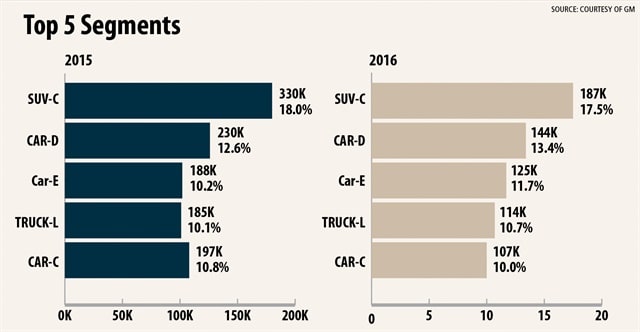
Although the Korean fleet market is dominated by Hyundai-Kia, other OEMs, such as General Motors Korea (GMK), have been growing their fleet presence in South Korea. Currently, commercial sales represent 9% of GM Korea’s total sales, according to Audrey Tan, corporate key account manager sales, service & marketing for General Motors International.
For instance, GMK fleet sales volume in 2016 increased by 6%.
“The GMK fleet team drove more sales by developing new customers and fully leveraging former dealers’ accounts,” said Tan. “Sales agents put more focus on small-medium sized enterprises and local-based rental/leasing companies.”
Traditionally, the sales network of Korean OEM manufacturers, e.g., Hyundai, Kia and Renault Samsung, is comprised of both their corporate sales branches and contracted sales agents. “Recently, GMK changed to sales agents,” said Tan. “For GM Korea, we only have sales agents and not owned sales branches.”
Another factor stimulating GM Korea’s sale growth has been its growing reputation of service quality among Korean consumers. For example, Chevrolet has been named No. 1 on the Korean service quality index for sales service for four consecutive years. The Korean Service Quality Index (KSQI) study is conducted by Korea Management Association Consulting. The KSQI study surveys 26 industries, evaluating 111 different companies.
“Chevrolet has been building upon a strong foundation since 2011. It has the longest vehicle warranty in Korea. It offers Chevrolet Complete Care, a 5-year/ 100,000-kilometer warranty for every new vehicle, except the Camaro, and free five-year roadside assistance,” added Tan.
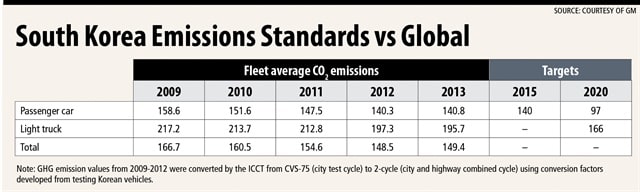
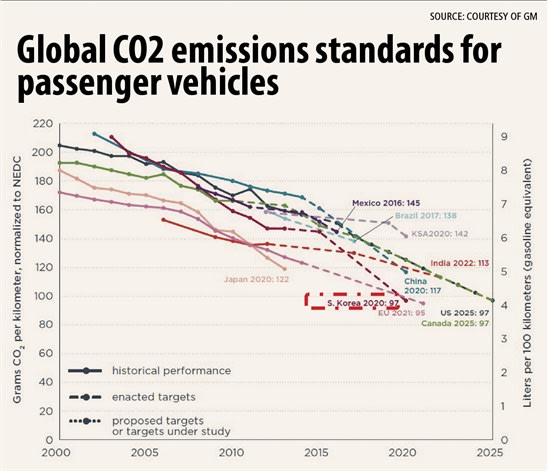
South Korea has few natural resources and is almost entirely dependent on imports for the industrial commodities it needs, particularly fossil fuels. In 2015, 96% of the energy consumed in South Korea was imported. This is one of the main reasons why South Korea is aggressively pursuing the development of renewable energy. The South Korea government has been very aggressive in promoting hybrids and electric vehicles. As a result, hybrid sales are increasing in Korea and promise to grow further with the introduction of all-new models such as the Hyundai Ioniq hybrid, PHEV, and EV models. In 2016, more than 40,000 PHEVs were sold in Korea, an increase of 7% over the year before. With the availability of the Hyundai Ioniq and Kia Niro, it is anticipated that the hybrid market will exceed 50,000 units in 2017.
Despite the growth, hybrids continue to have a relatively small market share. “Hybrid and electric vehicles, as in most developed markets, are still a relatively small interest, around 1.5% of business cars, but it is growing,” said Tan.
Auto Industry’s Global Scope
South Korea is one of the world’s fastest growing economies. It is the fourth largest economy in Asia, after China, Japan, and India. It has a gross domestic product (GDP) of $1.42 trillion, making it the 14th largest economy in the world. Over the longer term, the South Korean economy is expected to grow from 3.9% to 4.2% up to 2030.
Automobile manufacturing is a key sector of the South Korean economy. The South Korea automotive industry has experienced dramatic expansion in the past three decades. Currently, South Korea is the fifth largest automobile manufacturing country in the world, following China, U.S., Japan, and Germany. Of the vehicles produced in Korea, 68.3% of the production is exported, making it the world’s fifth largest automotive exporting country. The total value of automotive exports has achieved US$74.7 billion, representing a 13.4% share of total national exports, making it the top exported product. This is a dramatic achievement considering that the country’s initial automotive operations in the 1970s started as assembling CKD kits imported from foreign companies.
The Korean automotive industry has grown to now represent a 10% of the country’s national economy measured by employment, production, and export volume.
Car registrations are approximately 118.426 units per month from 2013-2016, which represents a total of 1.8 million vehicles per year.
General Motors has a sizeable footprint in the South Korea market. GM Korea is South Korea’s third largest automobile manufacturer and a subsidiary of General Motors, which operates the GM Korea Manufacturing Plant in South Korea. Along with selling Chevrolet product, Cadillac models are also available in South Korea. The Spark, Malibu, and Orlando are other popular models among GMK’s line-up. In addition, GM Korea provides region and brand-specific vehicle assembly kits for assembly by GM affiliates in China, the United States, Australia, Germany, India, and Brazil.
In 2002, GM established the GM Korea Design Center and Technical Center, which are developing GM’s current and next-generation global mini and small car architecture. It is the third largest among all of GM’s global design centers. It contributes to Global GM in designing many of GM’s best-selling products, including the Chevrolet Spark, Aveo, and Cruze.
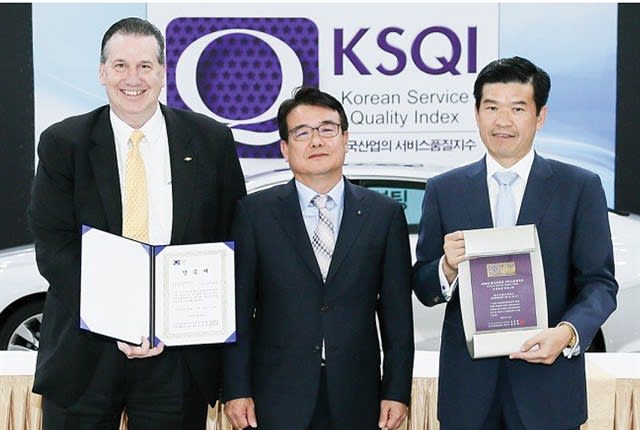
One factor stimulating GM Korea’s sale growth has been its growing reputation of service quality among Korean consumers. For example, Chevrolet has been named No. 1 on the Korean service quality index for sales service for four consecutive years. The Korean Service Quality Index (KSQI) study surveys 26 industries, evaluating 111 different companies.
Vehicle Funding Trends
Corporate fleets tend to sole source since involving a second supplier is considered disrespectful.
Business cars are given concessionary rates of tax compared with private cars. They are liable for acquisition tax at 4% compared with 7% for private cars. Lower rates of car tax are also applied to business cars.
Approximately half of all corporate cars are leased (either funded using a finance or operating lease). The other half of corporate fleet vehicles in operation in Korea are purchased.
Leasing and rental account for almost 50% of business cars sales. Despite the falling car market, the leasing and rental share of market rose to 48.5% in January to October 2013. Otherwise companies buy vehicles outright or acquire them using finance.
The top local financing companies include Hyundai Capital, Lotte Capital, and KB Capital. The biggest growth, however, has been seen in the operating lease business, called long-term rental in South Korea and dominated by local rent-a-car companies such as Lotte Rental, AJ Rent-a-car, Hyundai Capital, SK Networks, and Redcap Tour.
The advantages of renting are that rental customers are exempted from registration fees, taxes and insurance feeds (costs are all included in the rental fees).
Maintenance of the car is managed by the rent-a-car company. Rental customers are exempted from any regional government’s vehicle rotation systems by plate numbers to cut back on traffic or parking congestion. (Rental cars are classified as business-use cars).
Also, car rentals are governed by passenger transport service law. The rental market in South Korea is estimated to be 3.2 trillion won.
On the other hand, leasing is categorized as a financing business. Lessees need to pay insurance fees, taxes and the registration, as well as car maintenance. Although some financial companies pick up some of these costs, lessees can choose his or her own insurance. Leasing is governed under financial laws.
The car-leasing market was estimated to be 5.9 trillion won (USD$5.7 billion) in 2013.
Embryonic Car-Sharing Market
In October 2016, U.S.-based global investment firm Bain Capital announced it had made an investment of around 18 billion KRW (USD$15,849,360) in the South Korean car-sharing company Socar, which was launched in 2012. Socar launched with 100 vehicles in its fleet and was since expanded to more than 6,400 units, 1,000 of which GMK supplied in 2016. The company says it has a database of more than 2.5 million members as of the end of 2016.
The operating model is similar to Zipcar. Members are given a card key and use an app to book cars located in South Korea’s major cities. Rental times can be adjusted in 10-minute blocks.
More Global Fleet

GeoFencing Adds to Your Truck Security Arsenal
Geofencing is a familiar fleet tool today, but its early adoption marked a major shift in vehicle tracking, route monitoring, and the debate over employee privacy.
Read More →
Holman Takes Full Ownership of ARIZA in Mexico
Holman is bringing its Mexican fleet management operation fully under its own brand after more than 30 years as a joint venture. The change gives multinational fleet customers a single Holman operation across the U.S., Canada, and Mexico.
Read More →
5 Tire Maintenance Tips to Help Prevent Work Truck Downtime
Regular tire checks can do more than extend tread life. These five maintenance practices can help work truck fleets catch problems early, reduce costs, and prevent downtime.
Read More →

Proven Ways to Reduce Work Truck Downtime
The age-old problem of downtime will always be a reality, but with new strategies at hand, fleets have more ways to keep trucks on the road longer.
Read More →


Cameras, Safety and Insurance: From Reactive Claims to Real-Time Prevention (Part 2 of 2)
Part Two: Commercial auto remains one of the most challenging and costly lines of coverage for fleet operators and insurers alike. Continue learning more about how to effectively address these issues from Onur Aksan, Enterprise Business Development Executive, Geotab
Read More →
Cameras, Safety and Insurance: From Reactive Claims to Real-time Prevention
Commercial auto remains one of the most challenging and costly lines of coverage for fleet operators and insurers alike. Learn more about how to effectively address these issues from Onur Aksan, Enterprise Business Development Executive, Geotab.
Read More →
Fleet Costs Are Rising: Here’s How Leaders Are Responding
Fleet leaders are under pressure to reduce costs, adapt to economic uncertainty, and make smarter decisions. See how peers across North America are responding with real data, proven strategies, and forward-looking insights. Download the 2026 Market Pulse Report to benchmark your strategy and uncover where you can gain an edge.
Read More →
Enterprise Fleet Management Surpasses 900,000 Vehicles in U.S. & Canada
Enterprise Mobility connects with mobility solutions around the globe
Read More →