




Related: Fleet Crashes Flat Year Over Year
Rear-End and Parking Crashes Dominate the Fleet Industry
Accident rates remained mostly consistent in this year’s safety report. Rear-end and parking collisions were the most prevalent.

Andy Lundin・Former Senior Editor
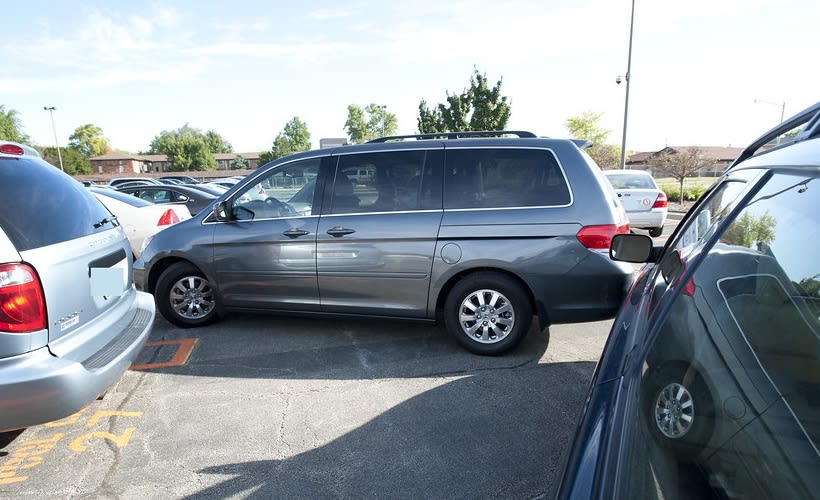
The introduction of having backup camera’s being implemented in all new vehicles beginning with the 2018 model year has seeked to curb this problem. However, the issue is still ubiquitous, especially in parking situations.
Photo courtesy of State Farm via flickr.com
4 min to read
While accident management safety statistics reported this year remained mostly consistent to what was reported in last year’s annual report, crashes that occurred during parking maneuvers, or rear-ending incidents, continued to dominate the fleet industry. These incident types are prevalent in the industry, and are a perennial concern to fleets everywhere.
Alarmingly, more than 6,000 people are injured every year as a result of vehicles backing up, with roughly 2,400 of those injured being children, according to the National Highway Traffic Safety Administration (NHTSA).
The introduction of having backup camera’s being implemented in all new vehicles beginning with the 2018 model year has seeked to curb this problem. However, the issue is still ubiquitous, especially in parking situations.
According to the National Safety Council, more than 50,000 collisions occur in parking lots and garage structures annually — resulting in 500 or more fatalities and over 60,000 injuries.
Despite the large numbers, fleets know these events are preventable.
“It’s not always a high cost because it’s usually at lowers speeds, but it’s 110% avoidable,” said Phil Samuelson, fleet and capital asset manager, USIC, with regards to vehicle backing incidents. “All the vehicles that we’ve acquired in the last three years have back up cameras and we’ve implemented back up alarms as well, but we still have backing accidents.”
Other in-vehicle technologies designed to prevent crashes in situations such as this includes automatic braking. Ten automakers report equipping more than half of the vehicles they produced between Sept. 1, 2017, and Aug. 31, 2018, with automatic emergency braking, according to both NHTSA and the Insurance Institute for Highway Safety (IIHS).
Similar to the mandate requiring new vehicles to be equipped with back up cameras, this is the second update of manufacturer progress toward equipping every new passenger vehicle with the crash avoidance technology by Sept. 1, 2022, according to NHTSA.
Since technology is not a panacea solution that will be able to make these types of different accident disappear overnight, drivers need to be more so considerate of their surroundings.
So whether or not drivers are equipped with the aforementioned technologies, reducing the risks associated with backing up begins with some simple preparation prior to driving. This includes adjusting mirrors, eliminating distractions, surveying the perimeter of the car, etc.
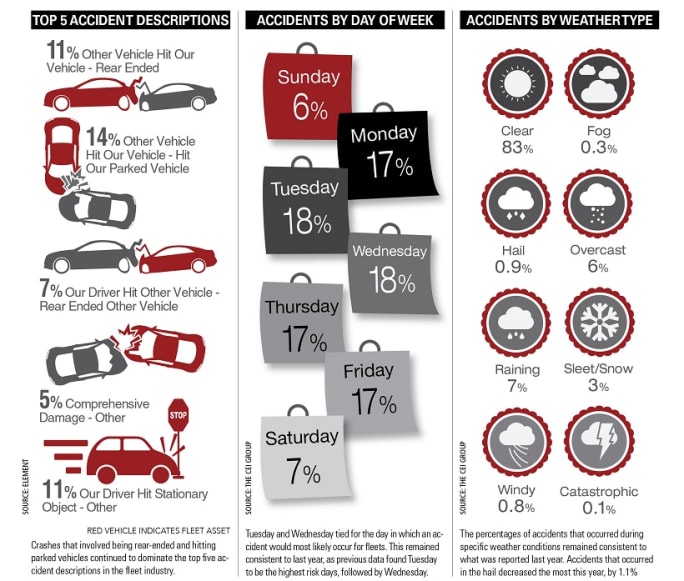
Other vehicles hitting a parked fleet vehicle was the No. 1 accident type for fleets in 2018. This was followed by other vehicles rear-ending a fleet vehicle, and then fleet drivers crashing into stationary objects.
Data courtesy of Fleet Response
“Being rear ended at a traffic light, or coming back to your vehicle in a parking lot and finding damage seems unavoidable, but there are things a driver can do differently to lessen the chance of this happening, from parking in a safer, less congested space to beginning your stop earlier, which can give the driver behind you more time to react. These safe habits are teachable moments worth reflecting on before and after an incident,” said Brian Kinniry, senior director, strategic services, The CEI Group.
Reviewing the Data
When analyzing other data that was reported, some of the data has remained mostly flat when compared to last year, though some of the data reveals noteworthy shifts.
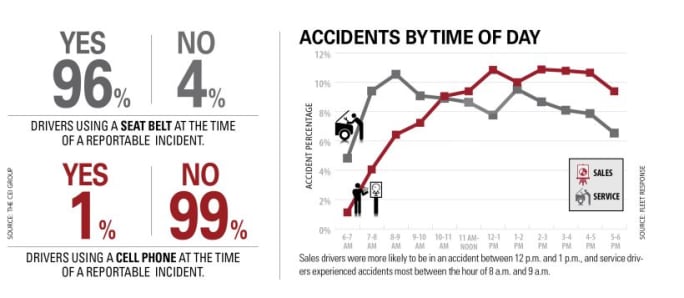
For example, analyzing accidents by time of day, service fleets still experienced, on average, an 8%-10% accident rate during a majority of the work day. However, the peaks and valleys have altered somewhat. For example, for service fleets the hour between 8:00 a.m. to 9:00 a.m. remains the time period in which drivers are the most susceptible to accidents, and increased by 0.37%.
The time of day that is also the least likely to have service fleets experience an accident, noon to 1 p.m., had its accident likelihood increase slightly, by 0.67%.
On the other end of the spectrum, peak accident times for sales fleets showed declines in the final hours of an average work day, accidents between the hours of 3 p.m. and 5 p.m. collectively dropped by 1.77%, and accidents between 5 p.m. to 6 p.m. showed declines by 1.71%.
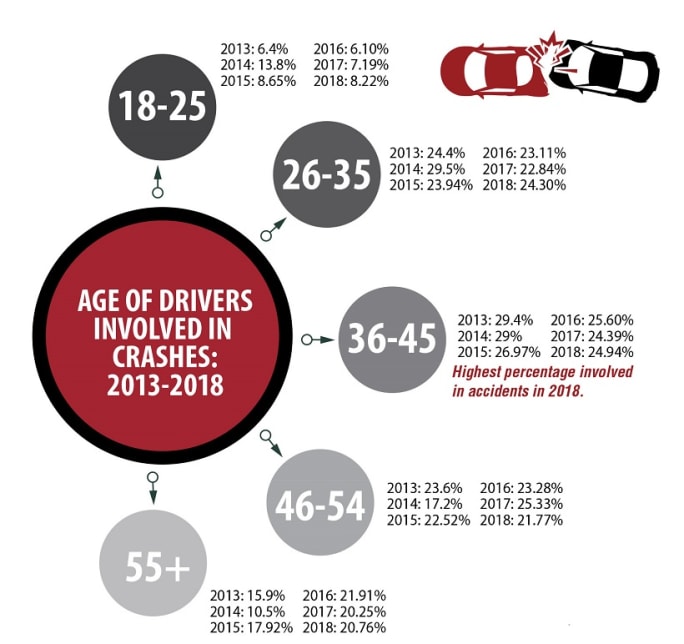
In other data reported for this year, accident rates for drivers aged 36-45 was listed as the age group with the highest percentage involved in crashes in 2018. Accident rates for drivers increased in every other age group except those between the ages of 46-54, which dropped by almost 4%. Drivers between the ages of 26-35 saw the biggest increase, growing by 1.46% between 2017 and 2018.
In the last five years of data compiled for the survey, drivers aged 55 and older saw the largest increase in accidents, compared to other age group chunks: in 2013 this age group was at a 15.9% accident rate and in 2018 it jumped to 20.76% after years of gradual growth.
Subscribe to Our Newsletter
More Safety
IIHS Crash Avoidance Tests Reveal Safety Gaps in Cargo Vans and Work Trucks
New crash-avoidance ratings from the Insurance Institute for Highway Safety reveal inconsistent performance among commercial vehicles, with several popular cargo vans and heavy-duty pickups struggling to avoid collisions with other vehicles and pedestrians.
Read More →
What’s Next for Fleet? Safety, AI & Industry Recognition | AF News Recap
Could your company's culture be encouraging distracted driving? This week, we're exploring how workplace expectations affect driver safety, what AI, EVs, and autonomous vehicles could mean for the future of fleet management, and how fleet professionals can strengthen their award nominations.
Read More →
Does Your Fleet's Culture Encourage Distracted Driving?
What happens when the people responsible for enforcing safety rules are the ones setting the wrong example? The answer may reveal why some of the biggest risks to fleet drivers have little to do with what's written in the employee handbook.
Read More →
Sponsored•October 1, 2026
Fleet Manager’s Ultimate Playbook: Navigating the New Standard in OEM Connectivity
Rising operating costs, driver safety concerns, and unplanned downtime are putting unprecedented pressure on modern fleets. Discover how fleet managers use embedded OEM connectivity and real-time vehicle data to cut TCO, prevent downtime, and protect drivers without aftermarket telematics hardware.
Read More →
From Driver Well-Being to EV Charging | AF News Recap
Mental health belongs in the fleet safety conversation. This week, we’re looking at five ways fleets can support employee well-being before a crisis, plus Holman’s expansion in Mexico, new one-day Fleet Forward passes, and why EV charging demand is outpacing infrastructure growth.
Read More →
Nexar-Nauto Merger Aims to Give Fleets Better Safety Intelligence Through Larger Driving Dataset
Stefan Heck tells Automotive Fleet that combining more than 10 billion miles of driving history with Nexar's AI models will give fleets deeper insights into driver risk and roadway conditions than either company could provide independently.
Read More →
Don't Wait for a Crisis: 5 Ways to Build Mental Health Into Your Fleet Safety Program
For Suicide Prevention Month, fleet and safety leaders have an opportunity to put mental health where it belongs: at the center of workplace safety.
Read More →
How Camera Data Can Strengthen a Fleet’s Insurance Renewal
Insights from a commercial insurance carrier and a broker show how fleets can turn video telematic data, driver coaching, and improved claims results into a stronger case at insurance renewal.
Read More →
The Safest Fleets Aren’t the Ones with the Most Technology
You’ve made the telematics investment. Here’s how to capture the other half of its value and build the safest fleet on the road.
Read More →
Sponsored•August 7, 2026
Hidden in Plain Sight: Fleet Compliance Risks
Fleet compliance isn't just about having policies — it's about consistently enforcing them. This practical guide reveals six hidden compliance risks common in public sector and shared fleet operations and outlines proven strategies to improve visibility, accountability, and audit readiness
Read More →