




Produce Company Experiments With Alt-Fuel Options
Testa Produce wanted environmentally friendly solutions for its fleet. See how its implementation of electric motors, biodiesel, and compressed natural gas (CNG) options fared.

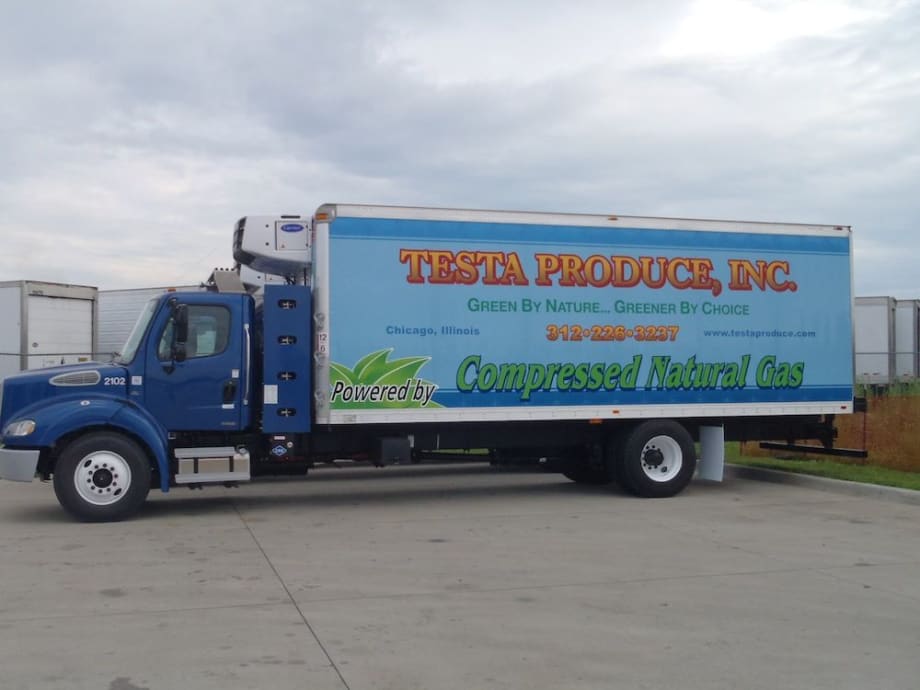
Testa Produce has 24 straight trucks in its delivery fleet running on CNG. Photo courtesy of Testa Produce
Testa Produce has 24 straight trucks in its delivery fleet running on CNG. Photo courtesy of Testa Produce
When Peter Testa wanted to go green at his produce company, he wanted environmentally friendly objectives to be reflected in all aspects of the business, including its fleet vehicles.
“As a produce company, we’re naturally a green company,” says Testa, owner of Testa Produce Inc., a Chicago-based company that has been supplying produce for more than 100 years. “So, using renewable energy and environmentally friendly fuels, it all kind of fits together.”
Partnering with Chicago Area Clean Cities (CACC), Testa has been in the process of switching the fleet of diesel straight trucks to run on compressed natural gas (CNG). The trucks deliver produce to restaurants, hotels, hospitals, country clubs, sports venues, and catering services.
Out of 42 straight trucks, 24 of them run on CNG — with two additional CNG trucks coming in the next few weeks. Each 24-foot refrigerated truck travels 50 to 100 miles per day delivering to customers in Illinois, parts of Wisconsin, and Northwest Indiana.
“The CNG trucks pair nicely with Peter’s vision for the company to be green and cutting edge,” says Claire Cameron, Testa’s facility and quality assurance manager. “He wanted our company to have as little a carbon footprint as possible.”
Located in Chicago, Testa’s facility earned the U.S. Green Building Council’s LEED Platinum certification. The $24-million, 91,300-square-foot facility features a wind turbine, solar panels, and a green roof that collects rainwater. If it’s a sunny and windy day, the solar panels and wind turbine can actually take the building’s energy use off the grid, says Cameron.
The company’s environmental initiatives have lowered costs by 10% to 15% each year, according to Testa.
Testing Options
Before implementing CNG trucks, Testa’s delivery truck fleet ran on diesel and biodiesel (B20). When looking to switch to a fuel option to lower the company’s carbon footprint, Testa first decided to try battery-powered trucks. Unfortunately, they didn’t work well for the company’s delivery fleet.
“With the cold weather and the weight we put on each truck, the battery power didn’t last like we needed it to,” says Cameron.
Then a program by CACC sparked Testa’s interest in CNG vehicles. Clean Cities helped Testa apply for some grants to help offset the cost of purchasing the CNG-powered trucks.
“The CNG trucks are approximately $40,000 more expensive than the diesel/biodiesel trucks,” she says. “The grant money covers 50% of the incremental cost to purchase the CNGs.”
So far, the CNG trucks have been running as well if not better than the diesels, according to Cameron.
The CNG has been especially beneficial in the winter months. In the early morning, the diesel trucks have a hard time starting — the biodiesel/diesel fuel can gel in extremely cold weather. But the CNG isn’t affected by the cold.
Testa has been able to secure a lower CNG price through relationships with local fueling stations and fueling companies. Although biodiesel/diesel prices have been lower — the price differential between CNG and biodiesel/diesel has been minimized recently — Testa knows that diesel prices will go up again, according to Cameron.
Leasing to Owning
A majority of Testa’s truck fleet (International and Freightliner straight trucks) is leased through two leasing companies. As Testa has acquired more CNG-powered trucks, the company has started to buy the trucks once they come off lease instead of extending the leases.
Currently, Testa has 10 leased CNG trucks, 14 owned CNG trucks, and four owned CNG day cab tractors.
Testa has been acquiring the CNG-powered trucks from a Freightliner dealership in Milwaukee; the trucks are already converted to CNG when they arrive at the Testa facility, according to Cameron.
After purchasing the trucks, Testa works with a body shop to build the boxes and then a Carrier dealer installs the refrigeration (“reefer”) units.
“The goal is to have the entire fleet run on CNG if the trucks continue to perform like they have over the last few years,” Cameron says.
Originally posted on Work Truck Online
More Global Fleet

GeoFencing Adds to Your Truck Security Arsenal
Geofencing is a familiar fleet tool today, but its early adoption marked a major shift in vehicle tracking, route monitoring, and the debate over employee privacy.
Read More →
Holman Takes Full Ownership of ARIZA in Mexico
Holman is bringing its Mexican fleet management operation fully under its own brand after more than 30 years as a joint venture. The change gives multinational fleet customers a single Holman operation across the U.S., Canada, and Mexico.
Read More →
5 Tire Maintenance Tips to Help Prevent Work Truck Downtime
Regular tire checks can do more than extend tread life. These five maintenance practices can help work truck fleets catch problems early, reduce costs, and prevent downtime.
Read More →

Proven Ways to Reduce Work Truck Downtime
The age-old problem of downtime will always be a reality, but with new strategies at hand, fleets have more ways to keep trucks on the road longer.
Read More →


Cameras, Safety and Insurance: From Reactive Claims to Real-Time Prevention (Part 2 of 2)
Part Two: Commercial auto remains one of the most challenging and costly lines of coverage for fleet operators and insurers alike. Continue learning more about how to effectively address these issues from Onur Aksan, Enterprise Business Development Executive, Geotab
Read More →
Cameras, Safety and Insurance: From Reactive Claims to Real-time Prevention
Commercial auto remains one of the most challenging and costly lines of coverage for fleet operators and insurers alike. Learn more about how to effectively address these issues from Onur Aksan, Enterprise Business Development Executive, Geotab.
Read More →
Fleet Costs Are Rising: Here’s How Leaders Are Responding
Fleet leaders are under pressure to reduce costs, adapt to economic uncertainty, and make smarter decisions. See how peers across North America are responding with real data, proven strategies, and forward-looking insights. Download the 2026 Market Pulse Report to benchmark your strategy and uncover where you can gain an edge.
Read More →
Enterprise Fleet Management Surpasses 900,000 Vehicles in U.S. & Canada
Enterprise Mobility connects with mobility solutions around the globe
Read More →