In 2015, average monthly personal-use charges increased to $128, up from the $123 average monthly charge reported in 2014. Personal use remains a sensitive topic, both with drivers and fleet managers.
In 2015, average monthly personal-use charges increased to $128, up from the $123 average monthly charge reported in 2014. In just the past four years, average monthly personal-use charges have increased by $12 per month ($116 in 2012 vs. $128 in 2015). Additionally, company fleets averaged 1,742 business miles per month and 398 personal miles per month.
Ad Loading...
In the endless discussion of reimbursement vs. a company-provided vehicle program, personal use is one factor that remains front-and-center in fleet decision making.
Ad Loading...
And, personal use remains a sensitive topic, both with drivers and fleet managers, which can cause headaches beyond the obvious issues revolving around accurate mileage reporting.
As one fleet manager who wished to remain anonymous put it: “Most drivers do not like paying for personal use, and they voice their opinion clearly. My best answer is, ‘For under $220 per month you drive a new vehicle, with all maintenance included, plus paid fuel and insurance. What more could you possibly ask for?’ ”
At a Glance
Some key takeaways from Automotive Fleet’s annual personal-use survey include:
Average monthly personal-use charges are up $5 over 2014.
More fleets are requiring an MVR on non-employees driving company vehicles.
The majority of fleets continue to allow personal use of company-provided vehicles at all times, whenever necessary.
Personal Use By the Numbers
For 2015, the percentage of fleets that operate field vehicles, 79 percent allow personal use, down from 82 percent in 2014. However, 38 percent of fleets that utilize non-field vehicles (such as executive fleets, etc.) increased their allowance of personal use by 7 percentage points over 2014.
Year-over-year, the majority of fleets allow an employee’s spouse personal use of a company vehicle, and 2015 was no different with 73 percent of fleet managers reporting that an employees’ spouse was allowed personal use of a company-provided vehicle, up from 65 percent in 2014. More fleets are allowing an employee’s licensed children personal use of a company-provided vehicle, at 8 percent in 2015 vs. 6 percent in 2014.
Only 28 percent of fleets in reported that they allow no one, aside from the employee, personal use of a company-provided vehicle, down from 34 percent in 2014.
Ad Loading...
Conditions for approved personal use remain consistent year-over-year, with most fleets (79 percent in 2015) opting to allow personal use at all times, whenever necessary, relatively flat compared to 2014.
Additionally, job function remains the No. 1 factor fleet managers use to determine the assignment of company-provided vehicles, at 70 percent of respondents in 2015, but down from a high of 77 percent of respondents in 2014. Fewer fleet managers (53 percent in 2015 vs. 58 percent in 2014) are utilizing annual business miles driven to govern vehicle assignment, followed by job title at 49 percent, equal to this past year.
However, one big change is the increase in fleets that are requiring MVR checks for all non-employees driving a company-provided vehicle, at 70 percent in 2015 vs. 61 percent in 2014, and 67 percent reported in 2013.
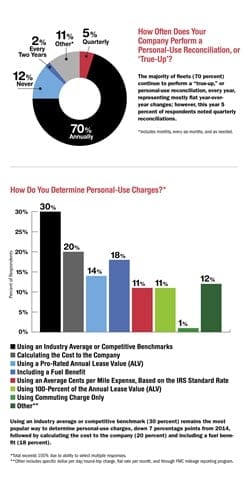
The majority of fleets still perform a true-up, or personal-use reconciliation each year (70 percent in 2015, up just 1-percentage point over 2014). However, an increasing number of respondents reported quarterly reconciliations, creating an all-new category. The percentage of fleets that never perform a true-up decreased by 2-percentage points, from 14 percent in 2014 to only 12 percent in 2015.
Data obtained from AF Research Department.
Fleet managers continue to use an industry average or competitive benchmarks in determining their personal-use charges (at 30 percent of respondents), down from 37 percent in 2014. The second-most popular method to determine personal-use charges was calculating the cost to their company at 20 percent (equal to 2014), followed by including a fuel benefit at 18 percent (up 2-percentage points over 2014). More fleets are opting to use a prorated annual lease value (ALV) when determining personal-use charges, at 14 percent in 2015 compared with 12 percent in 2014.
Ad Loading...
While overall average personal-use charges are $5 higher per month in 2015 vs. 2014, when breaking down overall average personal-use charges, the majority of fleets (58 percent) charge more than $100 per month, down from 63 percent in 2014. However, the percentage of fleets charging more than $150 per month increased by 2-percentage points in 2015 over 2014 figures.
When collecting personal-use charges, the majority of fleets continue to opt for a payroll deduction (87 percent in 2015, up 1-percentage point from 2014). This year, fewer fleet managers are reporting opting to collect personal-use charges by employee check (3 percent in 2015 vs. 5 percent in 2014), while the percentage of fleet manager respondents who utilize an expense account deduction (4 percent) remained flat year-over-year.
Additionally, the most common way employees are reimbursed for business use of a personally-owned vehicle remains a per-mile rate at 86 percent (same as 2014), followed by utilizing a fixed & variable rate (FAVR) allowance at 6 percent (down 1-percentage point over 2014 figures). The remaining percentage of fleet managers equally utilize either a flat monthly rate or combination per-mile/flat rate.
Challenges in Personal Use
From managing personal use of executive vehicle fleets to ensuring all drivers accurately report business and personal miles, a personal-use program does have its challenges.
A few fleet managers, who wished to remain anonymous, shared some of their personal-use challenges with Automotive Fleet:
Manager & Driver Education
“My largest headache revolving around personal use is explaining corporate ‘Limited Personal Use Policy’ to managers and drivers in newly acquired business units. It is difficult if they come from a history of unlimited personal use ‘company car’ fleet environment.”
“My largest headache is explaining to employees how the fringe program works, and annual lease value (ALV) and IRS tax implications.”
Accurate Reporting
“One concern is the under-reporting of personal mileage. Accident data (showing time/day) seems to suggest that drivers are actually using their vehicles for personal use at two or three times the rate that is actually reported.”
“Utilizing our mileage reporting tool and adding or deleting drivers from it is extremely difficult.”
“Drivers simply fail to report their mileage.”
”Driver’s don’t think they even drive personal miles so they don’t report it.”
Neology’s neoFleet platform will manage toll transactions and toll-authority operations for vehicles across Avis, Budget, Payless, Budget Truck and Zipcar.
Nearly eight in 10 surveyed fleets allow personal use of company vehicles, while just over half of respondents report charging employees for the privilege.
Could developments overseas offer a preview of what’s coming for U.S. fleets? This week, we’re looking at the future of AI, autonomy, and electrification, plus Ford Pro’s new certified pre-owned program, smarter vehicle offboarding, and a new way for fleets to manage toll expenses.
Rising operating costs, driver safety concerns, and unplanned downtime are putting unprecedented pressure on modern fleets. Discover how fleet managers use embedded OEM connectivity and real-time vehicle data to cut TCO, prevent downtime, and protect drivers without aftermarket telematics hardware.
ADAS-equipped vehicles may crash less often, but they can cost more when they do. This week, we’re breaking down what that tradeoff means for fleets, plus Subaru’s first Forester Wilderness Hybrid, Nissan’s new e-POWER Rogue, and why Calstart has become Catalyst Mobility.
Iorillo brings nearly 20 years of fleet management and sales experience to the role, including previous positions at Element Fleet Management, CEI, Donlen and Ryder.
Where will fleet’s next generation of leaders come from? This week, we’re looking at the industry’s talent pipeline, what certification can add to a fleet career, how to build an award-worthy track record, and the return of Automotive Fleet’s Personal Use Survey.