




Maximize Efficiency and Safety: Understanding Truck Lifts
Truck lifts are a common feature of many maintenance facilities. Knowing the differences is one key to proper lift use and safety.

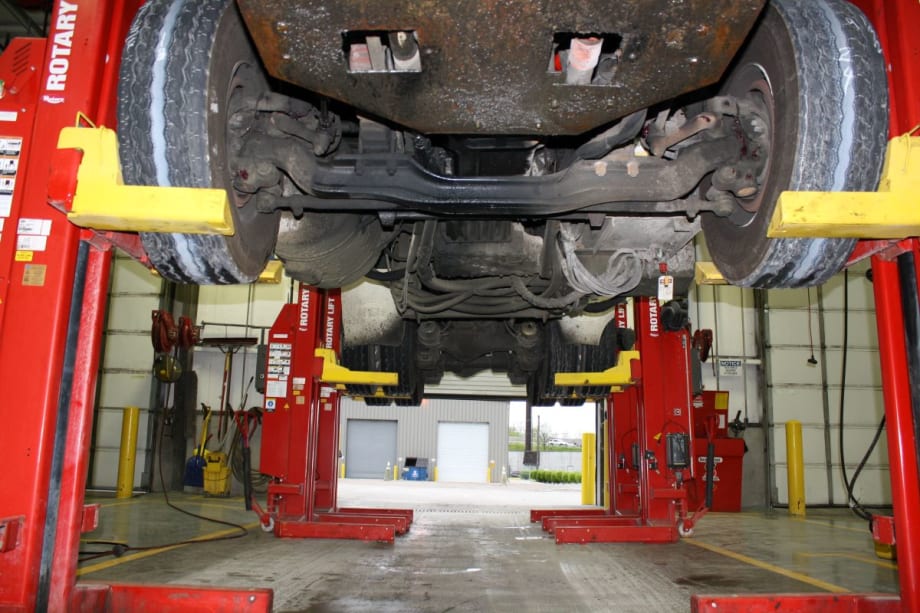
Mobile column lifts are ideal for the heavy-duty truck market and can be used for preventive maintenance tasks indoors or out. These lifts are not tied to a bay and can lift from 72,000 to more than 112,000 pounds.
Photo: Rotary Lift
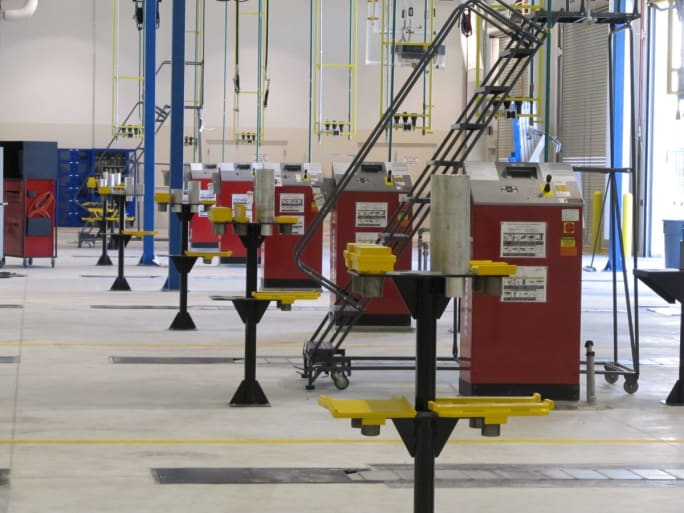
In-ground lifts provide clear vehicle access, take up the least floor space, and are the most ergonomic of the commonly used lift options. Standard lifting capacity for in-ground lifts is up to 105,000 pounds.
Photo: Rotary Lift
What is a truck lift? At the most basic definition, a truck lift is a device that raises and holds trucks in the air.
“A truck lift makes maintenance easier than the alternative — having technicians lie down and slide under vehicles to make repairs while on their backs. Jacks and dollies don’t qualify as lifts, because they’re not built to hold vehicles in the air indefinitely,” explained Doug Spiller, director of heavy-duty product management for Rotary Lift. “There are numerous advantages to using a vehicle lift, including increased productivity and profitability, improved ergonomics and safety, and improved employee recruitment and retention.”
Understanding your lift options, properly selecting your lift, utilizing the lift correctly, and ensuring appropriate maintenance takes place is essential to safety.
Choosing the Right Truck Lift
For the heavy-duty industry, there are many lift possibilities, including in-ground lifts, two-post surface lifts, platform lifts, and mobile column lifts. According to Spiller, each lift has a place and use:
In-Ground Lifts
In-ground liftsprovide the best access to the various maintenance items on a vehicle. They’re also the most ergonomic and space-efficient option, according to Rotary Lift. Available in scissor and two- or three-post options, in-ground lifts engage a vehicle by its axles.
The lift is operated either by a control box, pendant, or above-ground console, with the lift, power units, and hydraulics located in the ground. Standard lifting capacity for in-ground lifts is up to 90,000 pounds, and they are typically used to lift large two-, three-, and tandem-axle vehicles for most preventive maintenance and repair tasks.
Two-Post Lifts
Two-post lifts are the most widely used vehicle lift in the world, Spiller noted. Two-post lifts feature two sets of lifting arms attached to two columns. They are available in asymmetrical and symmetrical designs.
When the vehicle is parked between the columns, you manually position the arms to lift the vehicle at designated pickup points on the frame. Two-post lifts are typically used for lifting light- or medium-duty trucks and vans.
Four-Post Lifts
Four-post liftsrequire a vehicle to be driven onto runways situated between the posts and then lifted. There’s no set-up required for the lift process, and a technician can have a truck ready for service in about 60 seconds, Spiller said.
Four-post lifts can also be outfitted with rolling jacks that allow a technician to lift the front, rear, or all wheels off the runway by the axles. They can also be equipped with alignment kits. The typical lifting capacity for four-post lifts is up to 60,000 pounds.
They are often used for fast-turn services, such as oil changes, center undercarriage, and exhaust work, alignments, tasks requiring loaded suspensions, and work on long-wheelbase vehicles.
Parallelogram Lifts
Parallelogram liftslike four-post lifts, have vehicles driven onto runways that are then raised. Instead of going straight up like a four-post lift, however, these lifts move fore or aft as they rise. Because these lifts don’t require a set-up, Spiller explained they are one of the fastest lifts to use.
There are three versions of parallelogram lifts: surface mount, surface with recessed mount, and flush mount. The extra legs in higher-capacity lifts mean less vehicle positioning. The typical lifting capacity for parallelogram lifts is up to 130,000 pounds.
Mobile Column Lifts
Mobile column lifts are the fastest-growing category of above-ground lifts for the heavy-duty market. Mobile column lifts consist of four or six portable columns linked by a common control circuit. The columns are wheeled to the vehicle, then connected via wireless technology or control cables for synchronized lifting.
Some models allow the wheel forks to adjust to different wheel sizes. The typical lifting capacity for mobile column lifts ranges from 72,000 pounds to more than 112,000 pounds and is most commonly used for preventive maintenance and repair tasks — indoors or out. One additional benefit is the ability to turn just about any space into a repair, inspection, or wash area.
Heavy-Duty Platform Lifts
Heavy-duty platform lifts, like four-post lifts, require a vehicle to be driven onto a platform. But, heavy-duty platform lifts don’t have posts, they utilize a scissor lifting mechanism similar to a parallelogram lift. Unlike parallelogram lifts, though, heavy-duty scissor lifts raise and lower vehicles in a straight vertical path.
Once a vehicle is raised, it gives technicians full access to the underside of the trucks on the platform. Both surface-mounted and in-ground versions are available. The typical lifting capacity for heavy-duty scissor lifts ranges from 44,000 to 80,000 pounds. These lifts are most typically used for preventive maintenance and repair tasks, wash bays, inspections, and alignments.
Tips in Selecting a Truck Lift
Once you understand the different lift options, the next step is selecting the lift that is the most appropriate for your space and operational needs.
“Many fleet managers or shop owners assess the shop's needs today when deciding on what lift to purchase; however, they also need to think how the lift may fit the business both now and in the future,” Spiller said.
The type of services the facility performs — and will perform in the future — is the most critical factor in choosing the right lifts.
“For some facilities, a single model of lift is appropriate for all of the work they perform. That said, most facilities benefit from having a variety of lift styles so the service manager can assign jobs to the most appropriate bays,” he added.
Another factor to take into consideration when selecting a lift is available space.
“Will the lift I need fit in my facility space with every vehicle in my fleet? Often, approach ramps must be removed to close doors, vehicle overhangs are not considered, or overhead items must be moved after a lift is installed. There could be a better style of lift that is more flexible or adjustable and fit in your space,” Spiller said.
Finally, do not pick a lift based solely on the heaviest vehicle in your fleet. Sizing a lift for a single vehicle in a fleet may seem like a great idea, ensuring your largest vehicle can be maintained. But, consider how often you might service that vehicle and if that service could be done on a different style lift.
“For instance, 5% of your vehicles are over 30,000 pounds in weight, but 95% are not. Choosing a platform lift sized for those larger vehicles might make 95% of your service less than ideal. Perhaps that other 5 % of vehicles could be serviced differently,” Spiller said.
Find a local vehicle lift distributor or lift expert to survey your fleet, your needs, and your facility to help come up with a solution that fits all of those and your budget.
Safety First: What Mistakes to Avoid While Using a Lift
Now you understand your lift options and have selected the right lift for your space and needs. The next step is ensuring you are utilizing the lift effectively.
“One of the most common mistakes made when using a lift is misusing it or using it in an unsafe manner. Vehicle damage is possible when using a lift improperly. However, that is an easy problem to fix with proper technician training and understanding how to properly lift the vehicle according to the OEM manufacturer’s recommended pickup points,” Spiller said.
Additionally, do not modify your lifts.
“Changing a lift can reduce safety factors, put operators at risk, and invalidate the ALI gold label certification. Always contact the manufacturer or local representative to find out if there are special adapters or accessories that are vehicle or vehicle type-specific,” Spiller said.
Finally, ensure you not only perform but also record annual operator training.
“People are busy and sometimes take shortcuts to meet deadlines. Having training sessions on correct positioning, adapter use, and lift operation should not just be for new employees or mechanics changing jobs/stations. Annual reviews also benefit and protect everyone,” Spiller said.
Proper Inspections: Maintaining Your Lift
Properly maintaining any piece of equipment, from small shop tools to your largest vehicle, is critical in running a truck fleet. Your truck lifts are no different.
“One of the biggest mistakes we see is simply not performing regular maintenance. Lifts are a big financial investment, and lift inspections are one of the easiest ways to protect that investment and ensure that all safety and performance mechanisms are working properly. Performing daily maintenance checks per the manufacturer’s recommendation will help keep lifts working,” Spiller said.
The ANSI national standards cover lift operation, maintenance, and inspection. And, just like you ensure and record operator training, track all maintenance and lift inspections as well.
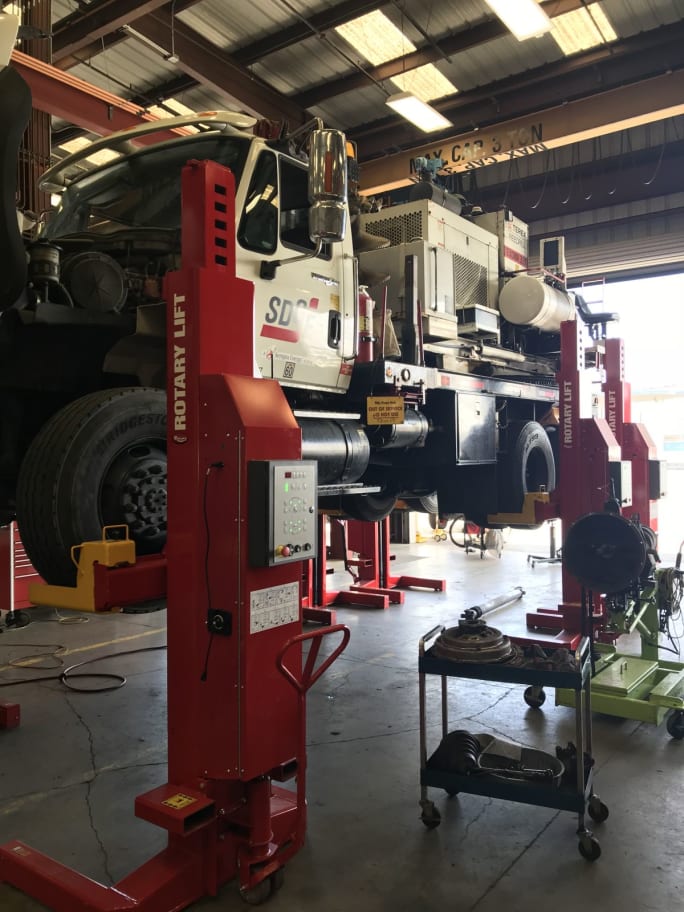
Understanding your lift options, properly selecting your lift, and ensuring appropriate maintenance is essential to lift safety.
Photo: Rotary Lift
“A growing number of state codes and regulations require annual lift inspections. It is also important to document annual lift inspections, which can help prevent OSHA citations and fines.
Inspections can catch missing or damaged safety and operation decals. They can also catch items beginning to wear or fail due to normal use,” Spiller said.
And finally, keep the season in mind. Winter brings deicers, water, and more road grit. Seasonal fluid changes in a vehicle might mean more spills on lifting components.
“Keeping the lift and its vehicle contact points clean not only extends the lift life, but it also prevents stuck mechanisms, improves safety, and reduces opportunities for failures vs. lifts that are not kept clean,” Spiller concluded.
10 Considerations When Purchasing a Lift
There are several things to consider before buying a lift, according to Doug Spiller, director of heavy-duty product
management for Rotary Lift. A few of these include:
Facility layout. Major considerations include space availability, traffic flow, concrete and soil quality, vehicle lengths, turning radius, and whether the facility is leased or owned.
Types, sizes, and weights of vehicles to lift. Consider lifting capacity and available accessories too. And remember to plan for any new vehicles that might be added to the fleet.
Services performed. The style of lifts selected can have a significant impact on the speed and quality of the work performed.
Efficiency, versatility, and productivity. The type of lifts considered should be conducive to the tasks performed. Evaluate whether it is user-friendly, how fast, and how useful the features are for the particular brand and model of lifts being considering.
Budget. When comparing the cost of lifts, look at the overall cost of ownership, not just the initial purchase price. The costs of repairs and downtime from a low-priced lift can easily outweigh any up-front savings.
Safety. First and foremost, look for the gold label that reads: “ALI Certified” Only lifts that have passed independent safety testing can use this label. Also, compare safety features and systems under consideration.
Ergonomics. Most technicians prefer to stand up rather than lie on a creeper under a truck because they find less physical strain, and it’s much more efficient and productive. Some lifts do more to maximize operator comfort and productivity.
Environmental Concerns. Consider what precautions are designed into a lift to prevent hydraulic fluid leaks, electrolysis, water contamination, and other environmental concerns.
Lift Maintenance. Good lifts require minimal maintenance while offering years of safe, reliable service. Compare the maintenance schedules on lifts you’re considering because anytime a lift is down for maintenance, it’s cutting into productivity and revenue.
Lift Origin. Lifts and their components are manufactured around the world. Is there a preference that the equipment be made in America, something to take into consideration. And no matter where a lift or its components are manufactured, make sure it’s engineered and tested in North America to meet domestic engineering and safety standards.
Originally posted on Work Truck Online
More Global Fleet
GeoFencing Adds to Your Truck Security Arsenal
Geofencing is a familiar fleet tool today, but its early adoption marked a major shift in vehicle tracking, route monitoring, and the debate over employee privacy.
Read More →
Holman Takes Full Ownership of ARIZA in Mexico
Holman is bringing its Mexican fleet management operation fully under its own brand after more than 30 years as a joint venture. The change gives multinational fleet customers a single Holman operation across the U.S., Canada, and Mexico.
Read More →
5 Tire Maintenance Tips to Help Prevent Work Truck Downtime
Regular tire checks can do more than extend tread life. These five maintenance practices can help work truck fleets catch problems early, reduce costs, and prevent downtime.
Read More →

Proven Ways to Reduce Work Truck Downtime
The age-old problem of downtime will always be a reality, but with new strategies at hand, fleets have more ways to keep trucks on the road longer.
Read More →


Cameras, Safety and Insurance: From Reactive Claims to Real-Time Prevention (Part 2 of 2)
Part Two: Commercial auto remains one of the most challenging and costly lines of coverage for fleet operators and insurers alike. Continue learning more about how to effectively address these issues from Onur Aksan, Enterprise Business Development Executive, Geotab
Read More →
Cameras, Safety and Insurance: From Reactive Claims to Real-time Prevention
Commercial auto remains one of the most challenging and costly lines of coverage for fleet operators and insurers alike. Learn more about how to effectively address these issues from Onur Aksan, Enterprise Business Development Executive, Geotab.
Read More →
Fleet Costs Are Rising: Here’s How Leaders Are Responding
Fleet leaders are under pressure to reduce costs, adapt to economic uncertainty, and make smarter decisions. See how peers across North America are responding with real data, proven strategies, and forward-looking insights. Download the 2026 Market Pulse Report to benchmark your strategy and uncover where you can gain an edge.
Read More →
Enterprise Fleet Management Surpasses 900,000 Vehicles in U.S. & Canada
Enterprise Mobility connects with mobility solutions around the globe
Read More →