





Learn More: Rightsizing is Not the Same as Downsizing
Latest Trends in Vocational Truck Fleet Applications
Rightsizing and downsizing, use of alternative fuels, and the increased use of fleet management companies are a few of the current trends seen in the vocational work truck fleet segment.
July 15, 2011
Photo: Canva
5 min to read
While the recent recession necessitated downsizing in all vehicle segments, vocational truck experts are seeing a renewed commitment to right-sizing and overall increased growth and demand within the various industry segments.
"Utilities, communication, and the service industries are the primary sectors we deal with on a daily basis, and what we're seeing with all three is a trend toward the outsourcing of fleet management services and, of course, the increase in alternative-fuel technologies," said Paulette Spagnuolo, marketing manager for Steelweld. "Fleet management companies are becoming more and more important in handling the day-to-day specifications and orders within each of these markets, taking the burden off fleet managers."
The mining industry is currently experiencing strong demand and growth due to high commodity prices.
"Mining operations around the world - particularly copper, gold, iron ore, and oil - are purchasing not only our mechanics' trucks and lube trucks, but also our large articulating cranes and TireHandler products," said Jim Hasty, vice president of sales and marketing at Iowa Mold Tooling Co., Inc. (IMT). "Equipment dealers are another strong IMT customer base right now, mostly as a result of pent-up demand. The recession caused many fleets to extend replacement cycles. Now, they're replacing worn-out trucks and equipment to continue providing customers high-caliber service."
While segments such as mining are trending upward, according to Hasty, demand for service trucks in the construction industry - specifically the housing and building materials sectors - remains sluggish.
The Trend to Righsizing Vehicles
"Overall, we're noticing renewed commitments to rightsizing equipment and fleet management," said Hasty. "Customers are refraining from buying a fleet of the largest service trucks available. Instead, they're reducing costs and improving efficiency by purchasing a mix of service-truck models and carefully managing the fleet."
At a recent General Motors Fleet Preview, Adrian Steel prototyped two "thought starter" upfits for "fleets to review and provide feedback for future solutions they will need to carry cargo and keep passengers safe," said Elizabeth Peck, sales development manager for Adrian Steel.
"We are still seeing fleets utilize smaller vehicles (small SUVs and cars) where they can and where it makes sense in their fleet for two major reasons - fuel efficiencies and driver happiness (i.e. creature comforts and personal use)," Peck said. "We are seeing a trend to vehicles where fleet has made a logical decision to have the driver work with lower inventory, which may need to be replenished daily, or a parts runner that takes needed inventories to the jobsite. However, service technicians are still in larger vehicles and carry the most amount of inventory whether it is needed for the job or not."
Alternative-Fuel and Outsourcing Initiatives
"Each segment also has its own initiatives in alternative fuels and is focusing more attention on developing long-term plans to implement a viable program to support the growing demand as fuel economy gains in importance," said Spagnuolo of Steelweld. "Utilities are trending toward outsourcing to fleet management companies, communication fleets are trending toward smaller vehicles and alternative fuels, and service fleets are trending more toward alternative fuels and use of fleet management companies," Spagnuolo said.
The recession has also impacted manufacturer production levels.
"The recession forced chassis manufacturers to ramp down production, leading to a shortage of inventory today. Truck-buying customers who were used to four-week lead times have seen them stretched out to six, eight, even 10 weeks," said Hasty of IMT. "The parent company of IMT, Oshkosh Corp., is meeting this challenge through the efforts of its chassis council. The chassis council works with independent Oshkosh businesses as well as suppliers to manage chassis buys, resulting in better lead times and prices for customers."
As fuel prices continue to fluctuate and rise, increased fuel economy requirements have brought vocational fleets over to the "green" side of alternative fuels.
"Fuel economy is the most prevalent challenge fleets are facing today," said Spagnuolo of Steelweld. "Based on the rising cost of fuel, fleets are forced to look at alternatives to their current standard. Options could include alternative fuels, GPS tracking, idle tracking, as well as 'right-sizing' fleet. We believe optimizing vehicle fuel economy is the best solution, and this can be achieved through converting to run on compressed natural gas (CNG), as this is the most cost-effective option and is supported by a growing infrastructure."
Steelweld also sees the benefit of alternative-fuel vehicles in vocational fleets.
"There is a trend toward investing in alternative-fuel applications, which is providing fleet managers long-term solutions to the current fuel crisis," Spagnuolo said.
According to Peck of Adrian Steel, another way for fleets to save on fuel economy is improved cargo management.
"We have been successfully helping our customers by providing cargo management solutions that gain efficiencies in managing inventory, preventing loss or damage of the inventory, and increasing driver safety and driver/technician organization," Peck said. "Knowing what cargo is used and how it is managed is a trend that fleets need to dig deep into. Cost savings are an expectation of each fleet manager and they may be close to exhausting all the areas they have tapped into for the past few years: longer vehicle cycles, smaller engines, smaller vehicles, etc. Inventory management is the next 'big elephant' that needs to be addressed in order to show cost savings and company efficiencies."
Steelweld Service Body
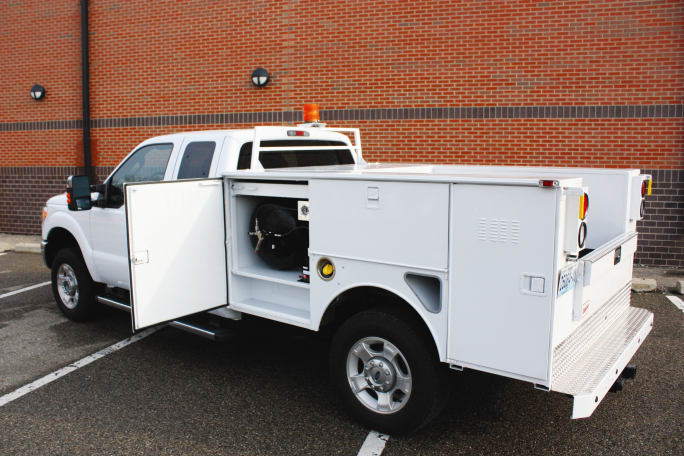
Steelweld builds a full "C" channel perimeter frame with full header and footer plates to join the side saddle boxes.
Photo: Steelweld
A best seller for Steelweld is a versatile, yet durable service body that fits a 96-inch cab-to-axle and has a full transverse compartment that can easily house CNG tanks for conversions, while not compromising storage space for work applications.
Steelweld is the only company to build a full "C" channel perimeter frame with full header and footer plates to join the side saddle boxes, according to the company. All bodies are assembled and then painted with DuPont's Imron paint system and carry a limited five-year warranty.
IMT Enhances Dominator Service Trucks
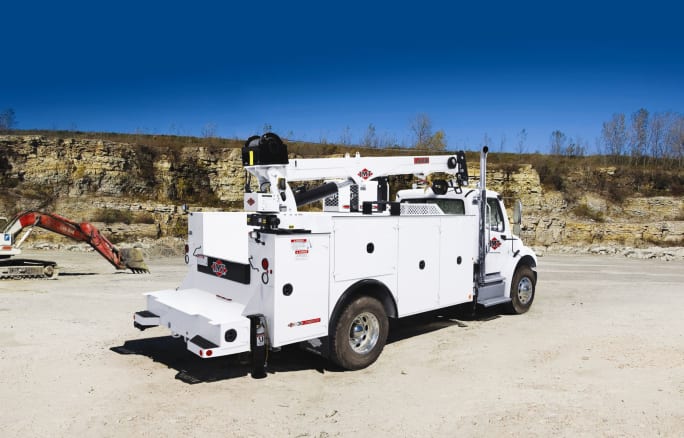
IMT has enhanced its existing lineup of Dominator service trucks.
Photo: IMT
IMT has enhanced its existing lineup of Dominator service trucks - and designed the new Dominator III body - to support the increased reach and capacity of new IMT telescopic cranes and to ensure that its mechanics truck-crane units would be stable, per the American Society of Mechanical Engineers (ASME) standards. The new telescopic cranes - the 7500, 8600, 9500, 10000, 12000, and 14000 - have model numbers corresponding to their maximum capacity in pounds and feature a patent-pending Penta Boom design.
They each offer up to 30 feet of reach and increased capacity over previous models. A new stabilizer is mounted at the right front of the body and extends out and down, providing greater stability than its predecessor. Operators now have the ability to perform lifts in the approved load area at full capacity of the crane load chart.
Topics:Adrian SteelVan UpfittingService BodiesRightsizingVocational FleetsAlternative FuelsVehicle ResearchOperations
Originally posted on Work Truck Online
Subscribe to Our Newsletter
More Vehicle Research
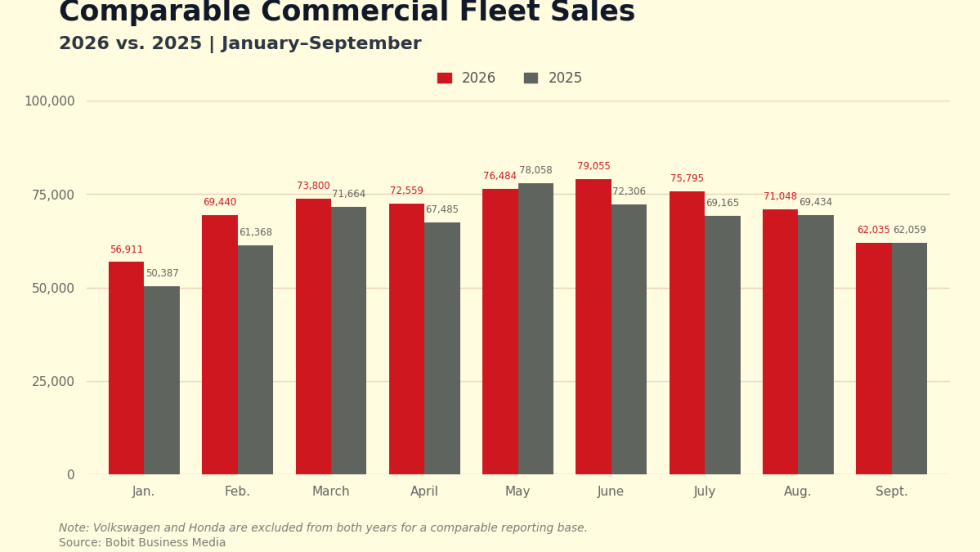
Commercial Fleet Sales Rise 5.8% Through September 2026
September commercial fleet sales were essentially unchanged from a year earlier, slowing year-to-date growth while keeping volume ahead of 2025.
Read More →
Hall of Fame Inductee: John Dmochowsky
The longtime Mondelēz International fleet executive joins the Automotive Fleet Hall of Fame.
Read More →
Hall of Fame Inductee: Lee Miller
After more than four decades at Boehringer Ingelheim, Lee Miller leaves a legacy built on fleet expertise.
Read More →
Hall of Fame Inductee: Mark F. Petersen
From managing fleets of thousands of vehicles to advancing safety and mentoring fellow professionals, Mark F. Petersen made his mark across both the corporate and supplier sides of fleet.
Read More →
When Charger Downtime Becomes a Fleet Availability Problem
As EV deployments move beyond pilot programs, charger reliability can directly affect vehicle readiness, driver productivity and route scheduling.
Read More →
2027 Nissan Rogue Hybrid Adds e-POWER, Standard AWD
The new Rogue Hybrid uses Nissan’s e-POWER system with dual electric motors, offers an estimated 40 mpg and starts at $35,490.
Read More →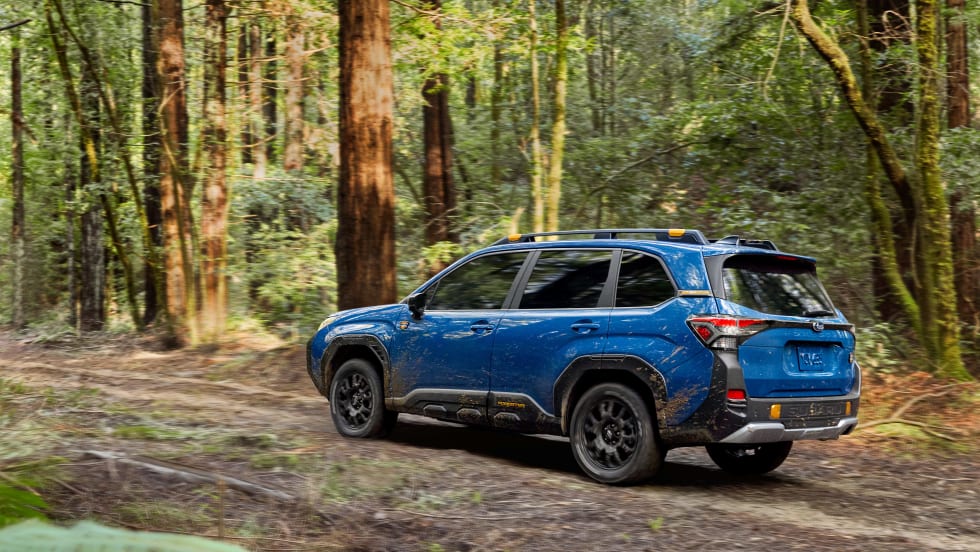
2027 Subaru Forester Adds First Wilderness Hybrid
The 2027 Forester lineup starts at $29,995 and adds a Wilderness Hybrid with 194 combined horsepower and 9.3 inches of ground clearance.
Read More →
EV Realty Names Henrik Holland President as Charging Platform Expands
The former Prologis Mobility and Shell executive will help expand EV Realty’s truck charging business and move its power-first infrastructure model into autonomous vehicle depots and other fleet sectors.
Read More →
Mercedes-Benz Introduces Electric GLC With Up to 350 Miles of Range
The GLC 400 4MATIC Electric features an 800-volt architecture, 330-kW DC fast charging and a 94-kWh battery, along with Mercedes-Benz's new MB.OS operating system.
Read More →
Fleet Has a Talent Pipeline Problem, not a Talent Problem
Where will the next generation of fleet leaders come from, and what does the industry need to do differently to find them?
Read More →