




Indigo Introduces an EV Built for the Gig Economy
How do you produce an electric commercial vehicle for $20,000? Make it lightweight and use patented robotic wheels to deliver a smooth ride. Then create a fintech ecosystem to lower delivery drivers’ cost per mile.

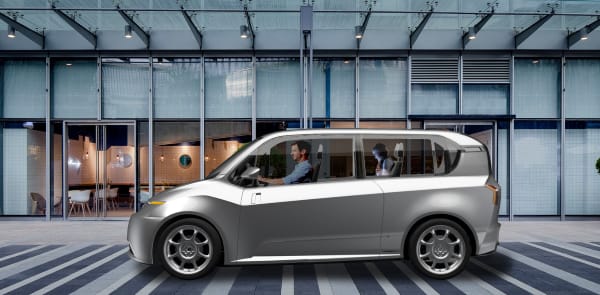
The purpose-built Indigo EVs will come in two variants initially, a four-wheel microvan (pictured) and a three-wheel delivery vehicle. Both are designed with a center driver seat, a removable rear bench seat, and two sliding doors for ingress and egress from either side.
Image courtesy of Indigo Technologies.
Weight is one of the biggest killers of electric-vehicle range. The average sticker price for an EV in the U.S. is over $50,000 and the average weight is 4,000 lbs. — a ratio that necessitates 95% of the electricity for most trips to be used to transport the car’s own mass.
EVs that have a better mass-to-payload ratio would allow for a smaller battery size, a more reasonable initial cost, and better cost-per-mile and CO2-per-mile performance. And yet, lighter EVs sacrifice handling, comfort, and a smooth ride. No delivery driver wants to feel every bump of a city street.
With this conundrum — and challenge — in mind, Indigo Technologies, an upstart electric OEM born at MIT, went about developing an EV for package, food, and people delivery that is lightweight yet offers the ride comfort of a traditional ICE delivery vehicle.
Indigo says it will get there in part with its patented “robotic wheel” intended to deliver the ride comfort and handling previously not achievable with conventional motor and suspension systems.
While new EV models are on the way with hub motors built into the wheels, Indigo takes the technology further by integrating a direct-drive, dual-stator electric motor with electric active suspension. Indigo’s robotic IndiWheel features adaptive, simultaneous control of horizontal propulsion and vertical suspension in steerable MacPherson strut or double wishbone configurations. The system mounts to standard wheels and 18-inch tire sizes.
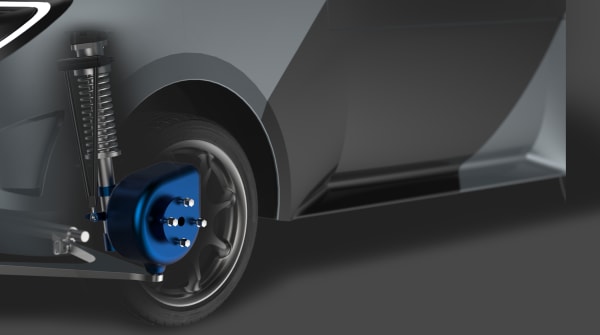
Image courtesy of Indigo Technologies.
The purpose-built Indigo EVs will come in two variants initially, a four-wheel microvan (Project Bravo) and a three-wheel delivery pod (Project Alpha). Both are designed with a center driver seat, a removable rear bench seat, and two sliding doors for ingress and egress from either side. Top speed is 80 mph.
The delivery pod vehicle will have 58.3 cu. ft. of cargo space. (For comparison, the Chevy Bolt EV with the seat-delete package has a maximum cargo volume of 66 cu. ft.) The larger Project Bravo will offer 106 cu. ft. of space, which falls in the volume range a Ford Transit Connect.
Indigo’s CEO Will Graylin sees a specific sweet spot with gig economy drivers such as those in Amazon’s Flex program who use their own vehicles. “What those drivers make on a per-hour and per mile driven basis are really important, and we designed our vehicles around that,” he says.
The delivery pod is designed to be more narrow than traditional vehicles for parking purposes, with side-mounted lights to find addresses at night and an LED display to alert delivery recipients.
With curb weights of 1,210 lbs. for Alpha and 1,650 lbs., and low GVWR (1,800 lbs. and 2,450 lbs.) the Indigo EVs can use smaller and cheaper 20 kWh or 30kWh battery packs. That means they can still offer ranges of 150 miles to over 200 miles and charge in between Amazon Flex’s three-hour shifts on Level 2 chargers.
The delivery pod accommodates the standard 50 cu.-ft. Amazon Flex container that drivers pick up at Amazon’s delivery centers. A rough estimation of payload capacity puts Project Alpha at 590 lbs. and Project Bravo at 800 lbs. These specs don’t lead the pack for conventional vans, but they don’t have to for many gig economy applications. Amazon’s Flex containers usually hold only about 200 lbs., Graylin says.

Image courtesy of Indigo Technologies.
Reducing Cost Per Mile
Because the battery is still the biggest single cost in an EV, their small size will also allow for a low starting price for a commercial vehicle: Indigo is targeting Project Alpha’s MSRP at $19,500, and Project Bravo at $23,500.
These prices are aimed at the pocketbooks of gig economy drivers and address the other conundrum in the EV ecosystem today — how to affordably put the right drivers behind the wheel. “Our competition isn’t other commercial delivery vehicles, it’s the used gas guzzlers they’re currently driving to make a living,” Graylin says.
The overall goal is to reduce the cost per mile for gig economy drivers to a point that allows them to make a reasonable margin doing their jobs. Graylin says that many drivers don’t pay enough attention to managing their vehicle costs such as depreciation, insurance, or maintenance. “Only the very experienced gig economy drivers have figured out how to do it,” he says. “The rest of them are losing money.”
In this regard, Indigo is combining with Graylin’s other company, fintech insurer OV Loop, to create a vehicle rental program. At the core of the program is an initiative that uses telematics, insurance, credit, and identification data to create a “universal digital wallet” and a portable driving score. Good drivers that opt in would get cheaper insurance, a key factor into putting a driver into an Indigo vehicle for less than 50 cents a mile with no down payment.
Indigo said it will scale production with contract manufacturing partners and will announce some of those partnerships in the coming weeks. An Alpha prototype is scheduled for production later this year, with models on the road targeted for late 2022.
On paper, Indigo’s plan to exploit a market segment with electrification would hold up in an episode of Shark Tank. Yet the realities of getting vehicles into production and road ready is at another level entirely. Graylin understands this fully.
When it comes to growing the electrification ecosystem, “It can’t just be about the vehicle,” Graylin says, adding that it takes manufacturing the right type of vehicle for the right situation and then offering targeted components such as insurance. “That’s what we’re doing, that’s our one-two punch.”
More Fleet Forward

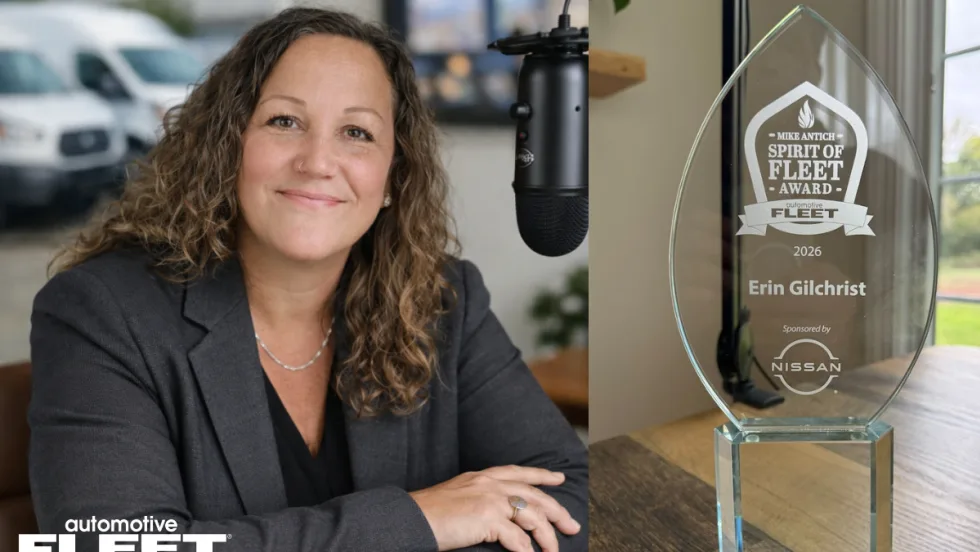
Erin Gilchrist Receives Mike Antich Spirit of Fleet Award
Last week at AFLA in Vegas, Erin Gilchrist received the inaugural, brand-new Spirit of Fleet Award.
Read More →
Dominika Leja Named the 2026 Fleet Manager of the Year
The AstraZeneca associate director of fleet was recognized for her leadership in fleet electrification, cost savings, and operational transformation.
Read More →
Jamie McKay Named the 2026 Fleet Visionary Award Winner
The Aptive Pest Control fleet manager was recognized for her approach to operations, data, lifecycle management, and driver needs.
Read More →
Fleet Forward Conference Introduces One-Day Passes for 2026
New one-day registration gives fleet professionals the flexibility to attend Tuesday, Wednesday, or Thursday, with passes available for $199 through Sept. 18.
Read More →
Vibe Coding: When Fleet Managers Become Software Builders
Five fleet professionals — none with programming skills — discuss how they’re using AI to build fleet solutions in-house and in a fraction of the time.
Read More →
Fleet Forward Conference Tackles Fleet Industry’s Growing Leadership Gap
This session will examine succession planning, knowledge transfer, and the skills the next generation of fleet leaders will need as veteran professionals leave the industry.
Read More →
2026 Fleet Manager of the Year Finalists Announced
Who are the 2026 Fleet Manager of the Year finalists?
Read More →
John Rossant to Deliver Opening Keynote at 2026 Fleet Forward Conference
The CoMotion founder will draw on developments across Europe, China, the Middle East, and other international markets to identify trends that could influence how U.S. fleets plan for the coming decade.
Read More →
How to Build Custom Fleet Tools With AI and Vibe Coding [Webinar]
A new Automotive Fleet webinar explores how fleet managers are using AI and vibe coding to automate routine work and create simple operational tools without traditional programming skills.
Read More →