




Related: Infotainment Systems Further Distract Drivers, Study Finds
In-Vehicle Entertainment Proliferates for Fleet Drivers
Commercial fleets, including those in the pharmaceutical industry, use an array of tools and perks, such as in-vehicle infotainment that can keep drivers entertained from Point A to Point B, to increase driver retention, as long as the drivers avoid distraction.

Paul Clinton・Former Senior Web Editor
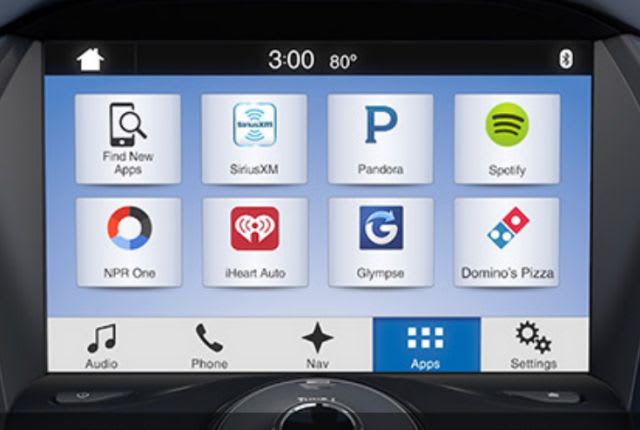
Screenshot of AppLink courtesy of Ford.
4 min to read
Screenshot of AppLink courtesy of Ford.
While driver retention has become a more pressing topic in the trucking industry, where carriers have bemoaned a shortage of qualified drivers, managers of light-duty fleets also focus on keeping trouble-free drivers behind the wheel.
Commercial fleets, including those in the pharmaceutical industry, use an array of tools and perks, such as in-vehicle infotainment that can keep drivers entertained from Point A to Point B, to increase driver retention, as long as the drivers avoid distraction.
And with the broad roll-out of smartphone project systems such as Apple CarPlay and Android Auto, more entertainment options are arriving with vehicles as standard equipment.
Fleet management companies have also stepped into the fray by forming partnerships with content providers such as SiriusXM and offering entertainment options to corporate drivers as a reward for a safe driving record.
Most automakers — with the notable exception of Toyota — have begun offering Apple CarPlay and Android Auto as standard equipment in new vehicles. These smartphone projection systems provide an interface that's reminiscent of a phone interface and support multitasking. For example, they allow a driver to listen to an internet radio stream, while using voice-prompted navigation.
Infotainment options abound now, as automakers are working to integrate their own systems with these smartphone overlays.
Apply CarPlay and Android Auto may hope to supplant infotainment systems offered by automotive manufacturers, but automakers now provide robust voice-controlled systems that incorporate an array of app-based entertainment options, improved navigation, and connection points with Wi-Fi and Bluetooth technology.
Fiat-Chrysler Automobiles is considered a pioneer in this realm. The company introduced its MyGig radio with the 2007 model year that was one of the first to employ a color display. The system was later relaunched as Uconnect, which is now in its fourth generation and paired with an 8.4-inch color touchscreen.
Ford introduced its Sync system with the 2008 model year. The system is now in its third iteration as Sync 3, and can be paired with a 6.5- or 8-inch color touchscreen. Sync 3 added AppLink, which allows users to choose from 16 mobile apps that stream content from SiriusXM, Pandora, iHeart Auto, and Slacker Radio.
General Motors began offering its Chevrolet MyLink with the 2012 model year. The system is branded as Intellilink in GMC and Buick vehicles. It includes HD Radio in select vehicles and, in its latest iteration, entertainment-related mobile apps that can be downloaded from the Shop app in the vehicle such as Pandora, iHeartRadio, and Audiobooks.com.
More than 75% of new vehicles now arrive with SiriusXM from the factory. There are more than 100 million vehicles on the road that now include the satellite radio service. By 2025, that number is expected to grow to 185 million, said Tricia Skapyak, SiriusXM’s director of automotive fleet and commercial partnerships.
"Drivers love the variety of programming we offer and so we are in very high demand," Skapyak said. "The companies we work with tell us that SiriusXM is one of the top three most desired features for their drivers, in both trucks and cars."
SiriusXM has formed partnerships with ARI and Element Fleet Management to provide the service to fleet drivers. Corporations who use these fleet management companies have begun offering it to reward good drivers.
Element offers the service as a corporate pay program, while ARI offers it as a driver-paid program. In April of 2016, SiriusXM first offered fleet pricing under a program announced at the NAFA Institute & Expo.
A spokesman from Pandora said the company is focusing more on OEM partnerships, rather than fleet service providers. Audiobooks.com, which maintains a library of more than 100,000 titles, has seen a spike in interest from commercial drivers.
"Audiobooks are an entertaining, enjoyable and even educational listening option for drivers — especially those who drive for a living," said Ian Small, general manager of Audiobooks.com. "Whether it is truck drivers transporting goods cross-country or cab drivers spending many local hours in their vehicles, the opportunity to listen to audiobooks can result in happier employees, and higher retention."
The proliferation of in-vehicle entertainment has raised some concerns among driver training firms such as Driving Dynamics. Art Liggio, the company's president and CEO, questioned whether entertainment options should be minimized.
Liggio cited a study conducted earlier this year by the University of Utah on behalf of the AAA Safety Foundation regarding infotainment options in vehicles.
"In the study, drivers testing all 30 of the 2017 model-year cars and light trucks took their eyes off the road and hands off the wheel ― for dangerously long periods of time while using these systems," Liggio said. "Your drivers will be safer and can spend their ride time looking out for those other drivers who are fiddling with infotainment technologies instead of focusing on their driving responsibilities."
Because infotainment choices are increasingly becoming standard equipment, fleet managers will soon no longer have the option to keep them out of the car.
"It really then becomes a matter of safety culture," Liggio said. "Whatever guardrails are put in place should be clearly communicated and outlined in the company’s safety policy so expectations are properly set across the organization."
Subscribe to Our Newsletter
More Safety
IIHS Crash Avoidance Tests Reveal Safety Gaps in Cargo Vans and Work Trucks
New crash-avoidance ratings from the Insurance Institute for Highway Safety reveal inconsistent performance among commercial vehicles, with several popular cargo vans and heavy-duty pickups struggling to avoid collisions with other vehicles and pedestrians.
Read More →
What’s Next for Fleet? Safety, AI & Industry Recognition | AF News Recap
Could your company's culture be encouraging distracted driving? This week, we're exploring how workplace expectations affect driver safety, what AI, EVs, and autonomous vehicles could mean for the future of fleet management, and how fleet professionals can strengthen their award nominations.
Read More →
Does Your Fleet's Culture Encourage Distracted Driving?
What happens when the people responsible for enforcing safety rules are the ones setting the wrong example? The answer may reveal why some of the biggest risks to fleet drivers have little to do with what's written in the employee handbook.
Read More →
Sponsored•October 1, 2026
Fleet Manager’s Ultimate Playbook: Navigating the New Standard in OEM Connectivity
Rising operating costs, driver safety concerns, and unplanned downtime are putting unprecedented pressure on modern fleets. Discover how fleet managers use embedded OEM connectivity and real-time vehicle data to cut TCO, prevent downtime, and protect drivers without aftermarket telematics hardware.
Read More →
From Driver Well-Being to EV Charging | AF News Recap
Mental health belongs in the fleet safety conversation. This week, we’re looking at five ways fleets can support employee well-being before a crisis, plus Holman’s expansion in Mexico, new one-day Fleet Forward passes, and why EV charging demand is outpacing infrastructure growth.
Read More →
Nexar-Nauto Merger Aims to Give Fleets Better Safety Intelligence Through Larger Driving Dataset
Stefan Heck tells Automotive Fleet that combining more than 10 billion miles of driving history with Nexar's AI models will give fleets deeper insights into driver risk and roadway conditions than either company could provide independently.
Read More →
Don't Wait for a Crisis: 5 Ways to Build Mental Health Into Your Fleet Safety Program
For Suicide Prevention Month, fleet and safety leaders have an opportunity to put mental health where it belongs: at the center of workplace safety.
Read More →
How Camera Data Can Strengthen a Fleet’s Insurance Renewal
Insights from a commercial insurance carrier and a broker show how fleets can turn video telematic data, driver coaching, and improved claims results into a stronger case at insurance renewal.
Read More →
The Safest Fleets Aren’t the Ones with the Most Technology
You’ve made the telematics investment. Here’s how to capture the other half of its value and build the safest fleet on the road.
Read More →
Sponsored•August 7, 2026
Hidden in Plain Sight: Fleet Compliance Risks
Fleet compliance isn't just about having policies — it's about consistently enforcing them. This practical guide reveals six hidden compliance risks common in public sector and shared fleet operations and outlines proven strategies to improve visibility, accountability, and audit readiness
Read More →