





Keep Going! Top 10 TCO: Compact Crossovers
How Maintenance Costs Affect Fleet Replacement
A scenario analysis of maintenance-only forecasts shows how mileage-based events can drive TCO volatility.
September 7, 2025

Vincentric’s forecast shows pickups face sharp maintenance spikes, while crossovers track more steadily, giving fleets clearer guidance on when to de-fleet.
Image: Automotive Fleet
4 min to read
When it comes to total cost of ownership (TCO), depreciation is always the largest expense. However, after two years, maintenance and repair costs quickly become the largest variable and the most difficult to predict.
To simplify the conversation, the lifecycle cost experts at Vincentric prepared a forecast isolating only maintenance and repair expenses for four common fleet vehicles: the Chevrolet Silverado 1500 WT, Ram 1500 Tradesman, Ford Escape Active 1.5L, and Toyota RAV4 LE.
The analysis tracked each vehicle across four horizons — 6, 12, 18, and 24 months — under different duty cycles.
It’s important to note that these horizons don’t start from zero. Each vehicle already has two model years in service and accumulated mileage. The analysis projects forward from these real-world starting points, not from new.
To illustrate this dynamic, Vincentric modeled a likely fleet scenario: An operator holds a set of 2023 vehicles — Chevrolet Silverado 1500 WT, Ram 1500 Tradesman, Ford Escape Active 1.5L, and Toyota RAV4 LE — each with different starting mileages and duty cycles. The operator then projects costs over the next six, 12, 18, and 24 months to decide when to sell each unit in order to optimize TCO.
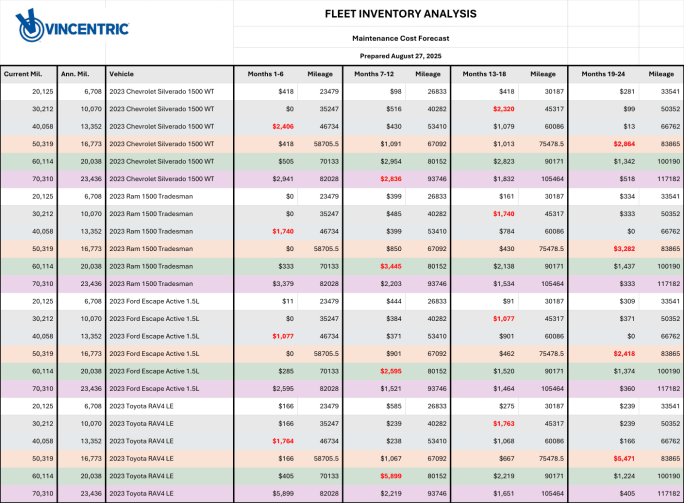
This chart illustrates that maintenance costs do not accumulate in a linear manner based on a vehicle’s mileage. Instead, they rise in unpredictable waves tied to mileage-based service events.
Photo: Vincentric
This exercise isolates maintenance and repair costs, excluding depreciation, fuel, insurance, and resale value. While maintenance alone wouldn’t be the final word on when to de-fleet, the analysis shows how costs rise not in a straight line, but in waves tied to mileage-based service events.
Trucks Show Cost Volatility
It wasn’t surprising to see that Silverado 5 (70,310 miles) and Ram 5 (70,310 miles) — which have the highest-mileage duty cycles — recorded the largest maintenance totals.
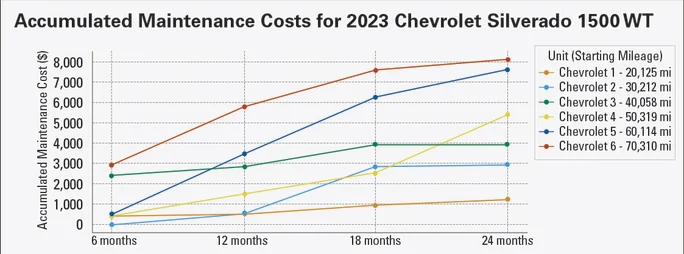
Silverado units show the most volatility. Silverado 3 (40,058 mi) hits a brake replacement at 45K, while Silverado 4 (50,319 mi) surges at 24 months (+$2,864). Higher-mileage units, such as the Silverado 5 (60,114 mi) and Silverado 6 (70,310 mi), face steep jumps as early as 12 months.
Photo: Vincentric
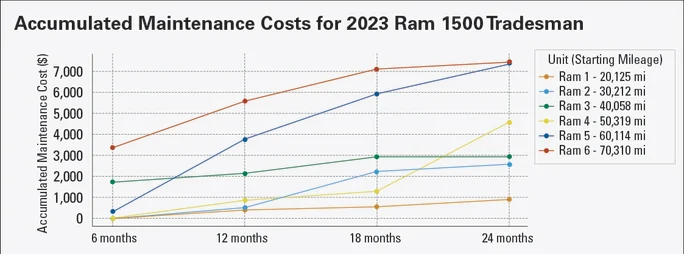
Ram units follow a similar mileage pattern. Ram 4 (50,319 mi) posts the single largest increase across all vehicles at 24 months (+$3,282), while Ram 5 (60,114 mi) climbs sharply at 12 months (+$3,445). Lower-mileage units rise more gradually.
Photo: Vincentric
But a closer look at Silverado 3 (40,058 miles) revealed something unexpected. Although the Silverado 3 had lower mileage than the Silverado 4 or Ram 4, it incurred one of the highest maintenance costs at both 12 and 18 months.
The likely reason is that mileage growth from 40,058 to 53,410 miles over the next year puts Silverado 3 squarely into a brake replacement at 45,000 miles. This one event caused a disproportionate bump in projected costs, after which the expense forecast dipped again at 24 months.
Crossovers Track More Predictably
The Ford Escape and Toyota RAV4 followed smoother, steadier curves. Their maintenance costs rose incrementally, without the same volatility as pickups.
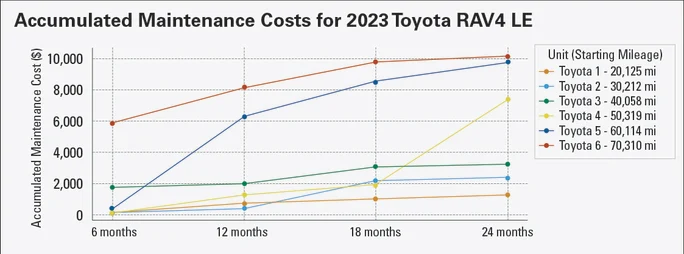
RAV4 units maintain a higher maintenance baseline than Escapes, but without the severe spikes seen in pickups. Costs climb steadily across horizons, with RAV4 2 (30,212 mi) and RAV4 4 (50,319 mi) recording the highest totals by 24 months.
Photo: Vincentric
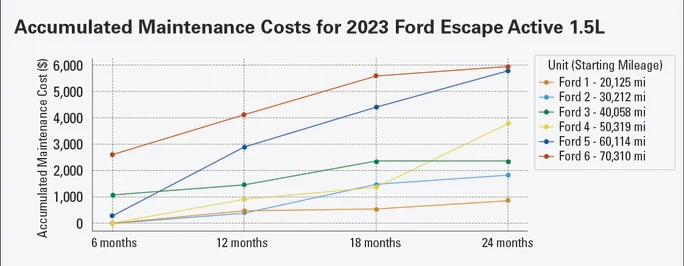
Escape units track more predictably, with lower overall maintenance outlays. The main anomaly is Escape 2 (30,212 mi), which posts an unexpected bump at 18 months (+$1,077). Other units remain relatively stable.
Photo: Vincentric
That said, the RAV4, in particular, showed a consistently higher baseline than the Escape, suggesting higher average maintenance costs in its first two years. Both models still experienced fluctuations, but they avoided the sharp spikes associated with single service events that characterized the Silverado and Ram.
When to Sell: Reading the Curve
This maintenance-only forecast gives some guidance on remarketing windows, even if it isn’t the full TCO picture. The data suggests that spikes are tied less to vehicle age and more to when mileage-based events hit.
Silverado 3 (40,058 miles): This unit runs directly into a brake replacement at 45,000 miles, causing its 12–18 month forecast to jump disproportionately. The operator holding this truck could look to sell before 12 months, exiting just ahead of the brake job.
Silverado 5 and Ram 5 (70,310 miles each): Already high-mileage units, they recorded the largest total expenses. These vehicles are further along in their lifecycle and projecting them forward even 12 months suggests diminishing returns.
Here, a near-term exit within six months would help avoid piling on expensive events at higher odometer levels.
Escape and RAV4 (mid-mileage units): Both crossovers tracked more predictably, with the RAV4 maintaining a higher baseline. For these vehicles, holding to 18–24 months still makes sense, provided resale markets are stable, since there’s no major single service event lurking in that window.
In short, the data suggests that when to sell depends on where the vehicle sits relative to its next major service trigger. For pickups, those events arrive sooner and hit harder, requiring tighter cycles. For crossovers, operators can often hold longer, up to two years, before volatility ramps.
Four Lessons
Mileage matters as much as age: Replacement should be tied to both calendar time and service-event thresholds. Silverado 3 proves the point.
Costs come in waves: Maintenance forecasts don’t climb in a straight line, but spike with major service events and dip afterward.
Pickups require tighter cycles: Brake events, heavy payloads, and higher duty cycles make them riskier to hold compared to crossovers.
18–24 months is the safe zone: For most fleet scenarios, this remains the optimal de-fleet point, balancing strong resale value with controlled maintenance exposure.
What This Scenario Tells Fleets
Vincentric’s maintenance-only analysis replicates how an operator might project costs across vehicles at different duty cycles.
While it doesn’t capture every lifecycle factor, it illustrates how anomalies like Silverado 3’s brake replacement at 45,000 miles or the consistently higher RAV4 baseline can shift the calculus on when to de-fleet.
For most fleets, the guidance from this data is:
Pickups with higher mileage (Silverado 5, Ram 5): Exit within the next six months.
Pickups approaching a big service event (Silverado 3): Sell just before that event.
Crossovers (Escape, RAV4): Holding 18–24 months remains reasonable.
Operators that extend to 36 months may still find value if resale markets are favorable and major service events can be delayed; however, the risk of encountering another cost wave increases.
Subscribe to Our Newsletter
More Maintenance

Sponsored•October 1, 2026
Fleet Manager’s Ultimate Playbook: Navigating the New Standard in OEM Connectivity
Rising operating costs, driver safety concerns, and unplanned downtime are putting unprecedented pressure on modern fleets. Discover how fleet managers use embedded OEM connectivity and real-time vehicle data to cut TCO, prevent downtime, and protect drivers without aftermarket telematics hardware.
Read More →
How Can Fleet Managers Tell Which Repairs Require Closer Review?
Fleetio’s Brianna Perry demonstrates how Service Advisor evaluates maintenance requests, identifies pricing anomalies, and provides the context fleet managers need to focus their attention on potential problems.
Read More →
Why Roadside Assistance Belongs in a Fleet Risk Strategy
Roadside assistance is more than a tow. See how the right partner can protect drivers, uncover fleet trends, and strengthen your risk strategy.
Read More →
Sponsored•August 7, 2026
Hidden in Plain Sight: Fleet Compliance Risks
Fleet compliance isn't just about having policies — it's about consistently enforcing them. This practical guide reveals six hidden compliance risks common in public sector and shared fleet operations and outlines proven strategies to improve visibility, accountability, and audit readiness
Read More →
How Maintenance Costs Compare Across 27 Fleet Vehicles
Vincentric’s three-year, 60,000-mile projections reveal wide differences for both scheduled and unscheduled maintenance among selected vehicle categories. Projected maintenance visits also play a factor.
Read More →
The EV Breakdown Nobody's Talking About: Why Most Electric Vehicle Roadside Calls Aren't Mechanical Failures
Here's why EV breakdowns are widely misunderstood.
Read More →
How Stellantis Plans to Get Ahead of Fleet Downtime
Keeping fleet vehicles on the road has become as important as buying them. Darren Bradshaw of Mopar North America explains how connected vehicle data, AI, and proactive service strategies are helping Stellantis reduce downtime and move closer to predictive maintenance.
Read More →
Merchants Fleet Expands Maintenance Network with Pep Boys
Merchants Fleet has expanded its relationship with Pep Boys, increasing the service provider's role within its national maintenance network. The move is intended to enhance maintenance coordination and support commercial fleets through Pep Boys' nationwide footprint.
Read More →
The Two Biggest Summer Downtime Threats for Fleets
A conversation with a maintenance expert reveals the two most common summer maintenance pains and how to prevent them.
Read More →
From Marine Corps Motor Pool to Managing 460 Fleet Vehicles
Cesar Ayala of O’Connell Landscape Maintenance shares how he transitioned from the Marine Corps to managing a 460-vehicle fleet—and the real-world challenges of maintenance, compliance, and driver management in California.
Read More →