





Related: Hot Takes: Developing the Ecosystem for Electric Commercial Vehicles
Hot Takes: Understanding CARB’s Commercial EV Moonshot
CARB’s new targets may be unrealistic, but will they propel the electrification market? Also: Tesla releases Autopilot crash data; autonomous start up attacks the middle mile.
May 12, 2020
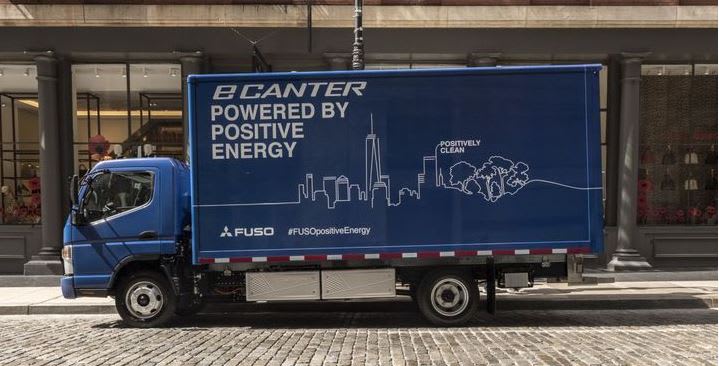
Mitsubishi was one of the first OEMs to release an all-electric commercial vehicle, yet there are only a few hundred Fuso eCanters on the road today. Will there be enough product like eCanter at a reasonable price point in four years to satisfy CARB's new rules?
Photo courtesy of Mitsubishi.
5 min to read
How do you make sense of it all? Hot Takes is our ongoing analysis of recent mobility news from a fleet perspective.
Admittedly, our minds are elsewhere. Who has time to worry about the future as it relates to fleets, particularly with way too much on our plates right now?
The California Air Resources Board (CARB) must have a pretty thick skin. Upon each update for more stringent rules to protect the environment, commenters on our channels reserve the most colorful rhetoric for the organization.
Last week, CARB released increased sales targets in California for zero-emission vehicles (ZEVs) in the medium-and heavy-duty truck sector. The conversation, of course, is whether these sales targets are realistic.
When CARB engineered the last EV sales targets for California, it necessitated manufacturers engineering an EV model for limited sales. It was wildly unprofitable — but did it push electrification technology forward? It most likely did, but to what extent we’ll probably never know.
Let’s remember that rule was for passenger cars. Electrifying the commercial vehicle market is a new ballgame. CVs have much smaller overall sales to begin with, not to mention exponentially increased challenges when it comes to payload and getting the massive amount of juice needed into the vehicles.
Like the last EV rule, fleets are not forced to buy these vehicles, the onus is on the manufacturers to sell them. But when CARB says there “are more than 70 models of zero-emission vans, trucks and buses commercially available from manufacturers,” that’s disingenuous to the realities of the market today.
That said: The market for electric CVs has moved from theoretical to product stage in three short years. Kennedy asked us for a moonshot, “because it was hard.” Looking at the clear skies over Los Angeles during the coronavirus, this becomes a challenge “we are unwilling to postpone.”
I think we’ll fall short of CARB’s sales targets that start to kick in by 2024, but we’ll be further along in electrification than we would’ve been without the rule.
In news on the autonomy front: Tesla released internal data on how its Autopilot and active safety technologies performed by quarter compared to the national average of automobile crashes.
For the uninitiated, the basic data sets seem eye-popping: In the first quarter of 2020, Tesla vehicles in the U.S. registered one crash for every 4.68 million miles driven in which drivers had Autopilot engaged. This compares to NHTSA’s data during that timeframe showing one automobile crash from 479,000 miles to 492,000 miles.
Let’s be clear, this is Tesla’s data and it’s not quite an apples-to-apples comparison to overall crashes. Autopilot has traditionally been only engaged on the highway, although with successive software updates, users are reporting more miles with Autopilot on city streets. (Insert Kevin from Home Alone face here.)
No one, including Tesla, is stating “It’s safer to use Autopilot than driving manually.” But we can interpret that the lowering of crash data from when Tesla released its first report in 2018 is a trend in the right direction.
One major barrier to autonomous vehicle adoption is solving for “edge cases” in which autonomous software must compute how to negotiate the myriad of issues with manually driven vehicles in city streets and busy parking lots.
Autonomous delivery startup Gatik is addressing a need that avoids these challenges — the middle mile. Gatik is starting a pilot that runs autonomous box trucks from warehouse to warehouse or warehouse to store. These fixed, predetermined routes reduce edge cases and have a clearer path to implementation.
Though the past year might’ve been the trough of “autonomy fatigue,” only exacerbated by the coronavirus pandemic. Not surprisingly, Ford has delayed its autonomous vehicle service launch from 2021 to 2022.
However, we’re starting to see realistic applications and actual business models evolve. Check out this analysis of how Udelv is working with fleets today to make autonomous deliveries. (Yes, you can lease an autonomous van!)
The recovery from the coronavirus pandemic has also affected the electrification market.
Lordstown Motors bought that GM plant in Ohio to make electric pickups for fleets, remember? The company is pushing back production start date from December of this year to January 2021. As this is only a pushback of one month, Lordstown wins the prize as the shortest delay due to the pandemic.
Still, understanding the years of delays when it comes electric vehicle production announcements, the start of production may best be seen as ceremonial. We shall see.
Circling back on commercial electric vehicles: The EV market lately has had a lot of activity in electrified chassis and platforms.
This month, Karma Automotive announced its E-Flex utility van platform, which can take a variety of configurations to serve commercial delivery fleet vehicles, shuttle buses, tradesman service vehicles, and camper vans.
Bollinger Motors (which laid the gauntlet for bad-ass electric truck at the LA Auto Show — take that, Tesla Cybertruck) recently announced “the world’s first and only Class 3 all-electric chassis-cab truck platform.”
At the Work Truck Show in March, Motiv Power Systems unveiled its new F-59 electric chassis, which will serve urban fleet deliveries, and school and shuttle buses.
While we wait for the major OEMs to launch fully electric commercial vehicles from the factory, these platforms will take traditional commercial bodies sooner. And hey California fleets — take advantage of the grants offered through CARB!
Finally, though the activity came from the last newsletter, it’s worthy to bring up what’s happening with drones. What the City of Westport, Conn. had planned to do, but decided against it, was launch drones to monitor citizens for spread of coronavirus.
Equipped with computer vision and sensors, the drones can actually detect infectious humans 190 feet in the sky. Big Brother, it took you 36 years, but you’ve definitely arrived.
Overall, we can’t sleep on drone technology. While we wait for autonomy and electrification, drones can perform many tasks at cheaper price points than incumbent processes. The coronavirus pandemic is proving this out.
Subscribe to Our Newsletter
More Fleet Forward

Erin Gilchrist Receives Mike Antich Spirit of Fleet Award
Last week at AFLA in Vegas, Erin Gilchrist received the inaugural, brand-new Spirit of Fleet Award.
Read More →
Dominika Leja Named the 2026 Fleet Manager of the Year
The AstraZeneca associate director of fleet was recognized for her leadership in fleet electrification, cost savings, and operational transformation.
Read More →
Jamie McKay Named the 2026 Fleet Visionary Award Winner
The Aptive Pest Control fleet manager was recognized for her approach to operations, data, lifecycle management, and driver needs.
Read More →
Fleet Forward Conference Introduces One-Day Passes for 2026
New one-day registration gives fleet professionals the flexibility to attend Tuesday, Wednesday, or Thursday, with passes available for $199 through Sept. 18.
Read More →
Vibe Coding: When Fleet Managers Become Software Builders
Five fleet professionals — none with programming skills — discuss how they’re using AI to build fleet solutions in-house and in a fraction of the time.
Read More →
Fleet Forward Conference Tackles Fleet Industry’s Growing Leadership Gap
This session will examine succession planning, knowledge transfer, and the skills the next generation of fleet leaders will need as veteran professionals leave the industry.
Read More →
2026 Fleet Manager of the Year Finalists Announced
Who are the 2026 Fleet Manager of the Year finalists?
Read More →
John Rossant to Deliver Opening Keynote at 2026 Fleet Forward Conference
The CoMotion founder will draw on developments across Europe, China, the Middle East, and other international markets to identify trends that could influence how U.S. fleets plan for the coming decade.
Read More →
How to Build Custom Fleet Tools With AI and Vibe Coding [Webinar]
A new Automotive Fleet webinar explores how fleet managers are using AI and vibe coding to automate routine work and create simple operational tools without traditional programming skills.
Read More →