





Watch: Catalytic Converter Thefts are Turning Violent and Deadly
Growing Fleet Danger Zone: Catalytic Converter Thefts
Drawn to the precious metals contained in catalytic converters, criminals are increasingly targeting corporate vehicles for quick and easy cash, posing a deadly threat to fleet drivers.
November 15, 2022
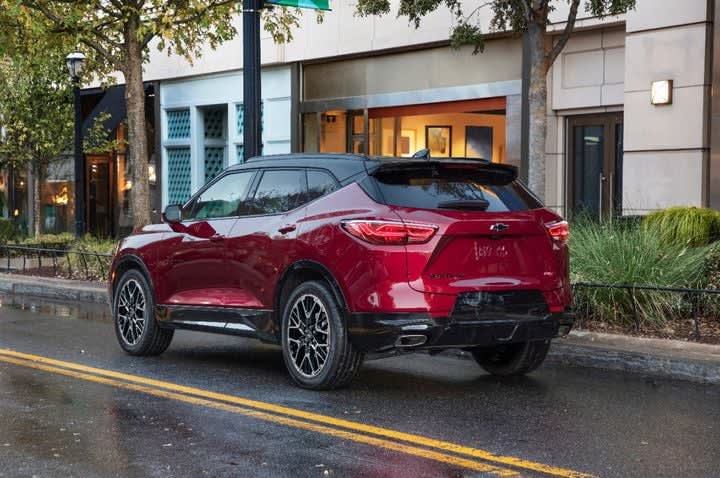
High clearance vehicles are easy targets for catalytic converter thieves. SUV clearances range from 4 inches to 16 inches. The Chevy Blazer here measures 7.4 inches in ground clearance.
Photo: Chevrolet
7 min to read
Thefts of catalytic converters, with their treasure troves of gold and other precious metals, have risen to unprecedented levels – recording an astounding and troubling 325% increase in 2021 over 2020.
And the stakes are getting higher for fleets, clearly threatening driver safety, dramatically rising maintenance costs and immediately putting a vehicle out of service.
Employee Protection Paramount
Protecting your employee drivers whose company vehicles may be the target of catalytic converter thieves is paramount as more and more, catalytic converter thefts are turning violent and deadly.
On at least three occasions the vehicle owners were killed – murdered -- while the crime was in progress. During this past October, a man was shot and killed at the scene of a catalytic converter theft in Oakland, California.
And he wasn’t the first person murdered by thieves looking to steal a catalytic converter.
Earlier this year, on March 31 in Houston, Texas, an off-duty police officer and his wife returned to their car after shopping. They encountered three men in the process of stealing the vehicle’s catalytic converter. Gunfire erupted, and the police officer was hit and later died in a hospital.
On December 1, 2021, in Dallas, a man standing on a third-floor balcony of his condominium was shot and killed after he yelled at people below who were attempting to steal his car’s catalytic converter.
Dangerous Trend Escalates
It's a miracle more people have not been killed, because plenty of innocent people have been shot during the commission of a catalytic converter theft.
Here’s a rundown of people who were shot attempting to stop thieves from stealing catalytic converters in just one week in October this year:
In Hollywood, California, two people trying to steal the catalytic converter were confronted by the vehicle’s owner. The startled thieves jumped into their car and drove off but returned a few minutes later and shot up the car owner’s home.
A man was shot in Henrico, Virginia, after confronting someone attempting to steal the catalytic converter from his car.
A homeowner in Castro Valley, California, was shot when he confronted four people trying to steal the catalytic converter from his vehicle.
A simple Google search of people shot by catalytic converter thieves in just calendar-year 2022, reveals 38 victims, which most likely is an underestimation.
These victims all survived, but they could have easily been killed if they bullet struck another part of their body.
The YouTube platform contains videos showing victims encountering these criminals who, when confronted, pull a gun on the vehicle owner and start shooting – in one case, actually chasing the owners while firing their gun at them.
This is insane. Catalytic converter thefts have gotten dangerously out of control. Your drivers need to be cautioned to avoid confronting these criminals.
Educate Drives on Safe Practices
The most important aspect of your job as fleet manager is to help keep your drivers safe while driving their company vehicles. However, your job also includes keeping them safe from dangerous situations such as these.
If you haven’t done so, it is important to instruct your drivers to avoid confronting thieves who are attempting to steal the catalytic converters from their fleet vehicles. Instead, tell them to stay safe – keep their distance -- and immediately call 911.
In addition, you need to educate your employee drivers on how to make their vehicles less attractive to thieves. The reality is that -- for the most part -- catalytic converter thefts are typically “crimes of opportunity.”
All too often, the employee driver creates the opportunity that makes their company vehicle a tempting target for thieves. These employees may park their company vehicles in their dark driveways or nearby their homes on streets that may not be well-lit. These situations are the targets of opportunity criminals look for.
Fleet managers need to reassess their fleet policies and communicate to drivers how company vehicles should be secured after work hours. You need to alert your drivers of this threat and to have them garage vehicles when possible or to park vehicles in a well-lit area.
SUVs, Trucks, EVs Easy Targets
Typically, catalytic converters are stolen from high-clearance vehicles, such as trucks and SUVs. Their higher ground clearance enables a thief to easily crawl beneath the vehicle. Most thefts occur late at night when the catalytic converter is cold. A thief can slip under a vehicle, use a battery-operated saw with a metal-cutting blade to make two quick cuts, remove the catalytic converter, and be gone.
Another popular target of catalytic converter thieves are hybrid vehicles, such as the Prius. As ultra-low-emissions vehicles, hybrids emit fewer toxins, thereby providing a cleaner and more valuable catalytic converter, which has a higher demand on the black market and commands a higher price.
The bottom line is that theft of a catalytic converter results in immediate downtime of a vehicle since it is illegal to drive a vehicle without a catalytic converter. It is also extremely dangerous to do so, since hot exhaust blowing from sawed-open exhaust pipes could heat the vehicle’s fuel tank creating a potential fire risk.
In addition, replacing a catalytic converter is expensive. It costs between $965 to $3,700 for parts and labor to install a new replacement catalytic converter, and these costs vary by vehicle make and model and whether the vehicle is located in a metro market with high labor rates.
Of course, this is all contingent if you can actually get a replacement catalytic converter in a timely manner because is a huge backorder for replacement catalytic converters due to today’s supply chain constraints and the spike in catalytic converter thefts.
Jaw-Dropping Number of Thefts
In 2021, the latest full-year data we have from police reports and insurance claims in catalytic converter thefts increased 325% over calendar-year 2020 – and 2020 was the previous record year.
According to a report by the National Insurance Crime Bureau, the increase in catalytic converter thefts has been dramatic – in fact, it’s been jaw-dropping.
Consider this comparison: In 2018, 1,298 catalytic converter thefts were reported. Three years later in 2021, catalytic converter theft claims jumped to 14,433 incidents, a 325% increase in a single year.
Moreover, the volume of catalytic converter thefts has not plateaued, in fact, it is getting worse. Year-to-date in calendar-year 2022, more than 50,000 catalytic converters have been stolen from parked vehicles in the U.S., and we will have two more months to go.
Precious Metals Tempt Thieves
As we all know, thieves aren’t interested in the catalytic converter themselves. They want the precious metals within the converter – very expensive metals, oftentimes more expensive than gold itself.
The average catalytic converter contains one to two grams of three precious metals: platinum, palladium, and rhodium. Cumulatively, 14 to 15 stolen catalytic converters are required just to extract about one ounce of these metals.
But for a thief it’s worth it.
These stolen catalytic converters are as good as gold – actually, better. For example, the price of gold in mid-November was $1,778 per ounce.
Keep that figure in mind when comparing gold to the price of the other precious metals used in a catalytic converter.
One precious metal used in catalytic converters is rhodium, whose price as of mid-October was $12,763 per ounce.
Let me repeat the price to let it sink in: price of rhodium was $12,763 per ounce in October.
Do the side-by-side comparison. Gold is $1,645 per ounce, while rhodium is $12,763 per ounce.
Another precious metal used in a catalytic converter is palladium, which, in mid-November was valued at $2,135 per ounce.
Again, using an ounce-to-ounce comparison, palladium is actually more valuable than gold.
The third precious metal used in catalytic converters is platinum, valued at $1,028 per ounce in mid-November.
The value of these precious metals makes catalytic converters extremely tempting to thieves. In addition, catalytic converters can be very easily sold on the illegal market, adding another attraction to criminals looking for quick cash.
Often, catalytic converter thefts are committed by drug addicts because it is a quick crime and a quick way to get fast cash. These individuals may be armed with a gun or a knife and ay not be acting rationally.
So, let me come back full circle to my initial message.
Emphasize to your drivers the importance of being more vigilant in securing company vehicles to help make them less attractive targets to would-be thieves.
But more importantly, instruct drivers to avoid impulsively confronting these criminals. For instance, salespeople with type A personalities may react impetuously without thinking of the consequences.
Your company’s number-one priority must be to protect its employee drivers.
Subscribe to Our Newsletter
More Safety

Does Your Fleet's Culture Encourage Distracted Driving?
What happens when the people responsible for enforcing safety rules are the ones setting the wrong example? The answer may reveal why some of the biggest risks to fleet drivers have little to do with what's written in the employee handbook.
Read More →
Sponsored•October 1, 2026
Fleet Manager’s Ultimate Playbook: Navigating the New Standard in OEM Connectivity
Rising operating costs, driver safety concerns, and unplanned downtime are putting unprecedented pressure on modern fleets. Discover how fleet managers use embedded OEM connectivity and real-time vehicle data to cut TCO, prevent downtime, and protect drivers without aftermarket telematics hardware.
Read More →
From Driver Well-Being to EV Charging | AF News Recap
Mental health belongs in the fleet safety conversation. This week, we’re looking at five ways fleets can support employee well-being before a crisis, plus Holman’s expansion in Mexico, new one-day Fleet Forward passes, and why EV charging demand is outpacing infrastructure growth.
Read More →
Nexar-Nauto Merger Aims to Give Fleets Better Safety Intelligence Through Larger Driving Dataset
Stefan Heck tells Automotive Fleet that combining more than 10 billion miles of driving history with Nexar's AI models will give fleets deeper insights into driver risk and roadway conditions than either company could provide independently.
Read More →
Don't Wait for a Crisis: 5 Ways to Build Mental Health Into Your Fleet Safety Program
For Suicide Prevention Month, fleet and safety leaders have an opportunity to put mental health where it belongs: at the center of workplace safety.
Read More →
How Camera Data Can Strengthen a Fleet’s Insurance Renewal
Insights from a commercial insurance carrier and a broker show how fleets can turn video telematic data, driver coaching, and improved claims results into a stronger case at insurance renewal.
Read More →
The Safest Fleets Aren’t the Ones with the Most Technology
You’ve made the telematics investment. Here’s how to capture the other half of its value and build the safest fleet on the road.
Read More →
Sponsored•August 7, 2026
Hidden in Plain Sight: Fleet Compliance Risks
Fleet compliance isn't just about having policies — it's about consistently enforcing them. This practical guide reveals six hidden compliance risks common in public sector and shared fleet operations and outlines proven strategies to improve visibility, accountability, and audit readiness
Read More →
NETS Sets 2026 Fleet Safety Benchmark Conference for Indianapolis
The Sept. 15–17 program will feature fleet benchmarking data, case studies, emerging technologies, and implementation strategies while running alongside the NSC Safety Congress & Expo.
Read More →
Off-the-Job Crashes Account for 43% of Employers’ $61.7 Billion Crash Burden
NETS quantifies costs dispersed across fleet, risk, HR, and other departments while providing new per-crash benchmarks for employers.
Read More →