




Gasolines for Today and Tomorrow
Fuel - like every other aspect of the vehicle - is evolving. There are a number of grades of gasoline available today, plus a growing list of blending components and additives. What's more, you can expect to see even greater complexity in the future. As fleet managers, it's important for you to be ready for the fuels of the future in order to ensure maximum fleet performance and economy.
Fuel - like every other aspect of the vehicle - is evolving. There are a number of grades of gasoline available today, plus a growing list of blending components and additives. What's more, you can expect to see even greater complexity in the future. As fleet managers, it's important for you to be ready for the fuels of the future in order to ensure maximum fleet performance and economy.
When crude oil arrives at a refinery, one of the first things that happens is the separation of its components by distillation, based on the boiling points of various components. The lighter components come off first and the heaviest components may boil over 700°F. The gasoline fraction, which distills at about 80-400°F, is a complex mixture of hundreds of compounds called hydrocarbons.
By definition, the octane number of a gasoline is a measure of its ability to prevent engine knock. It's typically measured as an average of the "research octane number" and the "motor octane number," and is represented as (R+M)/2. These numbers, seen on gas pumps, represent two methods used to determine octanes in laboratory engines under different conditions.
Today we have three basic grades of gasoline in the marketplace: one leaded and two unleaded grades. Leader regular generally has an octane number of 89 on the East Coast and 88 on the West Coast. As far as "satisfaction" goes-this means the number of cars that will be satisfied by being essentially knock-free-it's about 90 percent on the East Coast and 85 percent on the West Coast.
Roughly 38 percent of the gasoline sold today is leaded regular. The Environmental Protection Agency (EPA) claims that about 15 percent of the vehicles which should be using unleaded gasoline are actually misfueling and using leaded.
The most popular of gasoline today is unleaded, which began to be required in American cars in 1975. Unleaded currently has a 47 Percent market share and about a 75 percent satisfaction rate. Fortunately, if you have problems with this grade you can move up to unleaded premium, where the octane may vary from about 91 to 93. Unleaded premium now has about a 15 percent market share and a satisfaction rate of better than 95 percent. However, the picture is changing because new EPA Lead Phasedown Regulations started to take place as of July 1.
For more than 60 years, lead has been used as an anti-knock compound in this country's gasolines and is the most effective such compound ever found. Ten years ago, we could use up to four grams of lead per gallon. In the mid-seventies, however, the EPA became concerned that lead pollutes the health of children. So the agency established a gradual phase-down. Until this summer, we could put a maximum of 1.1 grams of lead into each gallon of leaded gasoline.
This changed in July, when the allowable amount was further reduced to 0.5 gram. And by next January, we will be down to just 0.1 gram. That tenth of a gram will give little benefit in terms of octane. The EPA is allowing even that amount because older vehicles - those manufactured in '70 and before were designed to run on leaded gasoline. Lead acts as a kind of lubricant, and some cars need a small amount of lead to protect the valves.
Some oil companies will be able to "bank" the amount of lead that they haven't used during '85, receiving credit for the amount of lead below the maximum limit.
By '88, all the lead credits will have been used up, and we'll again have three grades of gasoline. The first made will probably be a sub-octane unleaded, with an octane number that could be as low as 85. Then we'll have a middle grade, which may or may not contain some lead, with an octane number some where between 88 and 89 - though a leaded grade with a tenth of a gram of lead is hardly worth the nuisance to produce. Finally, we will still have a super unleaded with an octane range of 90 to 92.
Unleaded is not necessarily cheaper. In unleaded, you use high octane blending components, usually obtained from gasoline by expensive processing. Xylene is one such example obtained by catalytic reforming. But you need to use a considerable volume of xylene to raise the octane to 89, perhaps a quart added to three gallons of gasoline. Isomerization is another example of processing. As more unleaded is being used, the oil industry searches for high octane blending agents.
Controversy Over Getting the Lead Out
by Catherine G. Bruhn
According to the Environmental Protection Agency, the health hazards of lead far outweigh lead's benefits in providing valve lubrication and better engine performance. But while the EPA plan to do away with lead in gas will supposedly leave us healthier, many motorists will be stuck with the two major disadvantages of lead-free gasoline: engine knock and engine wear.
Engine knock occurs when the fuel-air mixture within the cylinder chamber of an auto engine undergoes spontaneous ignition. Using ultra-slow motion, scientists have discovered that when unburned fuel is pushed prematurely past its "ignition threshold" by pressure and heat, the fuel explodes. The sound-waves ricochet off the cylinder wall and the hammering of the cylinder, the piston, and other components produces the vibrations the motorist hears. Not only is engine knock annoying, but the repeated vibrations put undue wear and tear on the powerplant. Engine knock also leads to lower fuel mileage and poor engine performance.
Traditionally, lead was added to gasoline because automakers found that lead can prevent this spontaneous ignition of fuel within the cylinder chamber. Lead also serves as a lubricant by coating and protecting engine valves. The use of anti-knock leaded gasolines allowed auto-makers to manufacture better, peppier engines.
But, in 1974, the government forced refiners to reduce the lead content of gasoline in order to avoid damaging the pollution control devices then being man-dated for new cars. The automakers complied with the phase-down of lead by building engines that would run on unleaded gasoline. Cars built after 1970 and light trucks built after 1979 have improved metal alloy valves designed to operate on unleaded gas.
Still, as many as 40 percent of the vehicles on the road today were designed to run on leaded gas.
With the reduction of lead to just 0.1 gram per gallon of gas by 1986, owners of older cars, trucks, and other vehicles are worried about excessive engine wear. And the possibility of a complete ban on lead in gasoline by 1988 has these owners worried even more.
While some studies show that damage occurs when older engines are run on unleaded gas, automakers differ on just how much lead is sufficient to prevent such damage. Ford Motor Co. considers 0.1 gram of lead per gallon enough protection. But Chrysler and General Motors maintain that the minimum amount of lead should be set between 0.2 grams and one gram per gallon.
Critics of lead reduction claim that older cars and trucks will break down prematurely. Their argument is that lab studies show valves in cars designed to use leaded gas wear out 10 to 20 times faster with unleaded gas. The problem is greatest when engines are run continuously at high speeds with revolutions exceeding 3,000 per minute.
Proponents of lead reduction, however, counter that the average vehicle does not reach 3,000 rpms without exceeding the speed limit. EPA analyst Joel Swartz notes that there is usually little added wear on engines that are run below 3,000 rpms. In addition, the U.S. Army and the Postal Service have switched their fleets of older vehicles to unleaded gasoline. None of these fleets have reported significant maintenance problems.
The lead phase-down will have other effects besides the problem of engine wear. The pump-price of regular unleaded gas may increase by three to four cents a gallon due to the new standards. Refiners say it's more expensive to produce lead-free gasoline because they're required to refine more crude, more intensively, in order to maintain the per-gallon octane rating. As a result, some smaller refineries may even be forced to close.
More Fuel
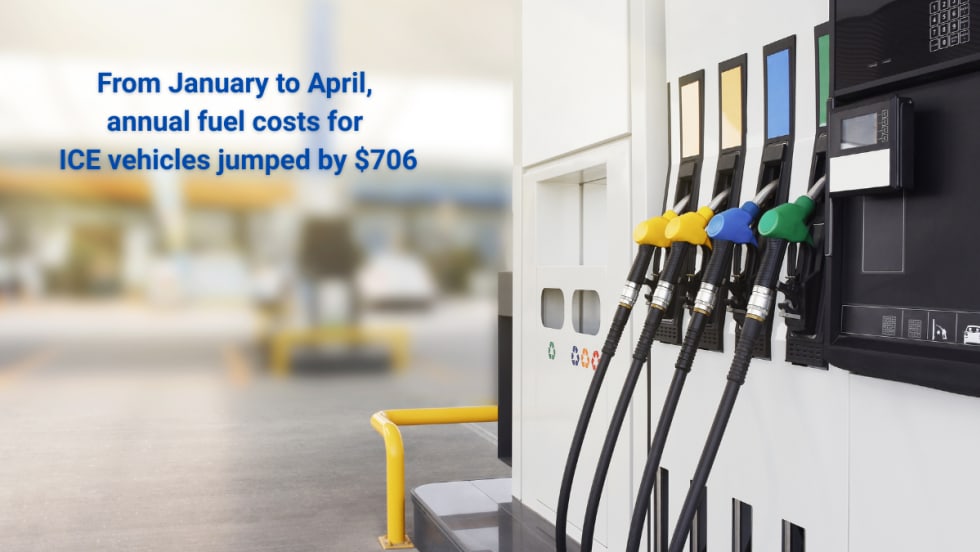
Study: How 2026's Gas Price Hikes Affect Different Vehicle Types
New data from iSeeCars reveals how rising fuel costs have affected different vehicle segments as gasoline prices climbed nearly 46% over the past four months.
Read More →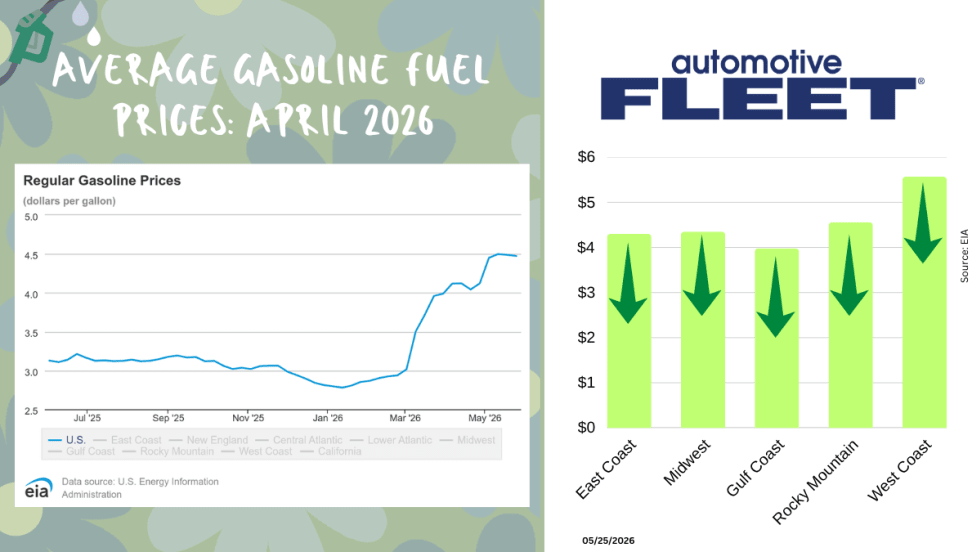
May Fuel Update: All Regions Experience Declines
Gas prices are finally easing in much of the country, but experts warn global tensions could quickly reverse the trend as the national average remains well above last month’s levels.
Read More →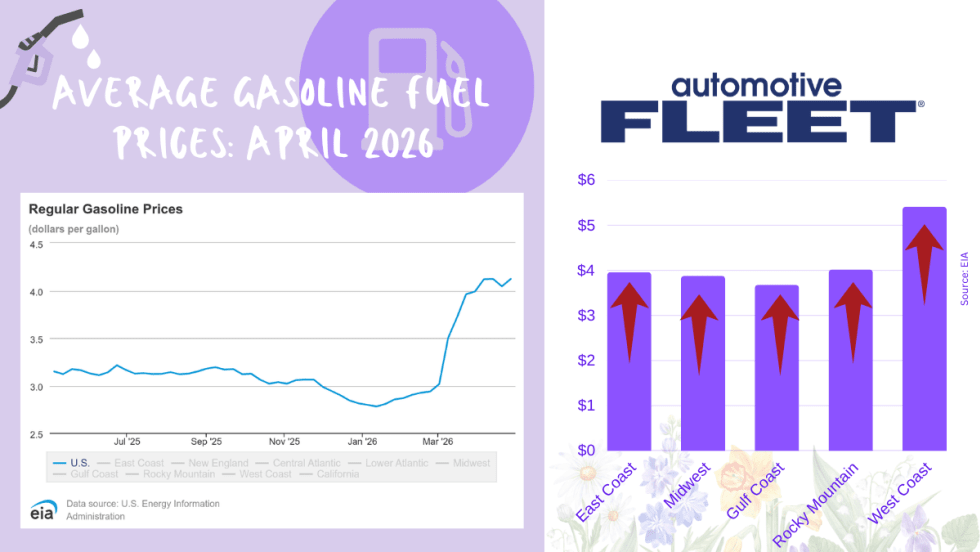
April Fuel Update: Prices Climb Above $4 as Spring Surge Accelerates
National average jumps to $4.04 per gallon, up sharply from last year, with West Coast prices topping $5 and further increases expected amid rising oil tensions.
Read More →
Tips from Fleet Managers on Saving Fuel Costs
Fleet leaders share practical strategies to reduce fuel spend through smarter policy, routing, and driver guidance.
Read More →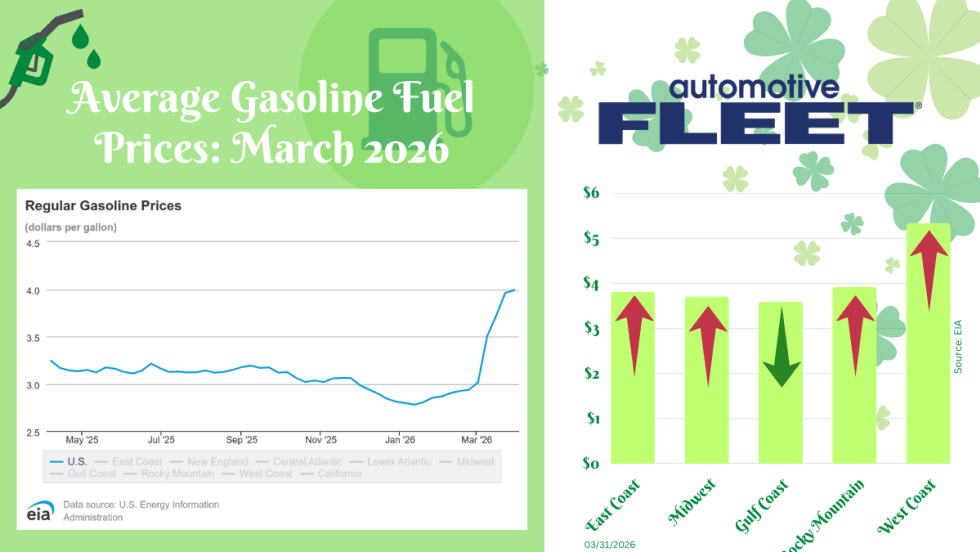
March Fuel Update: Prices Settle With a $4 Average
Fuel prices significantly slowed this week, but a $4 national average is still expected.
Read More →
Bob Adamsky on Fuel Volatility: “Don’t Panic — Have a Plan”
With oil prices rising again, AWP Safety’s fleet manager shares how to respond to rising fuel costs and how the right strategy can turn fuel spikes into cost-saving opportunities.
Read More →
Oil Market Turbulence Is Complicating Fleet Cost Planning
Rapid swings in crude oil prices driven by the conflict in the Middle East could create longer-term cost pressures for fleets, affecting fuel prices, supply chains, and vehicle strategy, says NTEA’s Andrew Wrobel.
Read More →
Report: How AI Is Reshaping Fleet and Field Service Operations
AI is rapidly transforming fleet and field service operations, from predictive maintenance and intelligent scheduling to customer self-service and real-time diagnostics. But while organizations are seeing measurable gains in uptime, productivity, and efficiency, many are still navigating workforce adoption, cybersecurity concerns, and data readiness challenges. Explore the latest trends, investment priorities, and emerging AI use cases shaping the future of fleet operations.
Read More →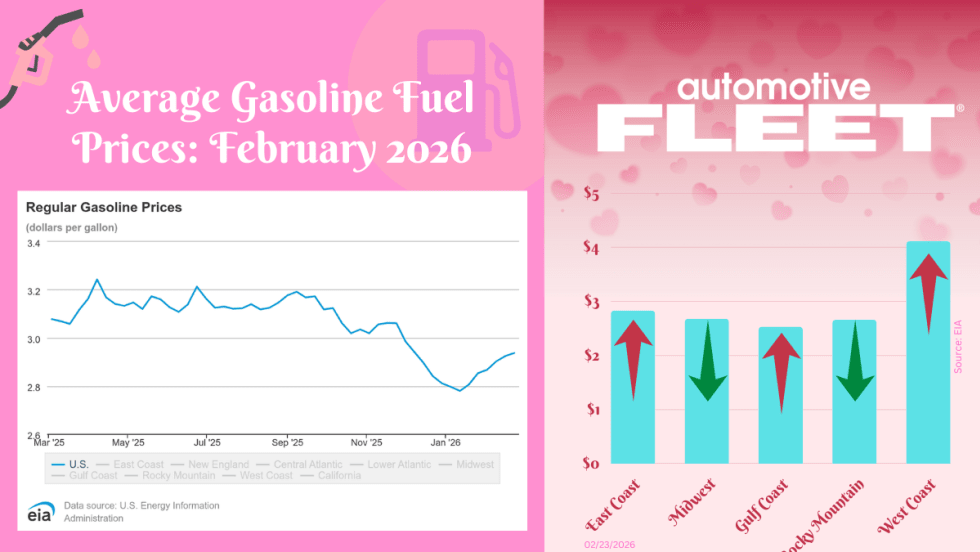
February Fuel Update: Prices Inch Higher for Third Week in a Row
The final February fuel update reveals prices continuing to inch higher for the third week in a row.
Read More →
The 2026 Fuel Economy Guide: Updated Cost and Efficiency Benchmarks for Fleets
Fleet managers can use the DOE’s 2026 Fuel Economy Guide to benchmark MPG across powertrain types using side-by-side vehicle ratings and compare new model-year options.
Read More →