




May Fuel Update: All Regions Experience Declines
Gas prices are finally easing in much of the country, but experts warn global tensions could quickly reverse the trend as the national average remains well above last month’s levels.

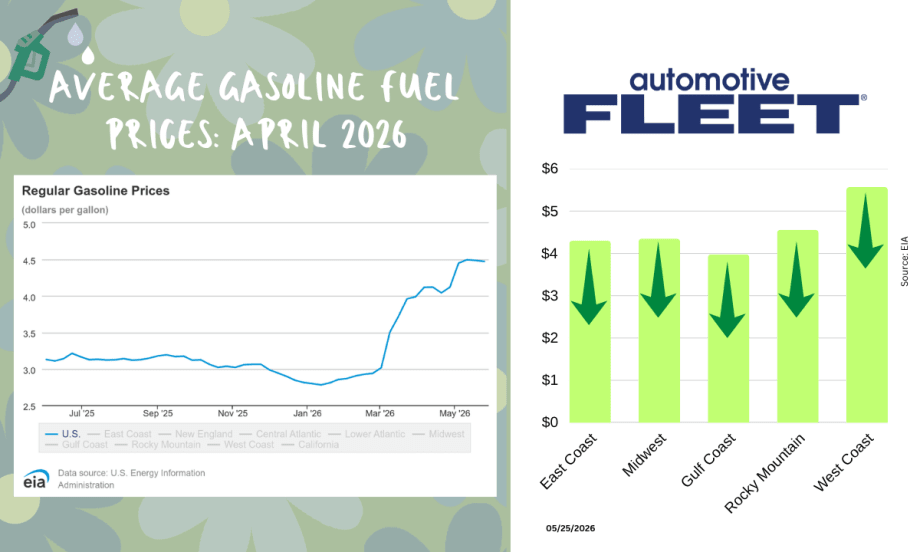
Drivers are seeing a slight break at the pump as the national average gas price drops to $4.45 per gallon, though prices remain sharply higher than a month ago amid continued volatility in global oil markets.
- Gas prices are decreasing across the country, offering some relief to consumers.
- Despite the current decline, national averages remain higher than they were last month.
- Experts caution that international tensions could quickly lead to price increases again.
*Summarized by AI
U.S Regional Gasoline Prices as of May 25, 2026
According to GasBuddy data compiled from more than 12 million individual price reports covering over 150,000 gas stations across the country, the national average for fuel has fallen 6.8 cents over the last week and stands at $4.45 per gallon.
This is up 41 cents per gallon from a month ago and 1.32 cents per gallon higher than a year ago.
“Average gasoline prices declined in 40 states over the last week as falling oil prices helped offset earlier price cycling in many markets, bringing relief to motorists after several states had already seen sharp increases,” said Patrick De Haan, head of petroleum analysis at GasBuddy. “Much of the decline came after renewed optimism surrounding a potential U.S.-Iran agreement pushed oil prices lower, easing geopolitical pressure on energy markets. In many states, that drop created breathing room after recent price cycles and allowed pump prices to fall again. While oil continued drifting lower over the weekend on hopes of a deal, new CENTCOM reports involving U.S. defensive strikes highlight how quickly the outlook could change. For now, motorists may continue to see some relief, but it remains too early to know how long the decline will last.”
Here’s a look at prices by region according to EIA data, as of May 25:
- East Coast: $4.30
- Midwest: $4.35
- Gulf Coast: $3.99
- Rocky Mountain: $4.56
- West Coast: $5.57
Here are the top 10 cheapest states to buy gas, according to AAA data:
State | Regular | |
|---|---|---|
1 | Indiana | $3.82 |
2 | Texas | $3.92 |
3 | Georgia | $3.93 |
4 | Mississippi | $3.93 |
5 | Oklahoma | $3.93 |
6 | Louisiana | $3.95 |
7 | Kansas | $4.01 |
8 | Arkansas | $4.01 |
9 | Kansas | $4.11 |
10 | South Carolina | $4.03 |
All regions saw a decrease in prices this week.
U.S Regional Gasoline Prices as of May 18, 2026
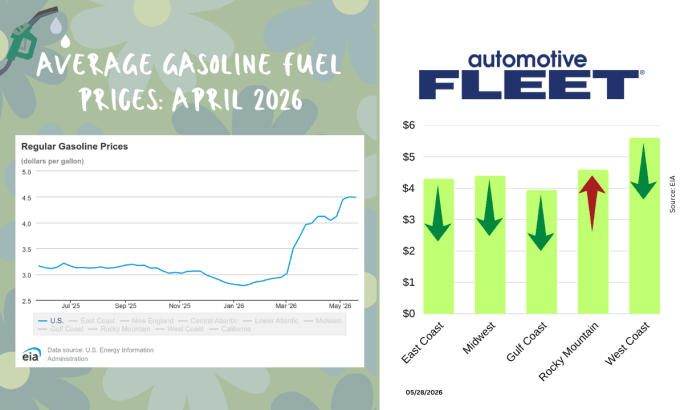
Automotive Fleet / EIA
According to GasBuddy data compiled from more than 12 million individual price reports covering over 150,000 gas stations across the country, the national average for fuel has fallen 1 cent over the last week and stands at $4.47 per gallon.
This is up 45.2 cents per gallon from a month ago and 1.33 cents per gallon higher than a year ago.
“The national average price of gasoline spent much of last week drifting lower after jumping early in the week as oil prices softened on hopes that diplomatic progress between the U.S. and Iran could help ease supply concerns,” said Patrick De Haan, head of petroleum analysis at GasBuddy. “However, that optimism faded after President Trump’s meeting with China’s Xi Jinping failed to produce a breakthrough on Iran, while renewed warnings toward Tehran have helped push oil prices higher again. With global oil inventories continuing to trend toward historically tight levels, markets remain extremely sensitive to geopolitical developments and potential supply disruptions. As a result, gasoline and diesel prices are likely to remain volatile, and with Memorial Day approaching, any sustained increase in oil prices could begin pushing retail fuel prices higher again in the weeks ahead.”
Here’s a look at prices by region according to EIA data, as of May 18:
- East Coast: $4.31
- Midwest: $4.40
- Gulf Coast: $3.95
- Rocky Mountain: $4.59
- West Coast: $5.61
Here are the top 10 cheapest states to buy gas, according to AAA data:
State | Regular | |
|---|---|---|
1 | Texas | $3.99 |
2 | Mississippi | $3.99 |
3 | Georgia | $4.00 |
4 | Louisiana | $4.03 |
5 | Oklahoma | $4.05 |
6 | Arkansas | $4.06 |
7 | Alabama | $4.09 |
8 | Indiana | $4.10 |
9 | Kansas | $4.11 |
10 | South Carolina | $4.15 |
The Rocky Mountain region is the only region with a price increase this week.
U.S Regional Gasoline Prices as of May 11, 2026
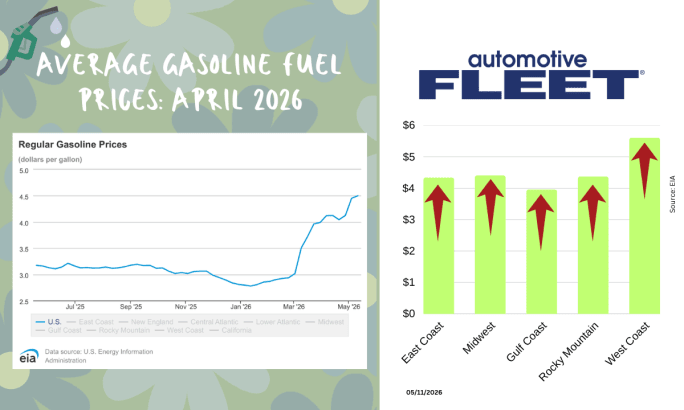
Regional gas prices climbed across the country in mid-May, with the West Coast surpassing $5.60 per gallon as oil market uncertainty continues to pressure fuel costs ahead of summer travel.
Automotive Fleet / EIA
According to GasBuddy data compiled from more than 12 million individual price reports covering over 150,000 gas stations across the country, the national average for fuel has risen 38.2 cents over the last week and stands at $4.48 per gallon.
This is up 37.3 cents per gallon from a month ago and 1.40 cents per gallon higher than a year ago.
“Average gasoline prices declined in just six states over the last week, led by the Great Lakes region, where motorists in states like Michigan and Ohio saw prices fall sharply, while Indiana experienced even steeper relief after the state temporarily waived both its excise and use taxes on gasoline,” said Patrick De Haan, head of petroleum analysis at GasBuddy. “Those declines helped pull the national average lower by roughly eight cents over the last several days after oil prices eased mid-week on optimism that the U.S. and Iran could reach a deal. However, that optimism has since largely unraveled, with talks appearing to stall and President Trump signaling the latest proposal is unacceptable, helping push oil prices higher again in Sunday electronic trade. As a result, many states could see another round of price cycling in the days ahead, potentially sending the national average toward the $4.65-per-gallon mark if oil continues climbing. In addition, diesel prices across much of the Great Lakes region are nearing new record highs as ongoing refinery issues continue to disproportionately impact diesel production. Should geopolitical tensions escalate further, fuel prices could rise even more sharply in the weeks ahead.”
Here’s a look at prices by region according to EIA data, as of May 11:
- East Coast: $4.34
- Midwest: $4.41
- Gulf Coast: $3.90
- Rocky Mountain: $4.37
- West Coast: $5.61
Here are the top 10 cheapest states to buy gas, according to AAA data:
Rank | State | Regular |
|---|---|---|
1 | Oklahoma | $3.98 |
2 | Mississippi | $3.99 |
3 | Louisiana | $3.99 |
4 | Georgia | $4.00 |
5 | Texas | $4.00 |
6 | Arkansas | $4.03 |
7 | Alabama | $4.06 |
8 | Kansas | $4.07 |
9 | Nebraska | $4.12 |
10 | South Carolina | $4.13 |
All regions saw an increase in prices this week.
U.S Regional Gasoline Prices as of May 5, 2026
Automotive Fleet / EIA
According to GasBuddy data compiled from more than 12 million individual price reports covering over 150,000 gas stations across the country, the national average for fuel has risen 38.2 cents over the last week and stands at $4.42 per gallon.
This is up 38.2 cents per gallon from a month ago and 1.31 cents per gallon higher than a year ago.
“Gasoline prices rose in every state over the last week, with some of the most significant and fastest increases concentrated in the Great Lakes, where states like Michigan, Indiana, Ohio, and Illinois saw sharp spikes, while Wisconsin experienced more modest gains,” said Patrick De Haan, head of petroleum analysis at GasBuddy. “At the same time, diesel prices surged to new records in parts of the region, with some areas touching the $6-per-gallon mark. While refinery outages were a key driver behind those outsized increases, early signs of improvement could help ease some of the most extreme price pressures in the Great Lakes in the days ahead. Beyond the region, markets are also digesting a wave of new developments—including OPEC+ raising production for June and President Trump outlining a plan to free stranded ships—which could help restore some supply. However, with so many moving pieces, the outlook remains highly fluid, and while some localized relief may emerge, broader price volatility is likely to persist in the near term.”
Here’s a look at prices by region according to EIA data, as of May 4:
- East Coast: $4.25
- Midwest: $4.40
- Gulf Coast: $3.90
- Rocky Mountain: $4.36
- West Coast: $5.83
Here are the top 10 cheapest states to buy gas, according to AAA data:
Rank | State | Regular |
|---|---|---|
1 | Oklahoma | $3.90 |
2 | Georgia | $3.91 |
3 | Mississippi | $3.92 |
4 | Louisiana | $3.92 |
5 | Arkansas | $3.96 |
6 | Nebraska | $3.98 |
7 | Texas | $3.98 |
8 | Kansas | $3.99 |
9 | Alabama | $4.00 |
10 | Missouri | $4.05 |
All regions saw an increase in prices this week.
More Fuel
Fuel Prices Surge in September | September Fuel Update
September brought major fuel price swings, including diesel crossing $6 a gallon. Here’s how gas and diesel prices changed throughout the month, and where they stood heading into October.
Read More →
Turning Fleet Payment Data into Executive Insights
Ramel Lindsay of U.S. Bank Voyager discusses how fleets can transform payment and transaction data into actionable intelligence to reduce costs, improve oversight, and support executive decision-making.
Read More →
Why the IRS Raised Its Mileage Rate in the Middle of 2026
Fuel-price volatility drove the rare increase to 76 cents per mile, the fifth midyear adjustment since 2000.
Read More →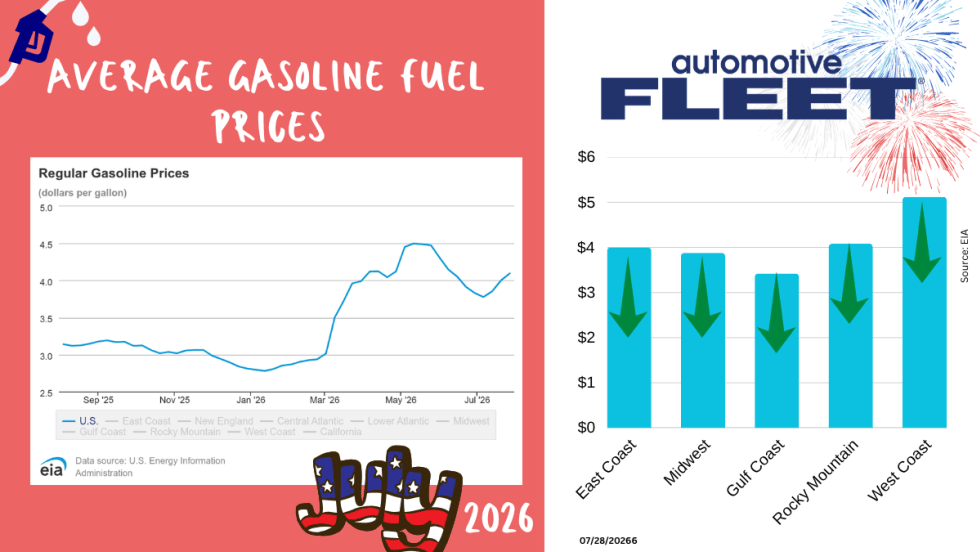
July Fuel Update: Prices Keep Rising in Light of More Conflict
Gas prices continue to rise as more and more conflicts do, too.
Read More →
Bob Adamsky on Fuel Volatility: "Don't Panic, Have a Plan."
When it comes to up and down fuel prices, Adamsky has a message for fleets: “Don’t panic.”
Read More →
How Fleets Can Gain Control of Non-Fuel Spend
Fuel often gets the spotlight, but non-fuel expenses can have a major impact on fleet costs. Ramel Lindsay of U.S. Bank Voyager discusses how fleets can gain better visibility and control over these often-overlooked expenditures.
Read More →
Fuel is Just the Start: How Middle East Tensions are Driving Up Fleet Maintenance Costs
The Middle East conflict is doing more than pushing up fuel prices. It’s also raising the cost of key maintenance products your fleet depends on, from motor oil to tires to windshield wipers. Here’s what you need to know about this budget-busting situation.
Read More →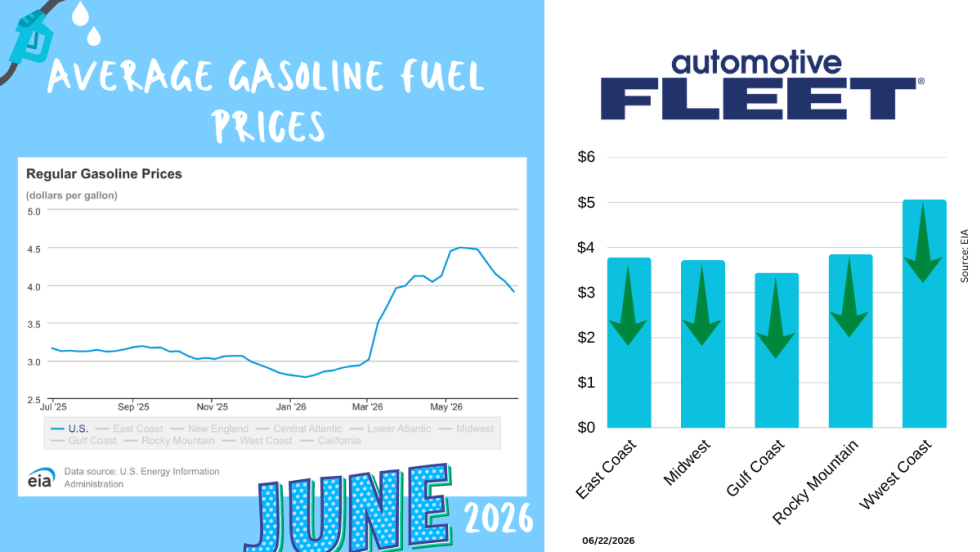
June Fuel Update: Prices Fall Below $4
Drivers are finally getting some relief at the pump. The national average gas price has dropped below $4 a gallon for the first time in months, with prices falling in 47 states as oil markets react to developments in U.S.-Iran negotiations.
Read More →
Study: How 2026's Gas Price Hikes Affect Different Vehicle Types
New data from iSeeCars reveals how rising fuel costs have affected different vehicle segments as gasoline prices climbed nearly 46% over the past four months.
Read More →
April Fuel Update: Prices Climb Above $4 as Spring Surge Accelerates
National average jumps to $4.04 per gallon, up sharply from last year, with West Coast prices topping $5 and further increases expected amid rising oil tensions.
Read More →