





Related: 10 Ways to Reduce Fuel Spend
February Fuel Update: Prices Inch Higher for Third Week in a Row
The final February fuel update reveals prices continuing to inch higher for the third week in a row.
February 25, 2026
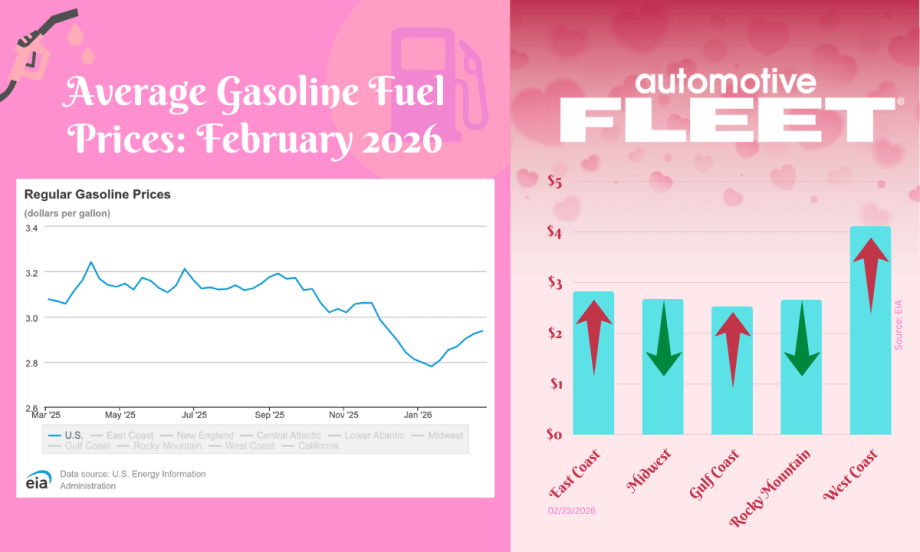
With continued tensions in Iran, gas prices have risen for the third straight week.
Credit: EIA/Automotive Fleet
6 min to read
U.S Regional Gasoline Prices as of February 23, 2026
Fuel prices have risen once again for the third week in a row.
According to GasBuddy data compiled from more than 12 million individual price reports covering over 150,000 gas stations across the country, the national average for fuel has risen by 1.2 cents over the last week to $2.88 per gallon, up 4 cents from last week.
This is up 2.8 cents from a month ago and 19.5 cents per gallon lower than a year ago.
“Average gasoline prices continue to drift higher as crude oil trades near its highest level since last summer, driven by mounting geopolitical risk premiums tied to escalating tensions between the United States and Iran,” said Patrick De Haan, head of petroleum analysis at GasBuddy. “While there has been no direct disruption to energy infrastructure, markets are increasingly pricing in the possibility of a broader exchange that could threaten supply flows. Beyond geopolitics, we’re also seeing localized supply constraints, including refinery outages and disruptions along the Olympic Pipeline, which have amplified price pressures in the Pacific Northwest. These developments are unlikely to be isolated, as planned refinery maintenance is set to intensify in the weeks ahead. As seasonal supply tightens, the national average is increasingly likely to retest the $3-per-gallon threshold.”
Here’s a look at prices by region according to EIA data, as of January February 23:
East Coast: $2.83
Midwest: $2.68
Gulf Coast: $2.53
Rocky Mountain: $2.66
West Coast: $4.11
The Midwest and Rocky Mountain regions saw a decrease in prices this week.
Here are the top 10 cheapest states to buy gas, according to AAA data:
Rank | State | Regular |
|---|---|---|
1 | Oklahoma | $2.37 |
2 | Arkansas | $2.50 |
3 | Kansas | $2.50 |
4 | Mississippi | $2.50 |
5 | Louisiana | $2.52 |
6 | Wisconsin | $2.53 |
7 | Missouri | $2.54 |
8 | Iowa | $2.55 |
9 | Tennessee | $2.55 |
10 | Kentucky | $2.58 |
U.S Regional Gasoline Prices as of February 16, 2026
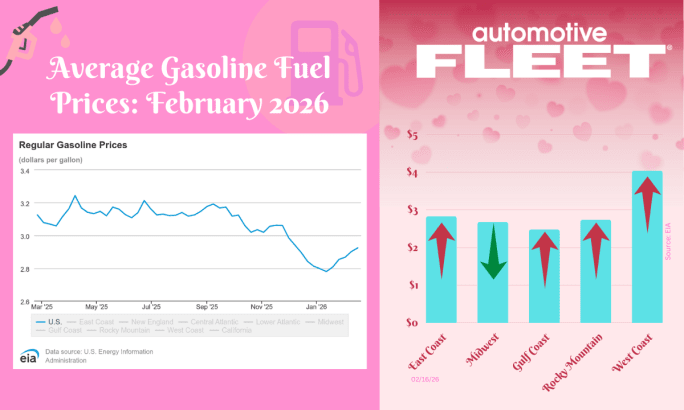
The current median U.S. gas price is $2.79 per gallon, which is up 20 cents from last week.
Photo: EIA/Automotive Fleet
According to GasBuddy data compiled from more than 12 million individual price reports covering over 150,000 gas stations across the country, the national average for fuel has risen by 2.6 cents over the last week to $2.84 per gallon.
This is up 4.9 cents from a month ago and 24.5 cents per gallon lower than a year ago.
“The national average price of gasoline continues to grind higher, and while the pace of increases remains modest for now, upward momentum could accelerate in the coming weeks as refinery maintenance intensifies and the broader transition to summer gasoline begins,” said Patrick De Haan, head of petroleum analysis at GasBuddy. “However, supply-side dynamics could temper that seasonal pressure. If OPEC+ proceeds with resuming production increases following its first-quarter pause, additional barrels could cap crude oil’s upside and limit the magnitude of the spring rally at the pump. That said, geopolitical tensions—particularly between the U.S. and Iran—remain an unpredictable variable, injecting risk into the outlook and leaving prices vulnerable to sudden shifts.”
Here’s a look at prices by region according to EIA data, as of January February 16:
East Coast: $2.83
Midwest: $2.68
Gulf Coast: $2.48
Rocky Mountain: $2.74
West Coast: $4.04
All regions saw price increases this week, except the Midwest, whose average remained the same.
Here are the top 10 cheapest states to buy gas, according to AAA data:
Rank | State | Regular |
|---|---|---|
1 | Oklahoma | $2.29 |
2 | Arkansas | $2.45 |
3 | Arkansas | $2.46 |
4 | Kansas | $2.47 |
5 | Louisiana | $2.51 |
6 | Missouri | $2.52 |
7 | North Dakota | $2.54 |
8 | Texas | $2.55 |
9 | Wisconsin | $2.55 |
10 | Minnesota | $2.57 |
U.S Regional Gasoline Prices as of February 9, 2026
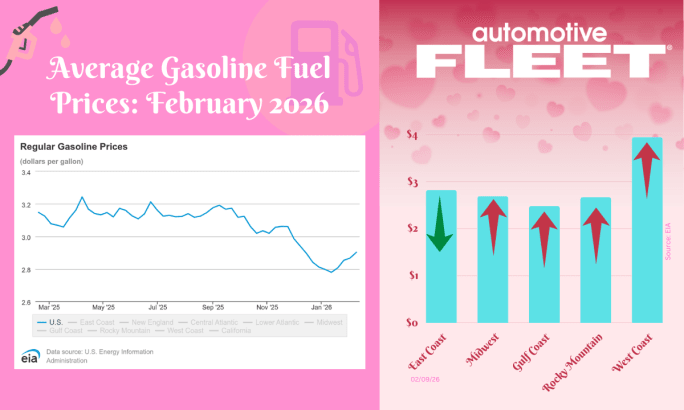
National gas prices rose by 1 cent in every region except the West Coast, which saw a significant increase.
Photo: EIA/Automotive Fleet
According to GasBuddy data compiled from more than 12 million individual price reports covering over 150,000 gas stations across the country, the national average for fuel has risen by 1.2 cents over the last week to $2.84 per gallon.
This is up 5.4 cents from a month ago and 24.9 cents per gallon lower than a year ago.
“The national average price of gasoline only edged slightly higher last week, but nine of the ten largest weekly price movements were increases, led by West Coast states as California begins the transition to summer gasoline,” said Patrick De Haan, head of petroleum analysis at GasBuddy. “Most states saw relatively minor fluctuations, but we’re now starting to see seasonal trends take hold on the West Coast, with those pressures expected to gradually push eastward in the weeks ahead. Even though oil prices slipped slightly last week amid reduced geopolitical risk, strengthening seasonal factors are likely to intensify, potentially driving the national average back above the $3-per-gallon mark, where prices could remain for at least part of the spring.”
Here’s a look at prices by region according to EIA data, as of January February 9:
East Coast: $2.82
Midwest: $2.69
Gulf Coast: $2.48
Rocky Mountain: $2.67
West Coast: $3.94
All regions saw price increases this week, except the East Coast, which held steady.
Here are the top 10 cheapest states to buy gas, according to AAA data:
Rank | State | Regular |
|---|---|---|
1 | Oklahoma | $2.34 |
2 | Arkansas | $2.46 |
3 | Mississippi | $2.47 |
4 | Kansas | $2.48 |
5 | Louisiana | $2.50 |
6 | Missouri | $2.51 |
7 | Tennessee | $2.54 |
8 | Texas | $2.55 |
9 | Kentucky | $2.55 |
10 | Iowa | $2.55 |
U.S Regional Gasoline Prices as of February 2, 2026
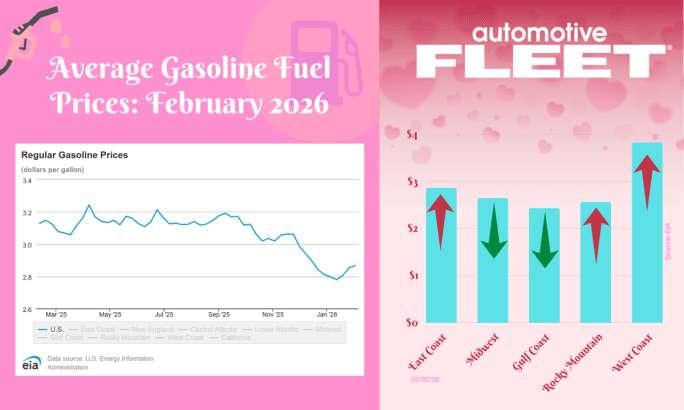
Gas prices fell or remained steady in many states but soared in others due to an influx of oil.
Photo: EIA/Automotive Fleet
According to GasBuddy data compiled from more than 12 million individual price reports covering over 150,000 gas stations across the country, the national average for fuel has fallen by 0.9 cents over the last week to $2.83 per gallon.
This is up 3.9 cents from a month ago and 21.3 cents lower per gallon than a year ago.
“While oil prices jumped to their highest level in months amid geopolitical tensions, a weakening U.S. dollar, and supply concerns, the national average price of gasoline saw little change compared to a week ago,” said Patrick De Haan, head of petroleum analysis at GasBuddy. “Just over half of states saw gas prices decline, led by Indiana, Ohio, and other price-cycling states that had previously seen prices jump but have since started to fall. Meanwhile, prices are rising across much of the West Coast as the transition to summer gasoline begins, and attention turns to another refinery shutdown in California expected in April. Over the coming weeks, we’re likely to see more states experiencing increases than decreases.”
Here’s a look at prices by region according to EIA data, as of January February 2:
East Coast: $2.82
Midwest: $2.65
Gulf Coast: $2.46
Rocky Mountain: $2.57
West Coast: $3.83
The Midwest and Gulf Coasts saw a decrease in prices this week.
Here are the top 10 cheapest states to buy gas, according to AAA data:
Rank | State | Regular |
|---|---|---|
1 | Oklahoma | $2.37 |
2 | Arkansas | $2.43 |
3 | Mississippi | $2.45 |
4 | Texas | $2.46 |
5 | Louisiana | $2.47 |
6 | Kansas | $2.47 |
7 | Iowa | $2.50 |
8 | Tennessee | $2.51 |
9 | Wisconsin | $2.51 |
10 | Alabama | $2.53 |
More Fuel
Fuel Prices Surge in September | September Fuel Update
September brought major fuel price swings, including diesel crossing $6 a gallon. Here’s how gas and diesel prices changed throughout the month, and where they stood heading into October.
Read More →
Turning Fleet Payment Data into Executive Insights
Ramel Lindsay of U.S. Bank Voyager discusses how fleets can transform payment and transaction data into actionable intelligence to reduce costs, improve oversight, and support executive decision-making.
Read More →
Why the IRS Raised Its Mileage Rate in the Middle of 2026
Fuel-price volatility drove the rare increase to 76 cents per mile, the fifth midyear adjustment since 2000.
Read More →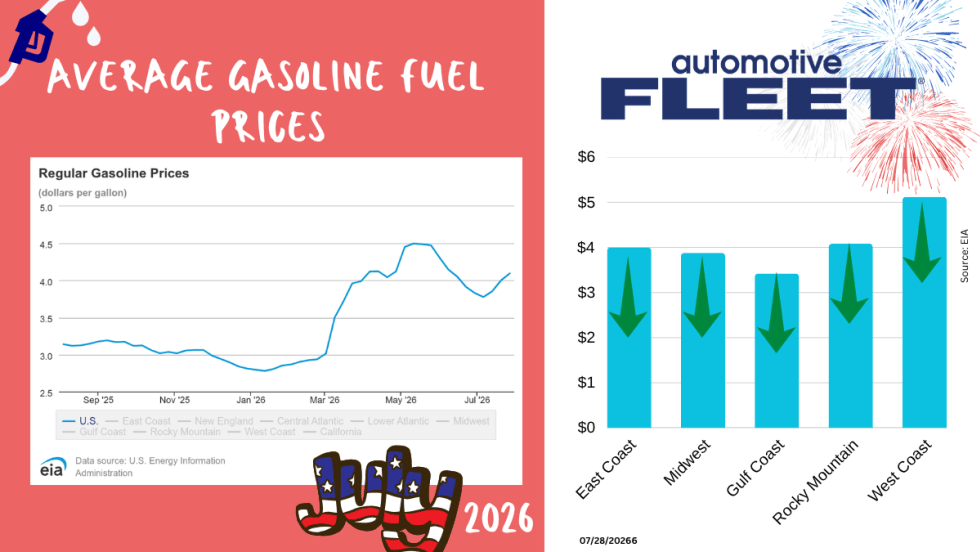
July Fuel Update: Prices Keep Rising in Light of More Conflict
Gas prices continue to rise as more and more conflicts do, too.
Read More →
Bob Adamsky on Fuel Volatility: "Don't Panic, Have a Plan."
When it comes to up and down fuel prices, Adamsky has a message for fleets: “Don’t panic.”
Read More →
How Fleets Can Gain Control of Non-Fuel Spend
Fuel often gets the spotlight, but non-fuel expenses can have a major impact on fleet costs. Ramel Lindsay of U.S. Bank Voyager discusses how fleets can gain better visibility and control over these often-overlooked expenditures.
Read More →
Fuel is Just the Start: How Middle East Tensions are Driving Up Fleet Maintenance Costs
The Middle East conflict is doing more than pushing up fuel prices. It’s also raising the cost of key maintenance products your fleet depends on, from motor oil to tires to windshield wipers. Here’s what you need to know about this budget-busting situation.
Read More →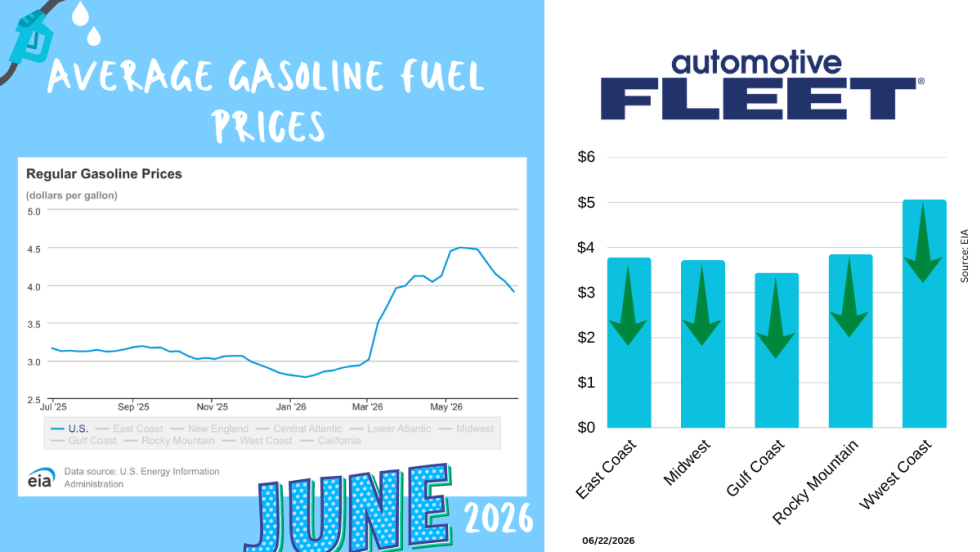
June Fuel Update: Prices Fall Below $4
Drivers are finally getting some relief at the pump. The national average gas price has dropped below $4 a gallon for the first time in months, with prices falling in 47 states as oil markets react to developments in U.S.-Iran negotiations.
Read More →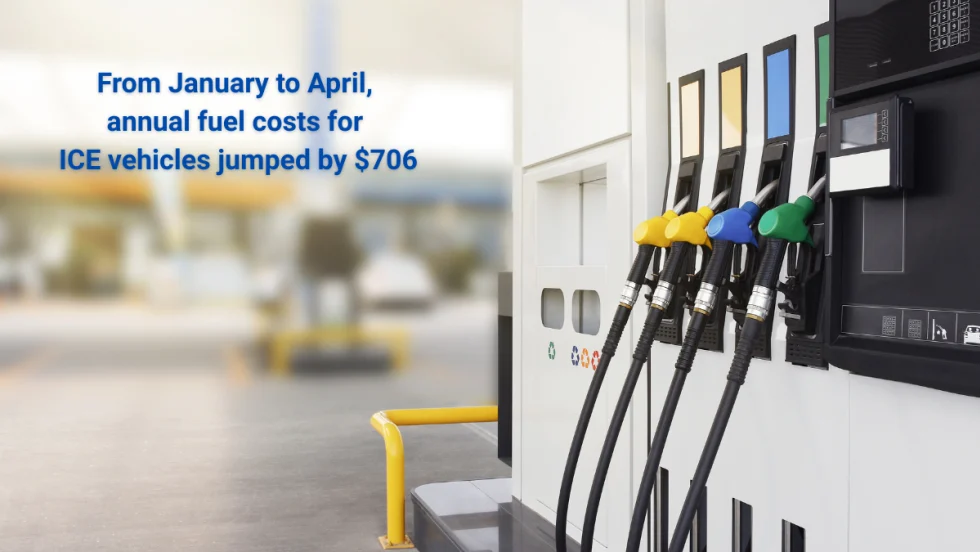
Study: How 2026's Gas Price Hikes Affect Different Vehicle Types
New data from iSeeCars reveals how rising fuel costs have affected different vehicle segments as gasoline prices climbed nearly 46% over the past four months.
Read More →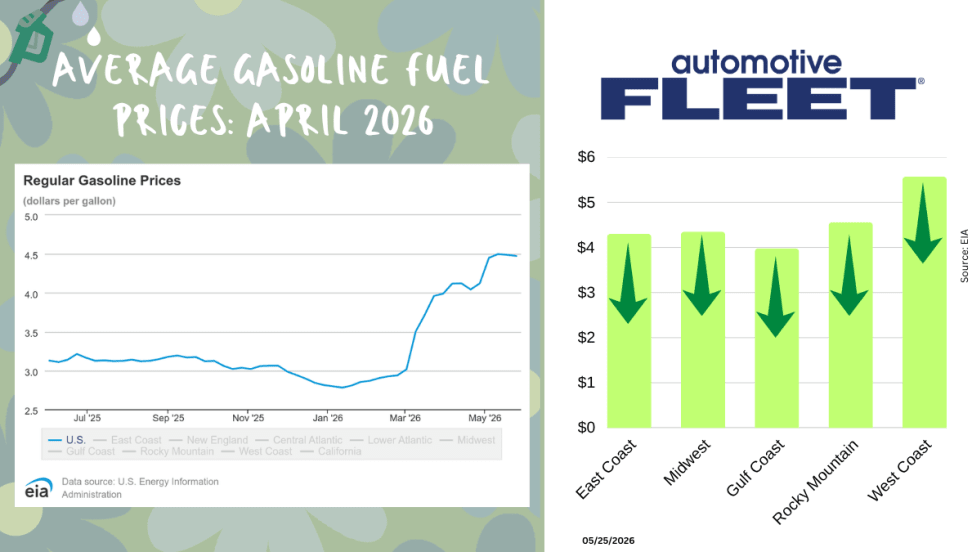
May Fuel Update: All Regions Experience Declines
Gas prices are finally easing in much of the country, but experts warn global tensions could quickly reverse the trend as the national average remains well above last month’s levels.
Read More →