




First-Ever Fleet Safety Conference Wows Attendees
Bobit Business Media’s 2012 Fleet Safety Conference had an impressive turnout for its first year. Featuring a mix of relevant topic discussions, sessions were packed and attendees shared positive feedback.

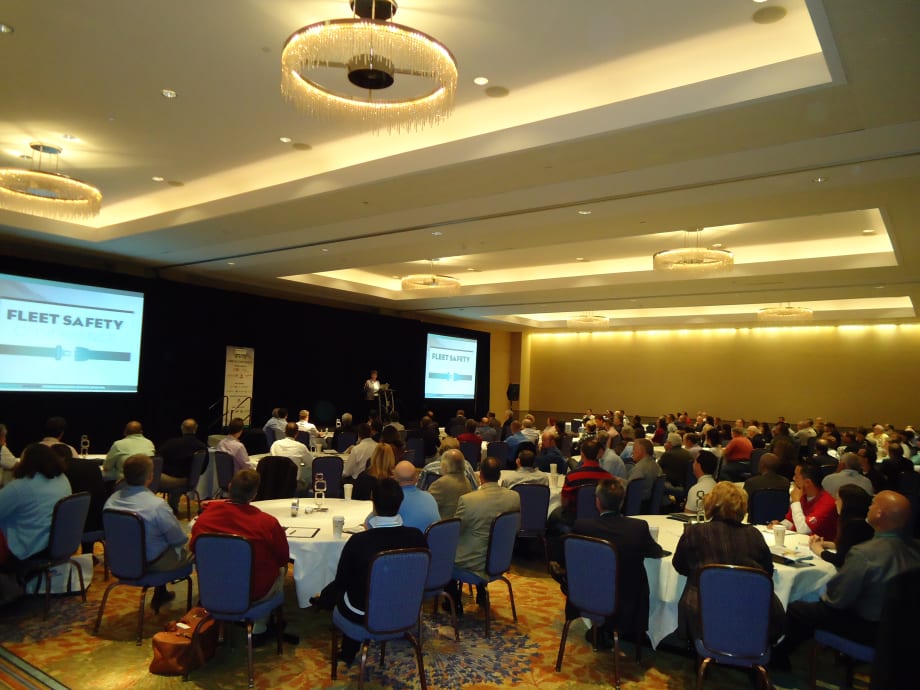
Attendees listened attentively to the keynote address from Monsanto’s Maggie Cole, who discussed how fleet safety plays a critical role in her corporate fleet.
Attendees listened attentively to the keynote address from Monsanto’s Maggie Cole, who discussed how fleet safety plays a critical role in her corporate fleet.
Bobit Business Media held its first-ever Fleet Safety Conference May 22-23 at the Renaissance Schaumburg Convention Center Hotel in Schaumburg, Ill. More than 230 fleet professionals registered for the two-day event, which focused on raising the bar for fleet safety.
Additional event photos are available here.
Endorsed by the American Automotive Leasing Association (AALA), the Network of Employers for Traffic Safety (NETS), and the National Safety Council (NSC), the two-day conference covered critical safety topics for today’s fleet manager.
Starting with a keynote address by Maggie Cole, director of Environmental Health & Safety (EH&S) for Monsanto, day-one sessions ranged from distracted driving and federal regulations for medium- and heavy-duty trucks to coping with a fleet fatality or serious injury among drivers.
Other topics included how to prepare for a safety-related lawsuit, safety issues tied to maintenance of alternative-fuel vehicles, minimizing risk exposure when expatriates drive company-owned vehicles, ways to encourage safe driving of company-owned vehicles by non-employees, and making safety a top-down effort.
Industry suppliers also had opportunities to share their expertise and latest solutions with attendees during networking breaks and in a panel discussion covering the latest fleet safety technologies.
Day two started off with a keynote address by Louis Tijerina, PhD., senior technical specialist, research and advanced engineering for Ford Motor Co., who shared the automaker’s research updates as it relates to developing technologies that improve driver focus.
Topics on the second day of the conference included liabilities associated with negligent entrustment, best practices for establishing successful fleet safety policies and programs, comparing National Highway Traffic Safety Administration (NHTSA) and Insurance Institute for Highway Safety (IIHS) safety ratings to real-world experience, effectively communicating policies to company executives and to fleet drivers, and benchmarking safety metrics to reduce costs and improve safety.
Adding to the highlights of day two was the Fleet Safety Award luncheon. Pam Sederholm, executive director for AALA, emceed the event and presented the award to Tammy Evans, VP of fleet operations for transportation and logistics company Modern Transportation Services.
Day two also featured a panel of representatives from Ford, Mercedes-Benz, Volvo, and General Motors discussing current and upcoming safety technologies in late-model vehicles. Other session topics included developing a driver safety accountability program and predicting and preventing at-fault crashes using driver profiles.
The conference ended with a “town hall” discussion, moderated by Automotive Fleet Editor & Associate Publisher Mike Antich. Panelists including Mark Kreindler, VPSI Inc.; Daniel Smith, NHTSA; Randy Shadley, CAFM, Corporate Claims Management; Beth Ann Stamer, Eli Lilly and Co.; and Louis Tijerina PhD, Ford, answered audience questions.
Event sponsors included 10n2 Technologies, Aegis Mobility, The CEI Group, Driver’s Alert, Fleet Response, Geotab Inc., GPS Insight, Greenroad, LeasePlan USA, Wheels Inc., and ZoomSafer.
Stay tuned to www.fleetsafetyconference.com for updates on next year’s event.
More Safety
What’s Next for Fleet? Safety, AI & Industry Recognition | AF News Recap
Could your company's culture be encouraging distracted driving? This week, we're exploring how workplace expectations affect driver safety, what AI, EVs, and autonomous vehicles could mean for the future of fleet management, and how fleet professionals can strengthen their award nominations.
Read More →
Does Your Fleet's Culture Encourage Distracted Driving?
What happens when the people responsible for enforcing safety rules are the ones setting the wrong example? The answer may reveal why some of the biggest risks to fleet drivers have little to do with what's written in the employee handbook.
Read More →
Fleet Manager’s Ultimate Playbook: Navigating the New Standard in OEM Connectivity
Rising operating costs, driver safety concerns, and unplanned downtime are putting unprecedented pressure on modern fleets. Discover how fleet managers use embedded OEM connectivity and real-time vehicle data to cut TCO, prevent downtime, and protect drivers without aftermarket telematics hardware.
Read More →
From Driver Well-Being to EV Charging | AF News Recap
Mental health belongs in the fleet safety conversation. This week, we’re looking at five ways fleets can support employee well-being before a crisis, plus Holman’s expansion in Mexico, new one-day Fleet Forward passes, and why EV charging demand is outpacing infrastructure growth.
Read More →
Nexar-Nauto Merger Aims to Give Fleets Better Safety Intelligence Through Larger Driving Dataset
Stefan Heck tells Automotive Fleet that combining more than 10 billion miles of driving history with Nexar's AI models will give fleets deeper insights into driver risk and roadway conditions than either company could provide independently.
Read More →
Don't Wait for a Crisis: 5 Ways to Build Mental Health Into Your Fleet Safety Program
For Suicide Prevention Month, fleet and safety leaders have an opportunity to put mental health where it belongs: at the center of workplace safety.
Read More →
How Camera Data Can Strengthen a Fleet’s Insurance Renewal
Insights from a commercial insurance carrier and a broker show how fleets can turn video telematic data, driver coaching, and improved claims results into a stronger case at insurance renewal.
Read More →
The Safest Fleets Aren’t the Ones with the Most Technology
You’ve made the telematics investment. Here’s how to capture the other half of its value and build the safest fleet on the road.
Read More →
Hidden in Plain Sight: Fleet Compliance Risks
Fleet compliance isn't just about having policies — it's about consistently enforcing them. This practical guide reveals six hidden compliance risks common in public sector and shared fleet operations and outlines proven strategies to improve visibility, accountability, and audit readiness
Read More →
NETS Sets 2026 Fleet Safety Benchmark Conference for Indianapolis
The Sept. 15–17 program will feature fleet benchmarking data, case studies, emerging technologies, and implementation strategies while running alongside the NSC Safety Congress & Expo.
Read More →