




Eric McCann Named 2023 Fleet Visionary
Hailed by colleagues as “the person everyone calls for advice and direction on fleet electrification,” McCann is helping lead Bimbo USA’s aim of zero carbon emissions through renewable energy sources.

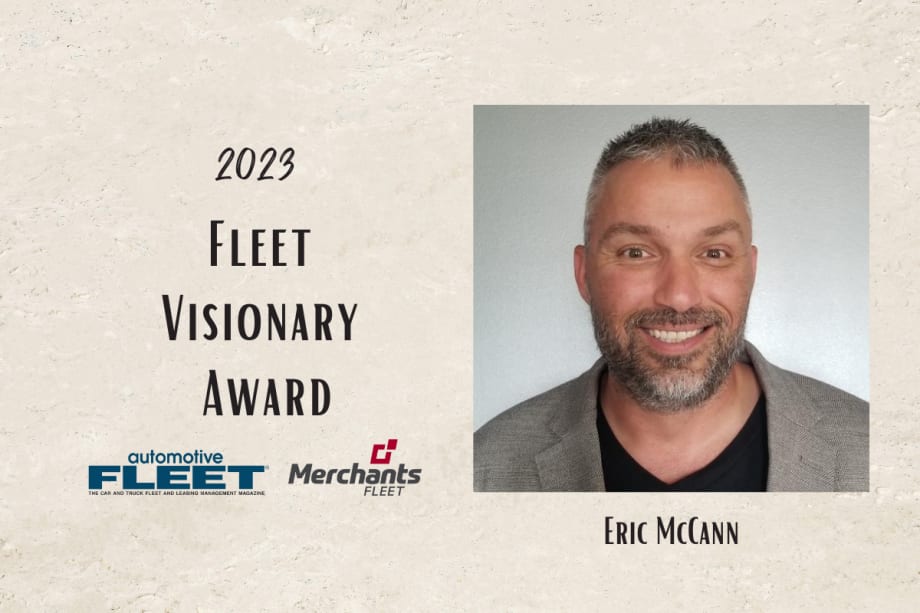
Eric McCann, director of fleet sustainability and technology at Bimbo USA, has been an early adopter of fleet electrification when EVs work for the application.
Photo: Automotive Fleet
As Director of Fleet Sustainability and Technology for Bimbo USA, Eric McCann’s vision for today’s fleet organization aligns with one of his company’s core values: to protect and preserve Planet Earth for generations to come.
For his leadership helping advance Bimbo’s aim to achieve net-zero carbon emissions by 2050 through renewable energy sources, McCann was named 2023 Fleet Visionary.
Sponsored by Merchants Fleet and presented at the recent Automotive Fleet & Leasing Association annual conference in Palm Springs, Calif., the Visionary Award spotlights an industry leader who promotes and champions innovation, resulting in more efficient, cost-effective, and safer fleet operation.
“I am truly blessed,” said McCann of his new accolade. “I work for a great fleet management team. I have probably the finest crew I’ve ever worked with.
“I throw some wild ideas out there, and if there’s a possibility it might help, they’re willing to help. I could not do this without the group working in this fleet department. They are really the heart and soul of it.”
Nation’s Largest Baking Company
McCann, who holds a degree in mechanical engineering, joined Bimbo (pronounced “Beembo”) USA in 2012 following a stint at truck manufacturer Navistar. The American corporate arm of the global Mexico-based Grupo Bimbo is the largest baking company in the U.S.
Producing such well-known brands as Thomas’, Entenmann’s, Sara Lee, and Oroweat, Bimbo USA operates more than 65 bakeries, employs more than 25,000 associates, and distributes products through 12,000 sales routes throughout the country.
Numbering about 6,000 powered units and 3,200 trailers, the company’s fleet comprises heavy-duty box trucks and tractors transporting products from bakeries to distributors and depots and walk-in/step vans for last-mile deliveries to grocery stores and retail outlets.
McCann directs Bimbo USA’s move from conventional fuels to sustainable energy products and oversees “bringing in technologies that will make the fleet more efficient.”
Soon after starting at Bimbo USA, McCann introduced propane-powered vehicles to the company fleet, drawing on his Navistar experience helping manage a propane project for a company with an extremely large fleet.
“The electric vehicle (EV) was the next step in the journey,” said McCann.
Electrification: The Process
Incorporating EVs and the supporting charging infrastructure into the Bimbo fleet began in 2019.
“The first thing we had to do was understand the technology, understand how it was going to work, how it was going to fit, the pros and cons — basically a data-mining mission,” McCann recalled. “Once we understood the technology —what it was, what it was capable of — I met with chassis and charging vendors.”
McCann and his team worked with Motiv Power Systems to design the electric-powered chassis, reviewing the unit “from a fleet perspective, to help them build a better chassis that would better fit the fleet market,” he recounted.
On a parallel path, McCann worked with an electrical contractor and a local utility to provide a charging solution.
Five Motiv chassis, paired with bodies, were pilot-tested in Modesto, Calif., chosen for its “ideal location” with mild weather and low-mileage delivery routes.
McCann and his crew brought drivers into the process upfront for their perspective. In addition to education and training, a half-day drive rodeo was held, during which drivers learned about regenerative braking and drove the units.
“We walked through every aspect of the chassis with them,” McCann said.
With the five trucks in place, he “left them alone for 12 months.”
Doing nothing from an engineering perspective, “We just watched, letting the drivers drive the trucks, charge them, etc. We just watched.” McCann recalled. Meetings with local Bimbo management elicited drivers’ reactions and comments.
Incorporating lessons learned from the year-long pilot, including changing to “smart chargers” for their data and oversight capabilities, an additional 27 Motiv electric chassis plus charging infrastructure were deployed in Rocklin and Yuba, Calif.
The company benefitted from a Pacific Gas & Electric and California state incentive project that saved significant costs on two charging depots.
McCann explained that three Motiv chassis were also sent to the Northeast to test the EVs in nonperfect conditions. That pilot program provided valuable data on battery usage in colder weather.
“Now, I can tell you where EVs work and don’t work for us,” said McCann. However, he admitted, “We’re still in the learning phase of chargers. We’re getting into the understanding of all the complexities that come with charging.”
Since the pilot, the fleet began replacing 30 ICE units with EVs each year.
McCann described the electrification process: "We’re taking this ‘elephant’ and eating it one bite at a time. Very methodically, trying not to add too many challenges to our plate at once.”
He added, “We had a challenge to try something new with EVs; we see how it works. We adjust, get it working, then move on to our next challenge.”
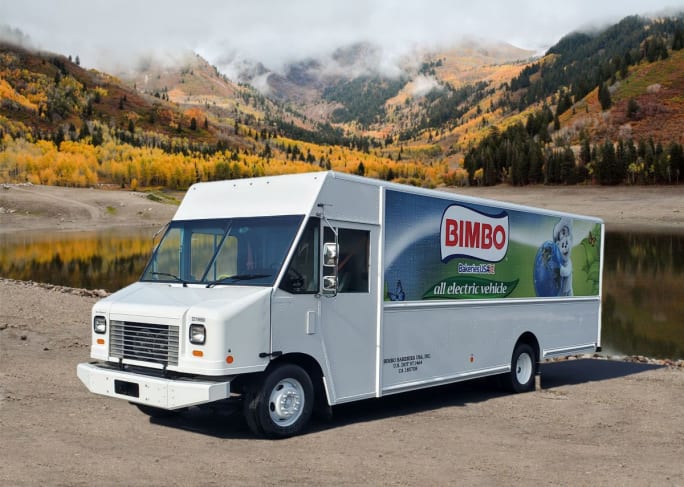
Bimbo USA deploys walk in/step vans with Motiv e-chassis for last-mile delivery of bakery products to stores and retail outlets.
Photo: Bimbo USA
One Size Does Not Fit All
However, according to McCann, electric vehicles are not the only answer to sustainability efforts.
“I don’t believe there’s a one-size-fits-all solution,” he explained. “EVs are not going to fit every situation or every route.”
Other alternatives to gas or diesel exist, he pointed out, alternatives that can be achieved faster and make a big impact, renewable propane or renewable natural gas, for example.
Bimbo USA is participating in a carbon-eliminating project using renewable propane mixed with DME (dimethyl-ether) in an effort “to continue to move the needle,” McCann said.
The company is also considering hybrid technologies and utilizations.
“We will need to push for electrification, but we need to push for it where it works,” McCann believes.
Don’t Be Afraid to Fail
One necessary attribute of innovative leadership is the understanding that failure is inevitable, the Visionary awardee advises.
“If you don’t fail, you’re not trying, but if you’re going to fail…fail quickly,” he contended. “Regardless of the outcome, it’s critical to educate those around you to avoid either making the mistake again or replicating the success throughout your organization.”
Another key to the learning curve of innovative initiatives is “not only understanding the technology but understanding how easy it will be to adopt and sustain within your organization,” McCann believes. “Not all technologies work everywhere, and although some seem to have opportunities, they may not be sustainable throughout the organization.”
McCann, who serves on many panels and workshops and appears on industry webcasts, advises fleet colleagues to “learn from some of us who have been through the trenches. If you’re just starting, there’s no need to learn from scratch. Most of those I know within the industry are glad to speak with you and discuss what did and did not work for us.”
The “beautiful” nature of the fleet industry, said McCann, “is that although we’re very large, it feels so small. It’s a very close group that supports one another. We are a community and a close one at that.”
More Operations

How Fleets Can Recruit and Train Veterans for Technician Roles
Here's how the technician shortage has affected uptime for fleets, and what to do about it.
Read More →
Avis Budget Group Deploys Neology Toll Management Technology Across Major Brands
Neology’s neoFleet platform will manage toll transactions and toll-authority operations for vehicles across Avis, Budget, Payless, Budget Truck and Zipcar.
Read More →
Fleet Personal-Use Charges Edge Higher in 2026
Nearly eight in 10 surveyed fleets allow personal use of company vehicles, while just over half of respondents report charging employees for the privilege.
Read More →
The Future of Fleet + What’s Changing Right Now | AF News Recap
Could developments overseas offer a preview of what’s coming for U.S. fleets? This week, we’re looking at the future of AI, autonomy, and electrification, plus Ford Pro’s new certified pre-owned program, smarter vehicle offboarding, and a new way for fleets to manage toll expenses.
Read More →
How to Handle Vehicle Offboarding
What do fleet managers need to do when a driver leaves?
Read More →
Fleet Manager’s Ultimate Playbook: Navigating the New Standard in OEM Connectivity
Rising operating costs, driver safety concerns, and unplanned downtime are putting unprecedented pressure on modern fleets. Discover how fleet managers use embedded OEM connectivity and real-time vehicle data to cut TCO, prevent downtime, and protect drivers without aftermarket telematics hardware.
Read More →
U.S. Bank Adds Verra Mobility Toll Management to Voyager Fleet Platform
The integration allows U.S. Bank Voyager fleet customers to manage toll payments and violations alongside fuel, EV charging and maintenance expenses.
Read More →
ADAS Prevents Crashes. But Repairs Cost More | AF News Recap
ADAS-equipped vehicles may crash less often, but they can cost more when they do. This week, we’re breaking down what that tradeoff means for fleets, plus Subaru’s first Forester Wilderness Hybrid, Nissan’s new e-POWER Rogue, and why Calstart has become Catalyst Mobility.
Read More →
Moventum Fleet Management Names Mark Iorillo Head of Sales
Iorillo brings nearly 20 years of fleet management and sales experience to the role, including previous positions at Element Fleet Management, CEI, Donlen and Ryder.
Read More →
Fleet Has a Talent Pipeline Problem. What Comes Next? | AF News Recap
Where will fleet’s next generation of leaders come from? This week, we’re looking at the industry’s talent pipeline, what certification can add to a fleet career, how to build an award-worthy track record, and the return of Automotive Fleet’s Personal Use Survey.
Read More →