




Ed Bobit: Is NADA an Enigma?
The National Automobile Dealer Assn. (NADA) has been about as predictable as your mother-in law: they never change their stripes. Year after year you can bet the farm on what they support and what they oppose; and they do it well with millions of dollars and real political clout.

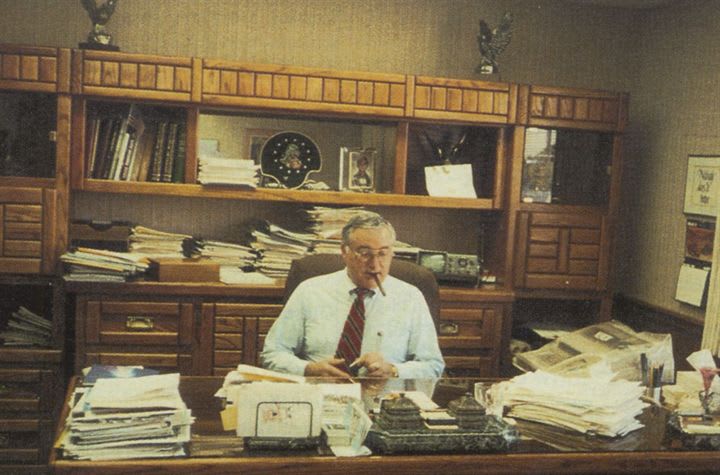
Ed Bobit, in his office, 1990
It is well for people who think, to change their minds occasionally in order to keep them clean.-Luther Burbank
The number of substitutes for fine and clean thinking the world provides positively gnaws at one's vitals.-Harold J. Laski
If we were all to be judged by our thoughts; the hills would be swarming with outlaws.-Johann Sigurjonsson
Just when you think that you've got it all figured out, the sun appears and you see everything in a different light. It's like Miami losing that first season game to BYU to knock them out of the nation's number one .spot after all the sportscasters rated them at the top all spring and summer long. It's like the cereal TV commercial when the mistrusting playmates say, "'Let Mikey eat 'em."
Ed Bobit, in his office, 1990
The National Automobile Dealer Assn. (NADA) has been about as predictable as your mother-in law: they never change their stripes. Year after year you can bet the farm on what they support and what they oppose; and they do it well with millions of dollars and real political clout. Their brush has painted a wide swath of venom over the commercial and rental programs offered to fleet accounts, and the immediate past-president of NADA bowed out last February announcing a giant lawsuit against the manufacturers for allowing fleet discounts to volume buyers. That ex-pres is Ron Tonkin, who turned the helm over to Ray Green, who promptly stated that he would continue to support all the goals already established: like making disparaging remarks about the free enterprise of a rental company used-car lot in the neighborhood; with some good supporting evidence that it wasn't all that beneficial to the new-car dealer.
GM listened and. even though it was a costly decision, instituted the 100 percent buyback program for car-rent companies Ford thought it was "a belter idea" and followed suit to be competitive. That's when NADA's new proxy gave us an interview and stated and NADA was "Happy" with the move. He also said that "we don't have to face that problem anymore" because GM assured NADA that the new policy was long-term. He also referred to Chrysler's pilot program of leasing rental cars as a harbinger of their direction equally ensuring control of the remarketing process.
NADA's dealer research seem-to support the increased emphasis on used-car sales with flagging retail interest. New-car dealers purchase 12 percent of their used cars at auction in 1987 and dramatically rose to 20 percent in 1989. And that's a strong trend established before the 100 percent buyback announcement. In an extension of this phenomenon, NADA has raised GM's attention to seriously consider treating program cars as "new" cars. In simple terms, the factory would credit the individual dealer with similar credit or points for selling either a totally new or a briefly-used program car. To many this makes sense because of the inflated retail pricing of domestic in allow for the retail rebate programs that the public is now fully expecting. Little wonder why NADA has changed its pace and face on the fleet market. They should be standing on their swivel chairs and cheering; Detroit caved in. Instead, it appears that they will share the booty from their swelled treasury war chest and help Ron Tonkin in his anti-fleet legal battle "with the hand that feeds 'em."
Perhaps the most amusing part of the interview with Ray Green was our question of his semantics. He readily admitted that he consciously refers to fleet programs as "subsidies," following an ancient NADA line, but maintains a strong preference for the term "incentives" when talking about the dealer's retail rebate discounts.
Somehow NADA is doing their homework better. They will remain a strong influence on the fleet programs, and fleet buyers need to create a vigilant posture for their own corporate interests or it will be "buyer beware" time.
More Operations
Here's When You Should Make an Exception to Fleet Policy
Fleet policies are designed to create consistency, but not every driver or situation fits neatly within standard rules.
Read More →
AI-Native or AI-Acquired: What Should Fleet Managers Look for in an AI Platform?
Six questions can help fleet managers look beyond AI marketing claims to evaluate integration, data access, and real-world operational performance.
Read More →
A buyer's guide to fleet management software in 2027
Buying fleet management software in 2027 means looking beyond features and price. As fleet operations, technology and expectations evolve, this guide explores what today’s fleet professionals should consider when choosing a system that can deliver value now and adapt to what comes next.
Read More →

What Will Shape the Next Era of Fleet Management?
EVs, AI, and autonomous vehicles are reshaping fleet management. Discover what’s ahead—and how fleet leaders can prepare for the next era.
Read More →
How Fleets Can Recruit and Train Veterans for Technician Roles
Here's how the technician shortage has affected uptime for fleets, and what to do about it.
Read More →
Avis Budget Group Deploys Neology Toll Management Technology Across Major Brands
Neology’s neoFleet platform will manage toll transactions and toll-authority operations for vehicles across Avis, Budget, Payless, Budget Truck and Zipcar.
Read More →
Fleet Personal-Use Charges Edge Higher in 2026
Nearly eight in 10 surveyed fleets allow personal use of company vehicles, while just over half of respondents report charging employees for the privilege.
Read More →
The Future of Fleet + What’s Changing Right Now | AF News Recap
Could developments overseas offer a preview of what’s coming for U.S. fleets? This week, we’re looking at the future of AI, autonomy, and electrification, plus Ford Pro’s new certified pre-owned program, smarter vehicle offboarding, and a new way for fleets to manage toll expenses.
Read More →
How to Handle Vehicle Offboarding
What do fleet managers need to do when a driver leaves?
Read More →
Fleet Manager’s Ultimate Playbook: Navigating the New Standard in OEM Connectivity
Rising operating costs, driver safety concerns, and unplanned downtime are putting unprecedented pressure on modern fleets. Discover how fleet managers use embedded OEM connectivity and real-time vehicle data to cut TCO, prevent downtime, and protect drivers without aftermarket telematics hardware.
Read More →