




Downsizing Truck and Van Fleets: What Matters?
Downsizing your fleet? Here's what matters and some key questions to consider.
Advances in materials (such as aluminum, high-strength steel, and composites) and modular shelving systems now enable upfits that minimize weight penalties.
Image: Automotive Fleet
Varying fuel costs and budgetary constraints on vehicle acquisitions prompt some questions for fleet managers.
What are the feasible options for downsizing? What process is less expensive and more fuel-efficient for fleet vehicles?
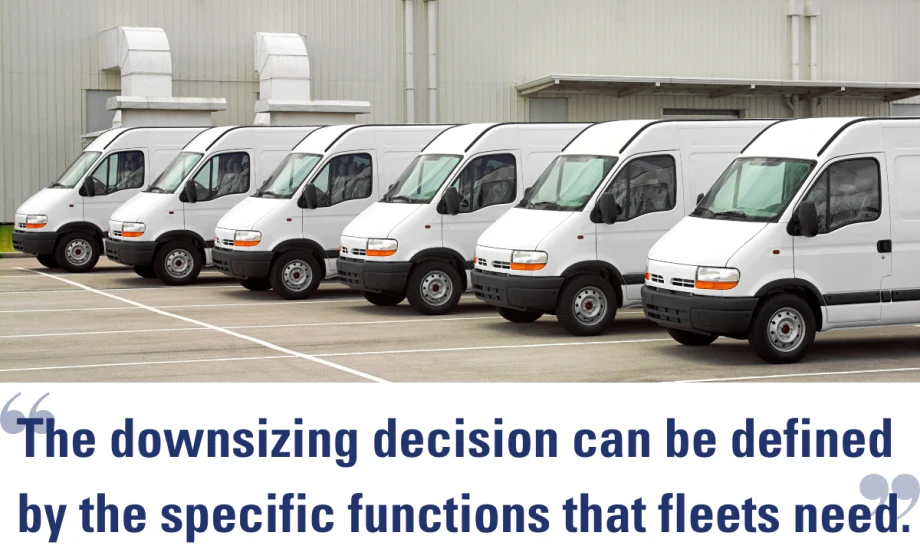
The downsizing decision can be defined by the specific functions that fleets need for trucks and vans compared to cars.
The load weight, bulk, composition, upfitting time, and expense require a significant analy
sis to determine whether a minivan can be substituted for a van, or a compact pickup for a full-size. The key question becomes: do the savings in operating expenses (as well as fixed costs) justify the change?
The Selection Process
Vehicle selection is a primary duty in the fleet management process. Much like hiring a new employee, a “job description” must be developed, the candidate’s qualifications evaluated, and the costs negotiated. For the most part, autos are “people movers”— their primary function is to transport employees and passengers from point A to point B; thus, selection options are plentiful. Trucks, however, must align more closely with their mission. Four people can be transported in a compact car as comfortably as in a full-size car. But a truck required to carry a ladder, tools, equipment, and heavy loads require more stringent qualifications. Cars are more often “chosen;” trucks are “engineered.”
The Cost Considerations
The two primary cost categories in running a fleet are fixed costs (primarily depreciation) and variable costs (fuel, maintenance/repair, tires, and oil). All of these expenses must be considered when deciding to downsize from a full-size van to a minivan, or from a full-size pickup to a compact pickup.
Minivans often serve a dual function, carrying both people and loads. They are more often used in sales marketing or merchandising roles, as opposed to the utilitarian mission of most full-sized vans. Because of this, minivans are usually replaced on a “car” cycle, while full-sized vans are replaced on a “truck” cycle.
A valid option then is “beefing” up a minivan to handle a more rugged mission and keeping it in service longer. The result is lower depreciation, which is further enhanced by a lower original cost.
Powertrain & Electrification Considerations
With the increasing availability of powertrains and electrification options for fleets, it's essential for fleets to consider factors such as size, range, charging time, and weight. Charging downtime on longer routes is also important to consider when replacing vehicles with their electric counterparts. Duty cycles, battery life, and the availability of charging stations are also important considerations.
Telematics and Dynamic Right‑Sizing
Telematics has made downsizing and upfitting a lot easier to gather information on load weight, idle time, acceleration, and route patterns. Fleet managers can observe these routes and match them with the vehicles that best fit their fleets. This may include reassigning smaller vehicles to lighter routes and larger ones only when necessary, which helps with downsizing and capacity management.
Regulation and Zero‑Emission Mandates
There are urban centers that now require fleets to have a certain percentage of zero-emission fleets by a specific year. In low-emission zones, downsizing to electric vans is crucial.
Corporate goals and company values also drive this as they get more involved in sustainability practices. Reducing gas emissions is now encouraging fleet managers to consider zero-emission units.
E-commerce and Last‑Mile Pressure
The world has now begun to run online.
Consumers often prefer to order items online rather than in person. This has produced a consumer culture that expects quick delivery and easy access. For this reason, urban routes tend to favor smaller cargo vans, as downsizing from large trucks enables more frequent daily stops. Blended fleets for these types of deliveries now deploy a mix of microvans and electric cube vans.
The Big Questions of Downsizing
If the assumption is that the smaller vehicle can do the job, these questions must be answered before a downsizing process can proceed. As stated earlier, the mission of a minivan is often distinct from that of a full-size van. Minivans more often perform duties similar to those of cars, primarily carrying people and smaller loads. Full-size vans either bring more people or transport larger, heavier loads of product and equipment. Full-size vans are also more frequently upfitted.
Several critical questions must be answered when determining the feasibility of using smaller trucks or vans:
What load must the vehicle carry?
How many people will ride in the van?
Can the smaller truck or van be strengthened to perform the same or similar function as full-size models?
Is it possible to change the mission or alter the load factors to accommodate smaller vehicles
Passenger and load-carrying capacity are relatively simple to assess. If a van is used only for delivery or service applications, passenger capacity is not really a factor. A full-size load van's capacity is significantly greater than that of minivans. How close to that capacity is a van typically loaded? Often, full-size vans are used simply because they’ve always been used. In such cases, downsizing is easier.
The drivetrain factor is crucial in converting full-size vans with partial loads into smaller vehicles, such as minivans. Fleet managers must make sure that the new unit has an engine and drivetrain capable of hauling the expected load. If not, savings in fuel and tires may well be compromised. The same holds for pickup trucks, with the additional factor of topography. Often used on job sites and for off-road applications, pickups are designed to carry bulky equipment, such as ladders, pumps, and generators. In addition, crew and club cabs are often required to have job crews and the equipment for those sites.
Compact pickups can be configured with extended cabs and beds, as well as four-wheel-drive applications. Therefore, the determining factors once again are load configuration and the availability of upfit packages. Installing larger engines, heavier drivetrains, larger tires, and enhanced suspensions in minivans and compact pickups can significantly impact anticipated savings. This impact should be considered in the downsizing decision, particularly in light of a possible longer service life. Fuel efficiency will suffer; tires will be more expensive and may require more frequent replacement. The question of changing the mission cannot be answered in a vacuum. Sales, service, and transportation personnel must be involved in the analysis.
Is Downsizing All or Nothing?
In many cases, fleet managers will discover that partial downsizing is a viable option. Some applications won’t lend themselves to smaller units; the route is too large, the load cannot be re-configured, or a minivan or compact pickup cannot be engineered to handle even a reduced load. However, downsizing can work for other applications. A partially loaded, full-size van can be replaced with a fully loaded minivan, or a compact pickup can serve as a substitute for a full-size pickup in specific applications.
The Takeaways:
Be ready to compromise. Accept that some applications can be downsized, and some cannot.
Examine the operation and review the mission. Find instances where the current, full-size vehicle has more capacity than is needed.
Include field sales, service, and transportation management in the process.
Consider that a fully loaded downsized vehicle must be engineered to handle the job, impacting anticipated savings.
Be flexible. The decision to downsize isn’t necessarily an all-or-nothing proposition.
More Operations

A buyer's guide to fleet management software in 2027
Buying fleet management software in 2027 means looking beyond features and price. As fleet operations, technology and expectations evolve, this guide explores what today’s fleet professionals should consider when choosing a system that can deliver value now and adapt to what comes next.
Read More →
What Will Shape the Next Era of Fleet Management?
EVs, AI, and autonomous vehicles are reshaping fleet management. Discover what’s ahead—and how fleet leaders can prepare for the next era.
Read More →
How Fleets Can Recruit and Train Veterans for Technician Roles
Here's how the technician shortage has affected uptime for fleets, and what to do about it.
Read More →

Avis Budget Group Deploys Neology Toll Management Technology Across Major Brands
Neology’s neoFleet platform will manage toll transactions and toll-authority operations for vehicles across Avis, Budget, Payless, Budget Truck and Zipcar.
Read More →
Fleet Personal-Use Charges Edge Higher in 2026
Nearly eight in 10 surveyed fleets allow personal use of company vehicles, while just over half of respondents report charging employees for the privilege.
Read More →
The Future of Fleet + What’s Changing Right Now | AF News Recap
Could developments overseas offer a preview of what’s coming for U.S. fleets? This week, we’re looking at the future of AI, autonomy, and electrification, plus Ford Pro’s new certified pre-owned program, smarter vehicle offboarding, and a new way for fleets to manage toll expenses.
Read More →
How to Handle Vehicle Offboarding
What do fleet managers need to do when a driver leaves?
Read More →
Fleet Manager’s Ultimate Playbook: Navigating the New Standard in OEM Connectivity
Rising operating costs, driver safety concerns, and unplanned downtime are putting unprecedented pressure on modern fleets. Discover how fleet managers use embedded OEM connectivity and real-time vehicle data to cut TCO, prevent downtime, and protect drivers without aftermarket telematics hardware.
Read More →
U.S. Bank Adds Verra Mobility Toll Management to Voyager Fleet Platform
The integration allows U.S. Bank Voyager fleet customers to manage toll payments and violations alongside fuel, EV charging and maintenance expenses.
Read More →
ADAS Prevents Crashes. But Repairs Cost More | AF News Recap
ADAS-equipped vehicles may crash less often, but they can cost more when they do. This week, we’re breaking down what that tradeoff means for fleets, plus Subaru’s first Forester Wilderness Hybrid, Nissan’s new e-POWER Rogue, and why Calstart has become Catalyst Mobility.
Read More →