




Current Trends in Mobile Resource Management
In the early days, telematics were synonymous with GPS. Today, they do so much more. The 2016-2017 U.S. Mobile Resource Management Systems Market Study tells us what’s going on in the market now.

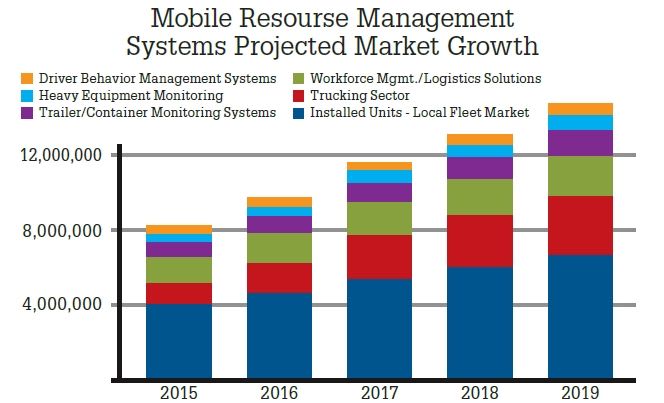
Breaking down the year-over-year growth by sector shows
a large potential increase in the trucking sector. (SOURCE: CJ DRISCOLL & ASSOCIATES)
MOBILE RESOURCE MANAGEMENT PROJECTED SYSTEMS GROWTH

Breaking down the year-over-year growth by sector shows
a large potential increase in the trucking sector. (SOURCE: CJ DRISCOLL & ASSOCIATES)
A lot has changed since C.J. Driscoll & Associates published the first edition of its U.S. Mobile Resource Management Systems Market Study report in 2003. The report provides in-depth information on each major mobile resource management (MRM) market segment and reveals today’s trends in the world of telematics.
When first produced, the term Automatic Vehicle Location (AVL) was commonly used rather than telematics or MRM, which are more widely known today. The first study estimated that the U.S. fleet market consisted of nearly 20 million vehicles (fleets of five or more), about 900,000 of which were equipped with AVL units — that’s less than 5% of U.S. fleet vehicles.
In December 2015, C.J. Driscoll & Associates published the fifth edition of its report, now featuring market segments such as vehicle-installed GPS fleet management systems; GPS-equipped smartphones, tablets, and other portable devices for managing mobile workers; and systems used to monitor trailers and heavy equipment.
Twelve years later, the study puts the fleet market at about 18.5 million vehicles, with 5 million-plus equipped with GPS/wireless devices. Adding units installed on commercial trailers and heavy construction equipment, and GPS-equipped smartphones and portable devices used to manage mobile workers, the total number of MRM units in service is now over 8 million. By 2019, the total number is projected to grow to more than 14 million units, with MRM hardware and service revenues growing to more than $4.7 billion.
MRM use has seen major growth since the early years of the industry, but that’s not the only trend to be seen. The 2016-2017 edition of the report takes a closer look at other trends going on today.
“We have been publishing the study about every three years,” said Clem Driscoll, president of C.J. Driscoll & Associates. “The report covers the latest trends, the size of the overall fleet market and individual fleet segments, MRM use by fleet categories, and profiles of more than 140 solution providers in a wide range of categories.”
Growth Ahead for Trucking Fleet Solutions
Although there has clearly been overall growth in the MRM market, actual growth has varied based on fleet sector. According to Driscoll, sales of local service and delivery fleet solutions have grown steadily in recent years, whereas trucking fleets have seen slower growth rates, overall.
“For quite a while we’ve seen strong growth of about 15% a year in the local service and delivery fleet market for GPS tracking solutions. Even during 2009, the growth rate slowed down during the recession, but it didn’t stop. It continued to grow at about 8%, as opposed to the 15% or so it’s growing since 2010-2011,” Driscoll said. “Trucking is distinct from local service and delivery. It’s been dominated by a couple of big suppliers and the market has been growing at about 10% per year.”
With the recently issued Federal Motor Carrier Safety Administration (FMCSA) mandate requiring Electronic Logging Devices (ELDs) to be used to record driver Hours of Service (HOS), MRM growth in the trucking market is bound to increase.
By the end of 2017, drivers required to record hours of service must stop using paper logs and instead use ELDs — essentially GPS tracking systems with certain HOS-related features — installed in their trucks. The FMCSA estimates that ELD regulations will affect 3.1 million trucks and 3.4 million drivers, so the use of these types of MRM solutions is poised to skyrocket.
“The ELD mandate will change the trucking space dramatically and will drive strong adoption of these solutions,” Driscoll said. “Most of the growth will be next year as the deadline gets closer. As a result, in 2017, the growth of the trucking sector will exceed that of the local service and delivery fleet market.”
Driscoll predicted that small trucking fleets not currently using an electronic HOS solution will wait until the last minute to implement. He also suspected those fleets that feel ELDs are an unnecessary expense will implement a low-cost solution that doesn’t have full GPS fleet management capabilities — they’ll simply monitor and record HOS to meet the mandate.
Just as growth rates for trucking fleets have differed from those of local service and delivery fleets, so have the types of devices used. Local service and delivery fleets have relied on a black box incorporating a GPS receiver and a cellular data modem — a relatively inexpensive solution. But, trucking fleets historically adopted more expensive solutions, which often included satellite communications instead of cellular and also a mobile data terminal (MDT).
“Over the years, those were two distinct markets,” Driscoll said. “They’re coming closer together today but are still somewhat distinct in their features.”
Today, hardware solutions available for the trucking sector have expanded, with driver interface devices ranging from traditional MDTs to tablets to smartphones (Bring Your Own Device, or BYOD). All can be connected to the Electronic Data Bus in the vehicle via hardwire, Bluetooth, Wi-Fi, or several other options.
So, the cost of hardware solutions now varies a lot depending on the fleet’s needs.
Low-Cost Solutions Challenge Price Points
The numbers show that MRM use has grown exponentially over the past 10-plus years and should continue to grow in the years to come. But, when it comes to providers, what does the market look like? According to Driscoll, a few key players are growing bigger and are becoming more dominant, but some new suppliers that have entered the market within the past two to three years are also holding their own.
“There are many suppliers of GPS fleet management solutions,” Driscoll said. “We see consolidation in the market, with a fair amount of mergers and acquisitions on the one hand; however, on the other hand, we see new companies coming in and some doing well. It’s a sign the market is maturing but it hasn’t slowed yet. The growth is still very strong.”
What does this mean for fleets? Driscoll said some of the newer providers are focused on offering very low-cost solutions, underpricing more established providers, and even forcing them to lower their prices.
Beyond GPS: Value-Added Services
As more low-cost players enter the market, Driscoll said another trend is for MRM providers to offer features beyond basic GPS fleet tracking. Although a simple fleet management solution may be offered at a low cost, additional capabilities such as driver behavior monitoring, navigation, and fuel card integration offer upsell opportunities for providers.
“Adding more features and functions is a way for providers to try to keep average revenue per unit up and counter the increased competition,” he said.
Driver performance monitoring is one such trend to emerge in the past few years.
“Five years ago, you didn’t see a lot of driver performance monitoring. Today, you can monitor speeding, hard braking, fast acceleration, and other parameters that point to risky driving behavior and can lead to accidents — everybody offers those features now,” Driscoll said.
Systems typically connect to the OBD-II port of a light commercial vehicle or the J-BUS/CAN-BUS on a heavy-duty truck to collect data on how the vehicle is being driven. In addition to providing data, many providers also offer a driver scorecard that ranks drivers based on safe driving habits. The risk of crashes are a big issue for all fleet operators, and these features can help to reduce it.
Navigation is another optional service trending these days. Many MRM systems can integrate with a navigation system to improve routing and dispatching.
“This enables you to send data messages to a Garmin or similar device in the vehicle so you can give drivers the address of their next stop and help them navigate to that address,” Driscoll said. “Increasingly, smartphones are also being used to support navigation and dispatching.”
As driver fraud continues to be a concern among fleets, fuel card integration has grown to be another popular option.
“A lot of cheating goes on as fleet drivers use the company fuel card to fill up their personal vehicles or even someone else’s,” Driscoll said. “Fuel card integration lets fleet managers correlate the location of the fleet vehicle with the time and location of where the fuel was purchased to make sure the purchase is legitimate.”
Customizing to Fleet Needs
As MRM providers offer value-added services, they are also customizing their solutions to meet the needs of fleets in specific vertical markets. For instance, a utility fleet may need the ability to integrate proprietary maps of underground facility and pipe locations with in-vehicle tracking or other handset- or smartphone-based solutions.
A plumbing company, on the other hand, might be more concerned about moonlighting — where employees use the company van to do their own plumbing work after hours. Such a company may only need vehicle tracking, geofencing, and the ability to monitor arrival and departure times at customer locations.
“A utility fleet’s requirements are not exactly the same as those of a plumbing and heating fleet,” he said. “They overlap but aren’t identical. For market segments with special requirements, solutions have to meet the market’s needs.”
The MRM study cites many drivers of growth in the MRM industry, including the ELD mandate, lower cost options hitting the market, and additional features beyond GPS. The study concludes, however, that the greatest catalyst for growth is a continually increasing awareness of the positive return on investment these systems provide across a wide range of applications due to increased productivity, efficiency, as well as safety and security.
Originally posted on Work Truck Online
More Global Fleet

GeoFencing Adds to Your Truck Security Arsenal
Geofencing is a familiar fleet tool today, but its early adoption marked a major shift in vehicle tracking, route monitoring, and the debate over employee privacy.
Read More →
Holman Takes Full Ownership of ARIZA in Mexico
Holman is bringing its Mexican fleet management operation fully under its own brand after more than 30 years as a joint venture. The change gives multinational fleet customers a single Holman operation across the U.S., Canada, and Mexico.
Read More →
5 Tire Maintenance Tips to Help Prevent Work Truck Downtime
Regular tire checks can do more than extend tread life. These five maintenance practices can help work truck fleets catch problems early, reduce costs, and prevent downtime.
Read More →

Proven Ways to Reduce Work Truck Downtime
The age-old problem of downtime will always be a reality, but with new strategies at hand, fleets have more ways to keep trucks on the road longer.
Read More →


Cameras, Safety and Insurance: From Reactive Claims to Real-Time Prevention (Part 2 of 2)
Part Two: Commercial auto remains one of the most challenging and costly lines of coverage for fleet operators and insurers alike. Continue learning more about how to effectively address these issues from Onur Aksan, Enterprise Business Development Executive, Geotab
Read More →
Cameras, Safety and Insurance: From Reactive Claims to Real-time Prevention
Commercial auto remains one of the most challenging and costly lines of coverage for fleet operators and insurers alike. Learn more about how to effectively address these issues from Onur Aksan, Enterprise Business Development Executive, Geotab.
Read More →
Fleet Costs Are Rising: Here’s How Leaders Are Responding
Fleet leaders are under pressure to reduce costs, adapt to economic uncertainty, and make smarter decisions. See how peers across North America are responding with real data, proven strategies, and forward-looking insights. Download the 2026 Market Pulse Report to benchmark your strategy and uncover where you can gain an edge.
Read More →
Enterprise Fleet Management Surpasses 900,000 Vehicles in U.S. & Canada
Enterprise Mobility connects with mobility solutions around the globe
Read More →