




Creating a Fleet Safety Matrix
Understanding that one-size solutions don’t fit all, the CEI Matrix Project is geared to help fleets create the most comprehensive safety policies and practices, specifically measured to each fleet.
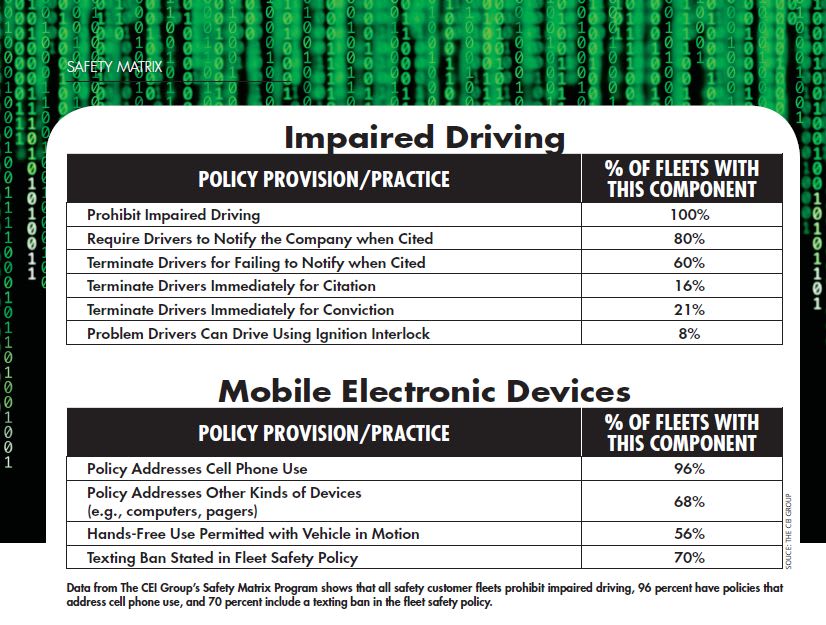
Data from CEI's Fleet Safety Matrix program.
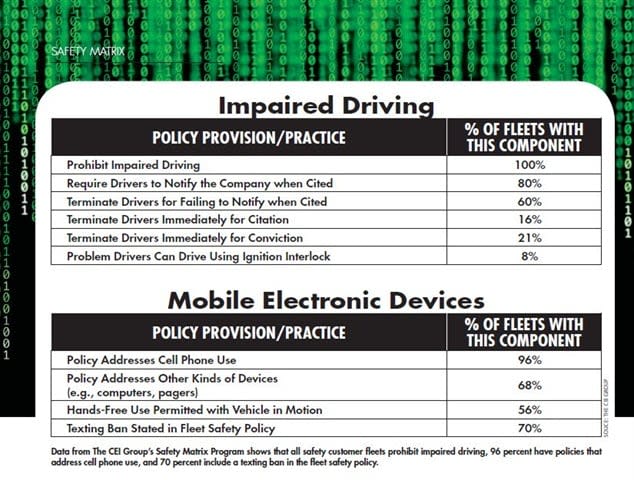
Data from CEI's Fleet Safety Matrix program.
At a Glance
The Safety Matrix Project by CEI:
Tracks nearly 100 different variables of fleet safety policies and practices.
Helps client fleets build effective safety policies and programs.
Assists in building a business case for adding new components to safety programs.
The DriverCare Safety Matrix Project is an ongoing effort by fleet management company CEI to catalog, index, and analyze fleet safety policies and practices to help its customers shape their fleet safety programs. It is a comprehensive index that tracks all the key policy provisions and safety practices The CEI Group’s safety customers have in place.
Basic fleet data is added, the most critical of which being each fleet’s accident rate.
“Essentially, the matrix is a checklist that indicates whether and how fleets address a wide variety of subjects,” according to Vincent Brigidi, president and COO of CEI. “Some key topics include driving under the influence, distracted driving, and secondary drivers.”
CEI’s Safety Matrix tracks nearly 100 different variables of fleet safety policies and practices, based on dozens of CEI safety customers.
“Behind the matrix is the text of all of our customer’s safety policies and procedures, which enables us to present individual parts of a policy without identifying whose they are to any fleet that is considering making a change to their program,” said Brian Kinniry, manager, risk and safety relations for CEI. “The added benefit is that we are presenting wording that has already been put to the real-world test in legal, risk management, fleet, and other departments at our customers.”
Starting with User Group Feedback
The Safety Matrix Project grew naturally out of CEI’s annual DriverCare Users Group meetings.
“The first part of these meetings is usually devoted to describing new features of our DriverCare fleet safety service, including those we’ve put in place over the prior year, ones we’re working on, and those our clients would like to see us add in the future,” Brigidi said. “The second part has been a knowledge-sharing discussion, in which fleets talk to each other about how they’re handling changes in the fleet environment, like the use of cell phones, texting, or the use of fleet vehicles by relatives of their employees.”
After a meeting two years ago, CEI decided to formalize the data from these meetings to enable the company to better share the information with fleet clients that were not members of the Users Group. The Safety Matrix Project is ongoing, with plans to update the matrix several times per year, keeping it up-to-date with changes fleets are implementing and adding new customer data as it’s available.
“We’re now conducting our first round of policy and program reviews with our clients using the matrix as a guide,” Kinniry noted.
The project’s goal is to help fleets build the most effective safety policy and programs possible. It’s for fleet clients creating their first fleetwide driver safety program, as well as those who want to revise or add to their existing programs.
“A long-range goal is to establish a connection between the addition of a new policy provision or safety program practice and show what kind of impact it has on accident rates,” Brigidi noted.
Another role the Safety Matrix Project is taking is helping customers create a business case for adding new components to their safety programs.
“Sometimes, a customer knows that a proposed new practice is likely to encounter resistance within his or her organization. Our Safety Matrix can help overcome that resistance by showing that the practice is in use and has had success for other fleets,” Kinniry noted. “An example is whether to run motor vehicle reports (MVRs) more than once a year. Nearly 63 percent of our customers do, but it’s an added expense. Knowing that many other fleets do it and that it has achieved desirable results, could help a customer secure management’s commitment to go forward.”
Providing Assistance Where Needed Most
When it comes to safety policies and programs, most fleets need (and want) help with their design and content. “They want to know what components to add based on what has worked in other fleets,” Brigidi commented. Our experience also tells us there is more than one way to deal with many subjects, and what works in one fleet doesn’t necessarily work for another.”
Why is this? “Every organization has its own unique culture. Our advice to fleets is to fit their safety program into their culture instead of trying to fit their culture into a safety program,” Brigidi said. “Challenging the status quo and ‘pushing the envelope’ are concepts that should be integrated into any efforts to improve driver safety. We are simply saying that a company’s culture is of critical importance and must be taken into account as any safety program is constructed or enhanced. Our approach adds another dimension to the change process, because we can show fleets a variety of ways others have had success in dealing with a subject.”
One example that CEI is working on with a few fleets currently is whether drivers should be required to pay for a portion of the expenses for repairs for at-fault accidents. “This topic has generated some interesting discussions with fleet and risk managers, and the CEI Safety Matrix has enabled us to provide significant detail around the subject,” Kinniry observed.
Another example is the practice of requiring drivers to report motor vehicle violations. “Again, this is a topic of considerable interest to the stakeholders of many of our customers, and even surfaced in discussions with attendees at the recent RIMS conference in Philadelphia,” Kinniry said.
“The objective of our Safety Matrix Project is to help fleets find what’s best for them among all the different practices our other customers follow, and new ones that come from the great work that customer safety experts and consultants do every day,” Kinniry said.
More Safety

Fleet Manager’s Ultimate Playbook: Navigating the New Standard in OEM Connectivity
Rising operating costs, driver safety concerns, and unplanned downtime are putting unprecedented pressure on modern fleets. Discover how fleet managers use embedded OEM connectivity and real-time vehicle data to cut TCO, prevent downtime, and protect drivers without aftermarket telematics hardware.
Read More →
From Driver Well-Being to EV Charging | AF News Recap
Mental health belongs in the fleet safety conversation. This week, we’re looking at five ways fleets can support employee well-being before a crisis, plus Holman’s expansion in Mexico, new one-day Fleet Forward passes, and why EV charging demand is outpacing infrastructure growth.
Read More →
Nexar-Nauto Merger Aims to Give Fleets Better Safety Intelligence Through Larger Driving Dataset
Stefan Heck tells Automotive Fleet that combining more than 10 billion miles of driving history with Nexar's AI models will give fleets deeper insights into driver risk and roadway conditions than either company could provide independently.
Read More →
Don't Wait for a Crisis: 5 Ways to Build Mental Health Into Your Fleet Safety Program
For Suicide Prevention Month, fleet and safety leaders have an opportunity to put mental health where it belongs: at the center of workplace safety.
Read More →
How Camera Data Can Strengthen a Fleet’s Insurance Renewal
Insights from a commercial insurance carrier and a broker show how fleets can turn video telematic data, driver coaching, and improved claims results into a stronger case at insurance renewal.
Read More →
The Safest Fleets Aren’t the Ones with the Most Technology
You’ve made the telematics investment. Here’s how to capture the other half of its value and build the safest fleet on the road.
Read More →
Hidden in Plain Sight: Fleet Compliance Risks
Fleet compliance isn't just about having policies — it's about consistently enforcing them. This practical guide reveals six hidden compliance risks common in public sector and shared fleet operations and outlines proven strategies to improve visibility, accountability, and audit readiness
Read More →
NETS Sets 2026 Fleet Safety Benchmark Conference for Indianapolis
The Sept. 15–17 program will feature fleet benchmarking data, case studies, emerging technologies, and implementation strategies while running alongside the NSC Safety Congress & Expo.
Read More →
Off-the-Job Crashes Account for 43% of Employers’ $61.7 Billion Crash Burden
NETS quantifies costs dispersed across fleet, risk, HR, and other departments while providing new per-crash benchmarks for employers.
Read More →
Ram Recalls More Than 1.27 Million 1500 Pickups for Seat Belt Anchor Issue
The recall affects certain 2019-2026 Ram 1500 pickups that may have improperly attached second-row seat belt buckle anchors.
Read More →