China & India Fleet Markets Poised for Major Growth
As a global organization, one of General Motor’s five regions is GM International (GMI), which covers more than 100 countries and territories in Asia Pacific, the Middle East, and Africa. This region accounts for nearly half of all motor vehicle sales around the world.
As a global organization, one of General Motor’s five regions is GM International (GMI), which covers more than 100 countries and territories in Asia Pacific, the Middle East, and Africa. This region accounts for nearly half of all motor vehicle sales around the world.
Ad Loading...
WEST
“GMI is comprised of diverse markets, ranging from emerging to mature, with growing middle classes and rising disposable incomes,” said Gary West, corporate sales manager, GM International Operations in Singapore. “GMI represents 49 percent of the world’s land area, 56 percent of the world’s population,17 percent of the world’s GDP, and 44 percent of global automotive sales and growing.”
Ad Loading...
The largest market in Asia Pacific is China, which is also the largest vehicle market worldwide, with 22 million units sold annually. “The market in China could easily reach 30 million units by 2020,” said West.
Another GMI region is the Middle East, which is the fastest-growing market outside the BRIC (Brazil, Russia, India, and China) nations. Sales in the Middle East are expected to double by 2020.
“ASEAN, the Association of Southeast Asian Nations, could become the sixth-largest market by 2018 if it can operate as a true single market,” said West.
GM’s position in the GMI region is also diverse, from the 150-year-old brand of Holden in Australia and New Zealand to the younger Chevrolet brand in ASEAN, where it is a challenger brand. “The markets of GMI are critical to GM’s long-term growth strategy,” said West. “GM is in the process of implementing a market-driven transformation, to ensure it maximizes the true potential of the region.”
China:
State of the Fleet Market
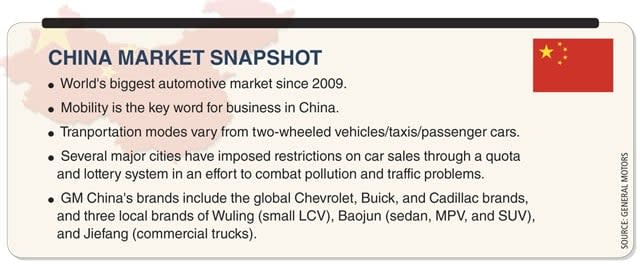
GM China’s brands include the global Chevrolet, Buick, and Cadillac brands, and three local brands of Wuling (small light commercial vehicle-LCV and passenger minivans-MPV); Baojun (sedan, MPV, and SUV); and Jiefang (commercial trucks).
Ad Loading...
In 2014, GM sold nearly 3.54 million vehicles in China; an average of one vehicle every nine seconds and almost 9,700 vehicles each day. GM’s sales were up 12 percent from the previous high of 3,160,377 vehicles sold in 2013. Fleet sales accounted for more than 130,000 units.
“As of the first nine months of 2015, GM and its joint ventures had record sales of 2,492,428 vehicles in China. Sales were up 1.6 percent on an annual basis, as increasing demand for SUVs, MPVs, and luxury vehicles helped offset the market slowdown,” said West.
While Chinese companies are moving toward a self-drive option for drivers, the standard solution for expatriates doing business in China is to provide a car with a driver.
“Mobility is the key word for businesses in China, which utilize various forms including public transport, two-wheeled vehicles, taxis, and, of course, passenger cars to mobilize employees to sell, service, and distribute their products,” said West. “As an example, multinational companies (MNC), many being GM global customers, have a mix of solutions for their business needs. Their fleet policies, or mobility policies, have been evolving very rapidly over recent years, with total cost of ownership (TCO) being a recent driver, but, in general, the market is still developing.”
Despite growth in the Chinese economy over the past several decades, all fleet leasing companies still have very small leased-vehicle portfolios. One reason, among many, is that in the small- to medium-company market many salespeople in China rely on public transportation.
Ad Loading...
Current Market Conditions
The Chinese fleet market breaks out into five vocational segments: sales to state-owned businesses, government, emergency services, long-term rental, and taxis.
Long-term rental, vehicles that are rented (sometimes with a driver) to multinational corporations and state-owned businesses have seen a 10-percent growth year-over-year (YOY).
In contrast, GM has seen other vocational segments extend replacement cycles, which is currently reducing overall fleet demand. Overall, the true fleet market is experiencing some pressure to accommodate the business needs during this current economic slowdown in China.
“The majority of sales in China are to new private drivers, however the fleet market and commercial sales market is growing. The fleet market is predominantly comprised of sales to state-owned companies, governments, operations, and long-term rental, what we would call leasing operations, in addition to multinational companies,” said West.
Recently launched models, such as the Buick Excelle GT and Cadillac ATS-L, have been well-received by Chinese consumers.
Ad Loading...
“Increased demand for several SUV and MPV models offered by GM has helped offset some market slowdown,” said West. The Buick Envision and Baojun 560 led the sales growth of GM’s SUVs, rising 161.7 percent, while sales of the Baojun 730 MPV more than doubled.
“We are seeing fleets extend replacement cycles, which is reducing current fleet demand. Overall, the true fleet market is experiencing some pressure to accommodate the business needs during this slowdown,” said West. “In the first half of 2015, GM China sold more than 77,000 fleet units down on a year-over-year basis, due to replacement cycle extensions and government purchase policy changes.”
In China, the current vehicle acquisition preference by fleets is compact-sized vehicles.
“The compact sedan is by far the largest segment used for fleets in China. GM sells the Chevrolet Cruze, Buick Excelle, and Baojun 630 in this segment,” said West. “However, we are seeing a trend of fleets looking at the compact MPV as an alternative that offers flexibility of use. GM is well positioned for this with its Baojun MPV.”
It is difficult to identify an average fleet size in China. “Fleet size varies widely and is dependent on the mobility policy of the company,” said West.
Ad Loading...
“Although there is a slight softening in fleet sales at this moment in time, due to a trend by companies to lengthen their replacement cycles, we see this as something that we can certainly overcome."
Also, recent government purchase policy reforms require a lower transaction price, smaller engine displacement, and acquisition of domestic brands. One consequence is that the Chinese Army is removing certain luxury brands and models from its fleet and replacing them with the domestic FAW Hongqi models.
"GM has proactively invested in its production capability in China, with more than 24 facilities. The vast majority of vehicles sold are built in China with our joint venture partners. Average order-to-delivery (OTD) is one to two months,” said West.
Fuel Price Trends
Currently, there is no significant correlation with the downward pressure on fuel prices and the types of vehicles acquired for fleet use. “However, with MNCs we are seeing the adoption of a TCO approach, which does take into account fuel efficiency,” said West. “The government, in its aim to reduce pollution, is implementing a government purchase policy directive that 30 percent of the government fleet is to be new energy vehicles (NEV), which are part- or full-electric vehicles.”
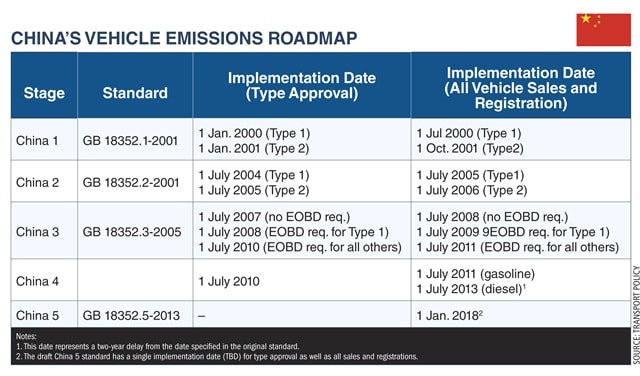
Source: Transport Policy
Chinese Resale Market
In the majority of cases, vehicles are sold to first-time buyers and drivers. “The pre-owned vehicle market is very buoyant with many options for disposal; from independent traders to OEM-branded certified programs. Although part of the overall equation, at present, residual values play a much smaller role in China, especially with international brands,” said West.
Ad Loading...
Chinese Interest Rates & Taxation
The current economic challenges in China are placing some downward pressure on the fleet market, with replacement cycles being extended. In 2013, the leasing industry in China was affected by the induction of the value-added tax (VAT) system in the most developed regions of the country.
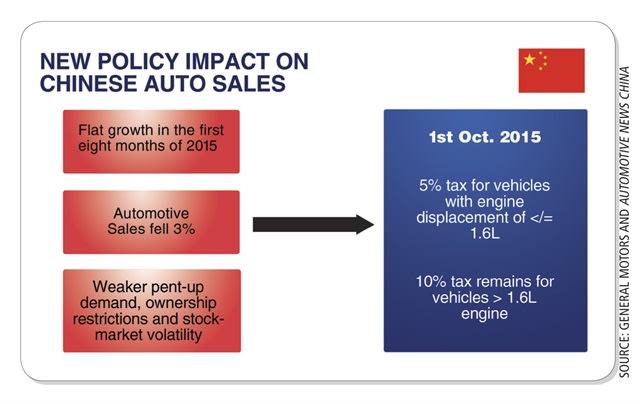
Source: General Motors and Automotive News China
Forecast for the 2016-CY
China is a very government-policy sensitive market and the new government purchase policy reforms will have a downward YOY impact on automotive sales in the 2016 calendar-year.
India:
State of the Fleet Market
General Motors recently announced an additional $1 billion (USD) investment in India, which will enable the automaker to fully localize, industrialize, and optimize its footprint and supports the creation of approximately 12,000 highly skilled jobs within GM and its suppliers.
“Our state-of-the-art Talegoan plant will become a global export hub, exporting 30 percent of its annual capacity. In 2015, GM India will be exporting 19,000 units to new markets of Mexico and Chile, which is a small car we produce branded as the Chevrolet Beat or Spark for export markets,” said West.
Domestically, GM India aims to double its market share by 2020 by launching 10 new products in the next five years and strengthening its dealer network.
Ad Loading...
In terms of current market conditions in India, total cost of ownership (TCO) is paramount, with the Indian consumer very focused on overall running costs.
Small car segments dominate the automotive industry in India due to their attractive total cost of ownership, acquisition methods, range from outright purchase and lease, to subsidized financing, whereby the driver funds part of the cost along with the company from pre-tax salary.
There is much growth potential for the automotive sector in India. Despite its population of more than 1.2 billion people, India sells just 3.38 million vehicles per year.
The corporate car market in India can be broadly divided into two segments: first, where the car is provided as a perk or as a tax-saving device and, second, where the car is a requirement for staff to carry out their duties efficiently or as a “tool of the trade.”
The average fleet size in India is between 50 and 100 vehicles, however, larger fleets are operated by companies in the IT and construction industries. The strongest vocational segments for commercial fleet sales are government, taxi/transport operators, corporate, and MNCs, being represented by IT, BPO, banking, agriculture, and construction companies. But, just like China, with the exception of large corporates and multinationals, most companies operating in India do not have a specific fleet policy.
Ad Loading...
As the majority of employees do not have access to personal four-wheeled transport, the large corporate and MNC entities hire the services of taxi/transport operators for the employee commute, whether by minibus or more recently MPVs.
“They may be busing employees in because they have no form of transport into the factory, their place of work, or they may be using two-wheeled transport for delivery of product. So, in general terms, we’re seeing an uptick in business,” said West.
One fleet sales segment is the leasing industry. “Although the leasing industry is relatively small, it is developing quickly,” said West. “We’re starting to see an increase in fleet leasing.”
The Indian car leasing market is about 15 years old with nearly 10 companies operating in the market. Among the lessors operating in India are global brands, such as LeasePlan, ALD Automotive, and Arval. There are also local brands, such as Raligare, Kotak Mahindra, and Tata Capital, which only offer finance leasing.
In 2015, there was growth in the leasing industry, which is made up of both global leasing brands and national operators, whose main customer has been traditionally the large national or MNC. “These leasing companies are starting to extend their offers into small and medium enterprises (SME),” said West.
Ad Loading...
When sales are examined by vehicle segmentation, small cars dominate the Indian retail and fleet markets. A mix of acquisition methods are available from outright purchase, to leasing, or subsidized financing where the driver funds part of the cost, along with the big company from an employee’s pretax salary.
“The emergence of app-based ride-sharing platforms (such as Uber and OLA, a local brand) has made a significant impact in India and has disrupted traditional fleet segments tour and travel operations,” said West. “These companies are helping to grow the fleet segment for a number of manufacturers.”
In India, sales to government entities, both national and state governments, is a very large fleet market.
“In the taxi segment, we are seeing an increase in purchase of hatchback cars over sedans, due to the flexibility of configuration,” said West. “In addition, we are seeing the emergence of some car-pooling start-ups. The self-drive (which we know as daily rental) car business models are also starting to grow in 2015, with some domestic rental brands leading the way.”
Fuel Price Trends in India
Gasoline and diesel fuel prices have declined in India, paralleling the global decline in oil prices. This is producing a positive impact on fleet operating costs. The fleet commercial segment in India is predominantly diesel.
Ad Loading...
Vehicle Resale Market in India
The pre-owned market is still emerging in India, with the majority of OEMs having a used-vehicle certification program. But, many used vehicles are bought and sold within the extended family or bought by traders and resold to rural customers in smaller towns and villages who can only afford second-hand vehicles.
Interest Rates, Taxation & Vehicle Regulations in India
India has complex regulations with regard to vehicle pricing, taxes, registration, and usage. The rules for each differ in its 28 states and seven union territories.
In each state, there are different value-added tax (VAT) rates and rules applicable. And, there are complexities in the formalities required for registration, transfer, and sale of cars. Unlike Europe and North America, leased vehicles must be registered in the name of the lessee, since the lessee has physical possession of the vehicle during the lease term, whereas the legal ownership continues to be with the lessor. Furthermore, a car registered in one state must ideally be used and sold in the same state to avoid double taxation and other complexities.
About the Author
Mike Antich is editor of Automotive Fleet magazine, published by Bobit Business Media, and conference chair of the Global Fleet Conference held in North America. He can be reached via e-mail at mike.antich@bobit.com.
Geofencing is a familiar fleet tool today, but its early adoption marked a major shift in vehicle tracking, route monitoring, and the debate over employee privacy.
Holman is bringing its Mexican fleet management operation fully under its own brand after more than 30 years as a joint venture. The change gives multinational fleet customers a single Holman operation across the U.S., Canada, and Mexico.
Regular tire checks can do more than extend tread life. These five maintenance practices can help work truck fleets catch problems early, reduce costs, and prevent downtime.
Part Two: Commercial auto remains one of the most challenging and costly lines of coverage for fleet operators and insurers alike. Continue learning more about how to effectively address these issues from Onur Aksan, Enterprise Business Development Executive, Geotab
Commercial auto remains one of the most challenging and costly lines of coverage for fleet operators and insurers alike. Learn more about how to effectively address these issues from Onur Aksan, Enterprise Business Development Executive, Geotab.
Fleet leaders are under pressure to reduce costs, adapt to economic uncertainty, and make smarter decisions. See how peers across North America are responding with real data, proven strategies, and forward-looking insights. Download the 2026 Market Pulse Report to benchmark your strategy and uncover where you can gain an edge.