




Chevrolet Silverado EV A Solid Power Work Truck
2025 Chevy Silverado EV WT 8 review: does this electric work truck deliver on range, power, and real-world fleet needs?

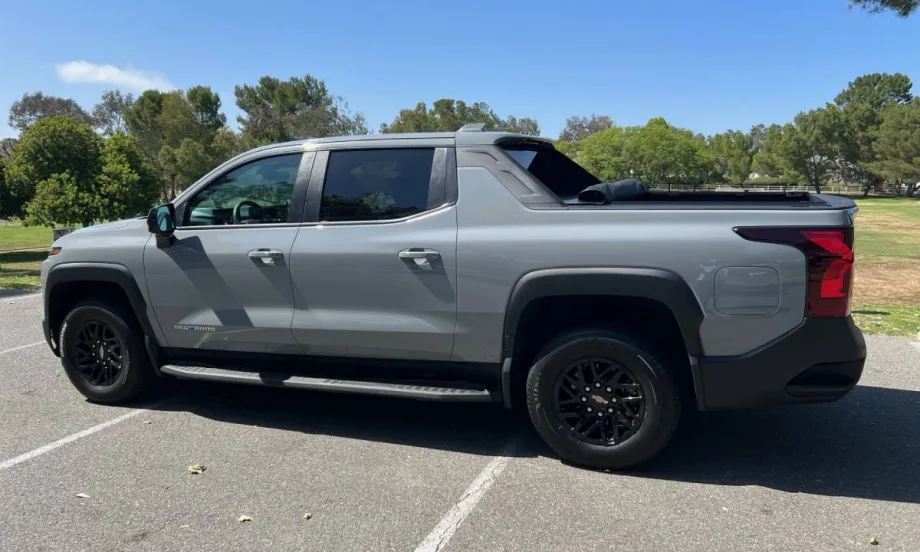
As with most electric vehicles, this electric work truck rolls quietly and smoothly with faster acceleration.
Photo: Martin Romjue / Automotive Fleet
- The review discusses the 2025 Chevy Silverado EV WT's range, power, and how well it meets the practical needs of fleet operations.
- Insights into the truck's performance highlight its suitability for real-world work environments.
*Summarized by AI
With each passing model year, electric pickup trucks gain more clout and street cred in the work truck world.
The 2025 Chevrolet Silverado EV WT 8 leads the e-truck club. When fully charged, it can reach a range of 492 miles. Thanks to rising battery quality and strength, the Silverado has gained about 45 miles in range from MY24 to MY26.
The Silverado numeric models of WT 4, 6, and 8 are based on package level, EV range, and size of battery, with the 8-model providing the most of each.
The Work Truck “Max” (8) has a starting MSRP of $76,295, which includes a $2,095 DFC. The cost of the full amenities truck I tested for Automotive Fleet is $80,460.
For fleets, the max extended range makes it possible for the truck to handle five weekday duty cycles of about 95 miles each. Another way to look at it is if you drive this truck 95 miles or less per weekday, you should only need to charge it on weekends.
Among large fleets using the Silverado EV work truck are McKinstry, a construction and energy firm, and Southern California Edison, a major utility.
With three trims — Work Truck, LT, and Trail Boss — Chevrolet offers a Silverado EV for every price point, capability need, and lifestyle. The Silverado EV lineup has expanded to provide customers with more choices.
The Quick Numbers Scoop
Among the core size-it-up stats and metrics of the WT 8 model:
The average annual estimated cost of electric power is $1,200.
GM estimates energy savings of $3,500 over five years when factoring in an average of 68 MPG for electric.
The truck has a rechargeable energy storage system comprising multiple linked modules
The charge time to a full battery is 13.3 hours on a 240-volt Level 2 charger.
Available DC fast-charging up to 350 kW: 100 miles in 10 minutes
A NACS DC adapter enables charging at certain Tesla Supercharger stations.
The cargo box contains 57.3 cubic feet of space, and the frunk has 10.7 cubic feet.
The battery and electric components come with a warranty of 8 years / 100,000 miles.
Up to 10.2kw/h of off-board power is available on all trims with outlets for tools available along the right interior panel of the cargo compartment.
The Silverado cargo bed features four 110-volt outlets, which provide a max of 2 kw/h of power, and one 220-volt outlet for 7.2 kw/h.
Drivetrain/motor: Performance torque vectoring dual front-rear motor 4WD (electronic 4WD)
Horsepower: 510
Torque: 580 lb.-ft.
Wheelbase: 145.7 in.
Length: 233.1 in.
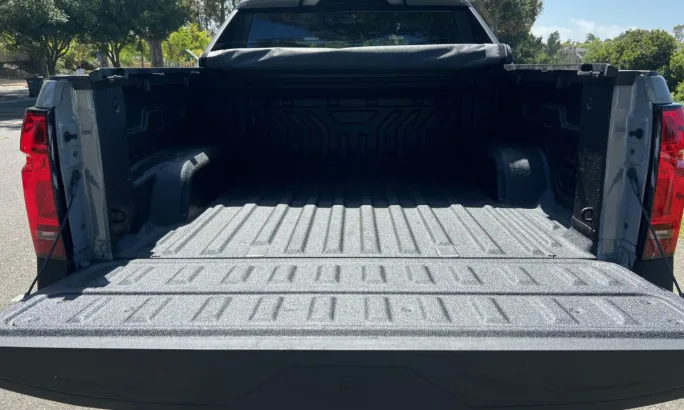
The soft roll-up tonneau cover allows for a sleek flexibility and ease in loading and unloading cargo. When fully covered, it can serve as one spacious trunk.
Photo: Martin Romjue / Automotive Fleet
Spacious Options
As with most electric vehicles, this electric work truck rolls quietly and smoothly with faster acceleration. Minus the grinds and churns of gasoline or diesel versions, the entire experience brings less friction and distraction. If your Silverado is not a work truck, you could easily lapse into the pampered mode of a luxury vehicle.
The dashboard and first row offer compartments with ample deep storage space, so you don’t have to put your work (or leisure) contents all in the frunk. For contents that need more upright support, the frunk proves ideal for toolboxes, bags, and containers of all types.
The soft roll-up tonneau cover allows for a sleek flexibility and ease in loading and unloading cargo. When fully covered, it can serve as one spacious trunk. I used it to transport some bags of recyclables to a collection center for cash, a very California thing to do in an electric pickup truck.
Premium Safety Tools Nudge Drivers
As fleets confront more safety challenges and adopt the technology to meet them, the Silverado pickup belongs in the top tier of safety, as I experienced driving around Southern California.
Overall visibility proves excellent, as you sit slightly higher than multiple SUVs I’ve driven. The combination of safety alerts, rear and side view mirrors with yellow lane change warning lights, 360-degree parking cameras, and side and rear window space together provide enough visual perception to give a driver confidence in maneuvering a large work pickup truck.
The safety alerts and warnings are the most attentive out of any vehicle I’ve ever tested or driven. Two examples underscore that point:
As I checked messages in a parallel parking space along a residential street with the truck turned on, I received an alert that specifically mentioned that someone was coming along the left side. (I don’t remember where I saw the info flash in front of me or what words it used). But it was a cyclist. Although I was absorbed in my phone with the transmission in “P” mode, the system sensed I may be turning out of the space at any moment. Good thinking by the truck.
While driving along a four-lane street with a 45-mph limit, a car suddenly pulled out of an exit lane at a medical complex in front of the car — in front of mine. A set of warning lights that looked like a set of angry red teeth flashed in the dashboard, and my seat vibrated as the car narrowly cleared the one in front of me and then abruptly turned left passing me in the other direction. I still had a safe following distance when I received the warning and only had to lift my foot off the accelerator while in the normal one-pedal mode.
As onboard ADAS technology applies more intelligence, even if it’s termed “artificial,” it can spare us real accidents and injuries in real-time situations.
Better Learn All That Tech
As with any new vehicle with advanced technology, a novice is prone to making mistakes that yield teachable moments. Fleets will need to invest in some quality training time so their drivers can fully appreciate the controls.
In my first drive to my local post office, I hit a button on the lower left of the dash next to the steering wheel that sent my EV range reader display plummeting from 474 miles to 280 miles, all while I was coasting down a hill. It was unnerving, to say the least, and of course, I imagined the worst: What if I hit an emergency release button to drain the battery of charge and I get stranded?!
Silly scaredy me; there is no such thing on an electric vehicle, and it was my latent range anxiety kicking in. It turns out I had either hit a driving mode button for towing and off-roading, which requires more power and limits your range, or I had opted for the truck to remain juiced for 60 minutes after parking it. I resolved the issue as randomly as I had caused it: the next day, I pressed an e-button on the iPad-style screen, and immediately the range shot back up to 474 miles. Whew.
Plenty Of Potential Ahead
After my test period, I spoke with Joe Roy, chief engineer of Silverado and Sierra EV vehicles, who said the 2026 model will continue the Silverado push for improvements. It will offer an 11.3-inch driver dashboard display instead of the 8-inch on the 2025 model, while the infotainment display will expand from 11 in. to 17.7 in.
“With 493 miles, range anxiety doesn’t exist,” Roy said. “It’s enough to optimize driving and charging and doesn’t seem to be an issue for our customers.” On the fleet side, work truck users get plenty of driving and usage per day.
The outlets come in handy for power tools to do work around the house and for available off-board power, said Roy, who works with his engineering team in Detroit. The Silverado EV is built with globally sourced parts at the Factory ZERO Detroit-Hamtramck Assembly Center in Michigan.
Chevrolet anticipates more upgrades and improvements as battery and charging technology evolve.
“The drivers are buying our trucks because they want our range,” said Catherine Scales, senior manager for Chevrolet communications. “We take feedback from our customers to give to Joe and his team so they can engineer vehicles to be the best and give customers what they expect.”
More Green Fleet

New Propane Autogas Program Offers Fleet Compensation
Qualified commercial fleets can receive $7,500 per eligible propane autogas vehicle and up to $10,000 for new refueling site prep. Learn how the program works and see whether your fleet qualifies.
Read More →
EV Charging Use Is Outpacing Infrastructure Growth
ChargePoint’s 2026 Charging Forward Report points to rising charger use, higher-powered charging, commercial vehicle electrification, and energy-management technology. Here’s what fleets should know.
Read More →
Merchants Fleet Reports 290M EV Miles as Fleets Navigate Changing Electrification Market
From millions in operating savings to hundreds of millions of EV miles, Merchants Fleet’s latest report reveals what’s working and what’s changing in fleet electrification.
Read More →
The EV Breakdown Nobody's Talking About: Why Most Electric Vehicle Roadside Calls Aren't Mechanical Failures
Here's why EV breakdowns are widely misunderstood.
Read More →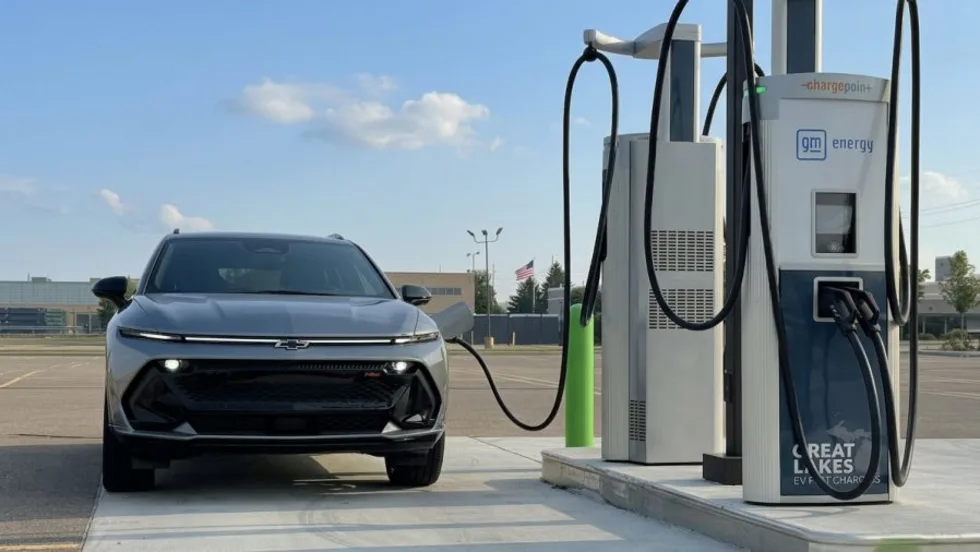
ChargePoint Now Available in Energy Pass
ChargePoint and additional planned charging network integrations were added to GM's Energy Pass.
Read More →

First Look: Slate Auto's Electric Fleet Pickup
Could an affordable, modular EV pickup make electrification more practical for fleets?
Read More →
Slate Debuts Colorful, Unique EV Models
A recent media and client event, studded with electric vehicles dressed up on platforms, planted a new position for the manufacturer in the wider EV market. Fleets will find cost-saving advantages.
Read More →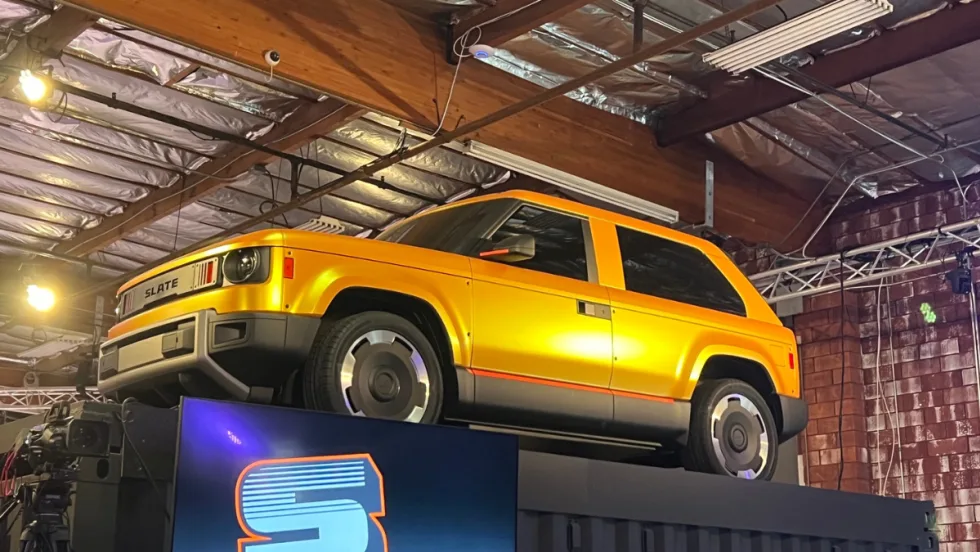
Slate Electric SUV, Pickup Switchable Model Aims For Light-Duty Fleets
Everything about this EV is counterintuitive and understated, making it stand out from the crowd.
Read More →
Inspiration Mobility Acquires Key Electrada Assets
Inspiration Mobility Group has acquired select assets of Electrada, adding the fleet electrification provider's team, technology, and charging infrastructure development capabilities to its energy management business.
Read More →