




Certification: What’s in It for the Fleet Manager?
From smarter fleet decisions to stronger career credibility, certification can give fleet managers knowledge they may never gain inside a single operation.


Certification matters because fleet management is about more than just experience; it’s about building knowledge and credibility.
Automotive Fleet
- Certification offers fleet managers essential skills that extend beyond routine professional development.
- Possessing certification can enhance a fleet manager's professional credibility and career opportunities.
- The value of certification is seen in its potential for increasing job satisfaction and leadership capabilities.
*Summarized by AI
Fleet professionals considering certification may already understand what the credential represents. The harder question is whether earning it is worth the investment of time and money.
After all, certification means studying, taking an exam, and maintaining a credential while already managing the demands of a fleet operation. For someone weighing that commitment, the value has to extend beyond adding four letters after a name.
What tangible value does certification provide to fleet professionals and the organizations employing them? The Certified Automotive Fleet Manager (CAFM) might be the move.
“I believe strongly in the CAFM because it represents more than knowledge," said Bill Schankel, CAE, CEO of the NAFA Fleet Management Association. "It demonstrates a fleet professional’s commitment to their career, their organization and the profession as a whole. Earning the CAFM requires professionals to demonstrate the broad range of knowledge needed to successfully manage today’s complex fleet operations, and that carries real value for both the individual and their employer."
For fleet professional Amy McAdams, certification initially offered something more immediate: credibility.
“I started it in 2012,” McAdams said. “I did it because I was new in fleet, and I felt like I needed it for internal credibility.”
For McAdams, however, the value ultimately extended beyond having a credential after her name.
Building Knowledge Beyond Your Own Fleet
Experience teaches professionals how their fleet operates. Certification can expose them to principles, practices, and disciplines they haven't encountered in their own organization.
Heather Schaefer, director of marketing and business development at NAFA, said fleet professionals enter the profession through different career paths, making a consistent foundation of knowledge valuable.
The CAFM certification covers eight disciplines: asset, business, financial, information, maintenance, risk, fuel management, and professional development. Together, those areas provide a broader view of how different parts of a fleet operation intersect.
For McAdams, who earned her CAFM in 2015, that broader perspective has been one of the lasting benefits of certification. Rather than focusing solely on how one organization approaches fleet management, the program exposed her to industry best practices and alternative approaches to problem-solving.
“It gives you core fundamentals that help you if it’s not your fleet,” McAdams said. “It’s best practices. It can help you think of alternatives.”
That knowledge can give fleet managers different ways of approaching a problem instead of defaulting to “the way we've always done it.”
Certification can help transform specialized experience into a more holistic understanding of fleet management.
Putting Certification to Work in Everyday Decisions
The value of certification isn't just passing an exam; it's whether professionals continue applying what they learned.
The asset management portion of the CAFM certification gave McAdams a framework to use when developing upfit specifications.
“For me, asset management was measurable. It has helped me focus on upfit specifications. I pull from that and experience. The combination of the two puts me in a good spot.”
Education didn't replace experience. The two complement one another.
“I go back to that every time I have to upfit. It becomes a habit. It helps me make good decisions.”
Education around evaluating internal maintenance operations can also prompt managers to examine staffing, technician needs, shop bays, and other factors when right-sizing a facility.
The strongest measure of certification's usefulness may be whether those lessons become part of a fleet manager's normal decision-making process.
Can Certification Reduce Risk?
Certification doesn’t eliminate risk, but broader knowledge can help reduce blind spots.
“That broader knowledge base can help professionals identify potential issues earlier, ask more informed questions and make decisions with a greater understanding of their operational, financial and organizational implications,” said Schankel.
Fleet decisions rarely stay within one silo. An asset decision can affect maintenance, finance, safety, fuel, operations, and other areas. Certification can help managers recognize those connections before making a decision.
“While certification alone cannot eliminate organizational risk, having a CAFM-certified professional in a fleet leadership role can strengthen decision-making and help the organization avoid preventable gaps, inconsistencies or oversights.”
NAFA's CAFM Validation Study included employers who reported that improvements in CAFM designees' work contributed to stronger decision-making and execution.
Certification isn't insurance against mistakes. Its potential value lies in giving managers a wider lens through which to recognize risks and consequences.
What Does Certification Signal to an Employer?
Employers can also view the credential as evidence of professional development and continuous learning.
According to NAFA's CAFM Validation Study, employers reported improvements in certificants' performance, productivity, confidence, capabilities, and quality of work.
McAdams has also seen the credential's value from the hiring side.
“When I was hiring for a fleet coordinator, I looked at that as time invested in themselves to make sure they know best practices to be a well-rounded fleet manager…no matter the situation I put them in, I knew they’d be able to go back to that education.”
Certification potentially tells an employer two things:
- The candidate has been exposed to a broad body of fleet knowledge.
- The candidate has demonstrated initiative by investing in professional development.
The caveat is that the CAFM isn’t universally required in fleet job postings.
“Looking at job postings, you won’t see CAFM required in a lot, but there are more and more companies recognizing its value…”
Certification may not be a prerequisite for fleet employment, but it can give employers another way to evaluate a candidate's knowledge and commitment to the profession.
Can Certification Advance a Fleet Career?
Certification can strengthen someone's professional position without guaranteeing a promotion or salary increase.
Respondents to NAFA's CAFM Validation Study reported increased opportunities, promotions, networking, and, for some, financial advancement. Other themes included greater confidence, credibility, professional standing, and personal achievement.
“Having the CAFM has benefited me not only in terms of credibility, but in the job hunt for new roles,” McAdams said. “Not necessarily a higher salary, but it was an extra tool in my tool belt.”
The knowledge can also transfer beyond traditional vehicle management. McAdams has managed equipment as well and found that some of the same management methods and best practices apply.
A well-rounded fleet career connects advancement and leadership skills, not just simply technical fleet knowledge.
The credential itself doesn't guarantee advancement, but the knowledge, credibility, and demonstrated commitment behind it can become additional assets when pursuing new responsibilities.
Preparing Fleet Professionals for Leadership
As responsibility increases, fleet managers often need to understand areas beyond the discipline in which they started.
A maintenance expert becoming a fleet director, for example, may suddenly need to understand finance, asset management, risk, data, and business strategy.
Certification can provide exposure to disciplines professionals haven't personally managed, while broader knowledge can help fleet managers communicate with leadership, manage change, and contribute strategically.
“As fleet management continues to evolve with new technologies, changing regulations, and increasing operational complexity, organizations benefit when leaders possess a broad understanding of fleet management disciplines and remain committed to keeping their knowledge current.”
NAFA says the CAFM Commission oversees the credential's standards and policies with the goal of maintaining its relevance.
Certification is a Foundation, Not a Finish Line
Certification is not a substitute for the knowledge that comes from years of managing vehicles, solving challenges, and adapting to the needs of a particular fleet. Instead, it can complement that experience through exposure to disciplines, best practices, and perspectives professionals may not encounter in their day-to-day responsibilities.
For fleet managers, that foundation can provide credibility and confidence, along with knowledge they can return to as their roles expand.
That foundation can be especially valuable for professionals who are just entering fleet. With people coming to the industry from a variety of career paths, certification can provide a starting point for developing a more complete understanding of the profession.
“The first thing I’d do for someone new to fleet is point them to the CAFM program,” McAdams said.
The letters following a fleet professional’s name may be the most visible result of earning a certification. But its greater value may be the knowledge behind those letters, and the ability to draw on it when faced with a challenge they haven’t encountered before.
More Vehicle Research
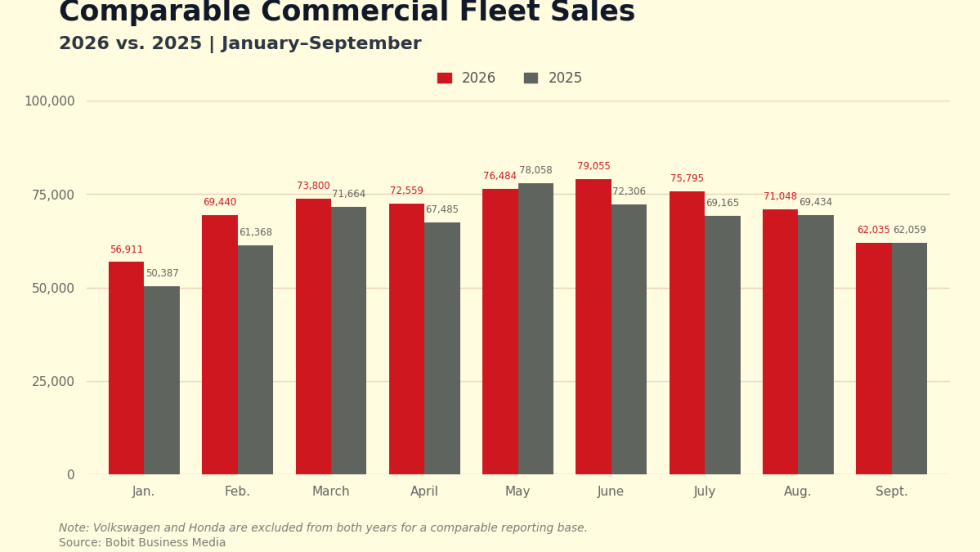
Commercial Fleet Sales Rise 5.8% Through September 2026
September commercial fleet sales were essentially unchanged from a year earlier, slowing year-to-date growth while keeping volume ahead of 2025.
Read More →
Hall of Fame Inductee: John Dmochowsky
The longtime Mondelēz International fleet executive joins the Automotive Fleet Hall of Fame.
Read More →
Hall of Fame Inductee: Lee Miller
After more than four decades at Boehringer Ingelheim, Lee Miller leaves a legacy built on fleet expertise.
Read More →
Hall of Fame Inductee: Mark F. Petersen
From managing fleets of thousands of vehicles to advancing safety and mentoring fellow professionals, Mark F. Petersen made his mark across both the corporate and supplier sides of fleet.
Read More →
When Charger Downtime Becomes a Fleet Availability Problem
As EV deployments move beyond pilot programs, charger reliability can directly affect vehicle readiness, driver productivity and route scheduling.
Read More →
2027 Nissan Rogue Hybrid Adds e-POWER, Standard AWD
The new Rogue Hybrid uses Nissan’s e-POWER system with dual electric motors, offers an estimated 40 mpg and starts at $35,490.
Read More →
2027 Subaru Forester Adds First Wilderness Hybrid
The 2027 Forester lineup starts at $29,995 and adds a Wilderness Hybrid with 194 combined horsepower and 9.3 inches of ground clearance.
Read More →
EV Realty Names Henrik Holland President as Charging Platform Expands
The former Prologis Mobility and Shell executive will help expand EV Realty’s truck charging business and move its power-first infrastructure model into autonomous vehicle depots and other fleet sectors.
Read More →
Mercedes-Benz Introduces Electric GLC With Up to 350 Miles of Range
The GLC 400 4MATIC Electric features an 800-volt architecture, 330-kW DC fast charging and a 94-kWh battery, along with Mercedes-Benz's new MB.OS operating system.
Read More →
Fleet Has a Talent Pipeline Problem, not a Talent Problem
Where will the next generation of fleet leaders come from, and what does the industry need to do differently to find them?
Read More →