




CBC Perfects The High Tech Road Trip
The Canadian Broadcasting Corp. runs three Kenworth Class 6–7 cabovers as mobile production units to disseminate news on the fly.
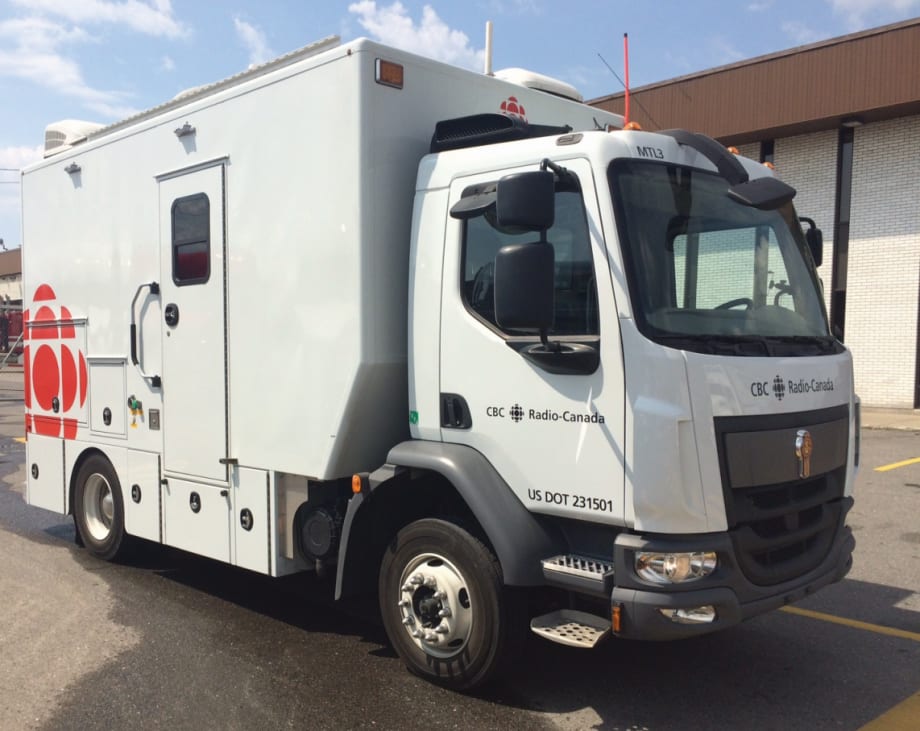
For covering local news, the CBC uses three Kenworths with custom-built mobile production units worth about $800,000-$1 million each. Photo: CBC
The Canadian Broadcasting Corp. (CBC) needed a truck that could turn on a dime and carry a heavy load, so Mario Gionet, corporate fleet senior manager for CBC Radio-Canada, decided to look into Kenworth and its line of cabovers.
CBC’s fleet operates several small trucks built on the Mercedes Sprinter platform that are used for news gathering and obtaining live shots of an event. However, its bread and butter for covering local news are three custom-built mobile production units — two Kenworth K270 Class 6 cabovers with 14-ft. bodies on 142-in. wheelbases and one Kenworth K370 Class 7 cabover with a 17-ft. body on a 182-in. wheelbase. Because the CBC broadcasts in both English and French, technicians must carry double the camera equipment, which the Kenworths can accommodate.
CBC serves as the national public broadcaster for both radio and television across Canada. Every vehicle in CBC’s fleet, most of which are located in Montreal, is under Gionet’s supervision. CBC also covers the news globally with vehicles in Los Angeles, China, Russia, and Israel.
Carrying the Load
Before switching to the Kenworth cabovers, CBC used a freight truck with a front-engine mount nose.
“The operations group requested a truck to be used in downtown Montreal for easy maneuverability and making sharper turns, while at the same time having the ability to carry a heavy payload,” Gionet says. “In that regard, Kenworth was the perfect choice for us.”
Gionet developed the truck’s specs with his engineering department, which built all the technical equipment that rides in the back of the vehicle. They worked together to provide a truck for the three technicians onboard so they can add more gear to their existing equipment without going over the vehicle’s weight capacity.
Staying Local
The Kenworths don’t travel much — no more than 20,000 km (about 12,400 miles) per year —however, the main challenge is to be on location and ready to go at all times. For the most part, the trucks are stationed in downtown Montreal, so they travel about 5 km per day for a shoot before returning to headquarters.
That said, the CBC has sent vehicles to large events or to cover disasters, such as Hurricane Irma in Florida. “We never know when the trucks are going to hit the road for a long trip or stay around and cover local stories,” Gionet says. “We are driven by the importance of the news.”
Keeping Up With Maintenance
The trucks are so specialized and expensive (about $800,000-$1 million each) that they can’t easily be replaced.
“If one truck breaks down, I can’t turn around and rent one,” Gionet says. “The news is at the moment, so if something really important is happening, we have to be there. We keep close eyes on regular maintenance. We’ll replace parts sooner instead of waiting for a breakdown.”
Gionet recalls a breakdown while covering a wild fire in Western Canada. The technical equipment onboard still worked, so they sent a tow truck to move the vehicle from the site where it was disabled to the scene of the fire to ensure they would be on the air for the news without placing the technicians in danger.
Because the CBC doesn’t have its own maintenance shop, Gionet relies on Kenworth Montreal’s maintenance and minor repairs program. He also has a maintenance and fuel plan through ARI, a fleet management company, to utilize ARI’s repair network in case of a breakdown far from home.
Because CBC crosses into the U.S. to cover stories, the trucks are equipped with electronic logging devices (ELD) to comply with the new U.S. regulation. Canada will begin to implement ELDs in January 2019, and they will be mandatory by 2020.
The ELD systems are equipped with GPS, allowing Gionet to track drivers in remote areas, understand mechanical issues, and route vehicles closest to an event.
Changing Technology
When CBC is ready to sell its vehicles, it’s usually because media technology has changed, not because the vehicle is at the end of its lifecycle. Most of the technical equipment is recovered for use in a studio and the truck is sent to auction.
“The trucks can only operate with that particular technical equipment, so once the technology needs replaced, the truck is of no use to us,” Gionet says. “We need a new truck with a whole new body.”
Originally posted on Work Truck Online
More Global Fleet
GeoFencing Adds to Your Truck Security Arsenal
Geofencing is a familiar fleet tool today, but its early adoption marked a major shift in vehicle tracking, route monitoring, and the debate over employee privacy.
Read More →
Holman Takes Full Ownership of ARIZA in Mexico
Holman is bringing its Mexican fleet management operation fully under its own brand after more than 30 years as a joint venture. The change gives multinational fleet customers a single Holman operation across the U.S., Canada, and Mexico.
Read More →
5 Tire Maintenance Tips to Help Prevent Work Truck Downtime
Regular tire checks can do more than extend tread life. These five maintenance practices can help work truck fleets catch problems early, reduce costs, and prevent downtime.
Read More →

Proven Ways to Reduce Work Truck Downtime
The age-old problem of downtime will always be a reality, but with new strategies at hand, fleets have more ways to keep trucks on the road longer.
Read More →


Cameras, Safety and Insurance: From Reactive Claims to Real-Time Prevention (Part 2 of 2)
Part Two: Commercial auto remains one of the most challenging and costly lines of coverage for fleet operators and insurers alike. Continue learning more about how to effectively address these issues from Onur Aksan, Enterprise Business Development Executive, Geotab
Read More →
Cameras, Safety and Insurance: From Reactive Claims to Real-time Prevention
Commercial auto remains one of the most challenging and costly lines of coverage for fleet operators and insurers alike. Learn more about how to effectively address these issues from Onur Aksan, Enterprise Business Development Executive, Geotab.
Read More →
Fleet Costs Are Rising: Here’s How Leaders Are Responding
Fleet leaders are under pressure to reduce costs, adapt to economic uncertainty, and make smarter decisions. See how peers across North America are responding with real data, proven strategies, and forward-looking insights. Download the 2026 Market Pulse Report to benchmark your strategy and uncover where you can gain an edge.
Read More →
Enterprise Fleet Management Surpasses 900,000 Vehicles in U.S. & Canada
Enterprise Mobility connects with mobility solutions around the globe
Read More →