




Further Reading
Can Innovative Fleet Practices Solve the National Worker Shortage?
Vehicle ownership enablement programs provide freedom and mobility to those who need it most and provide a much larger new employee pool for entry-level jobs.
by John Possumato
December 30, 2021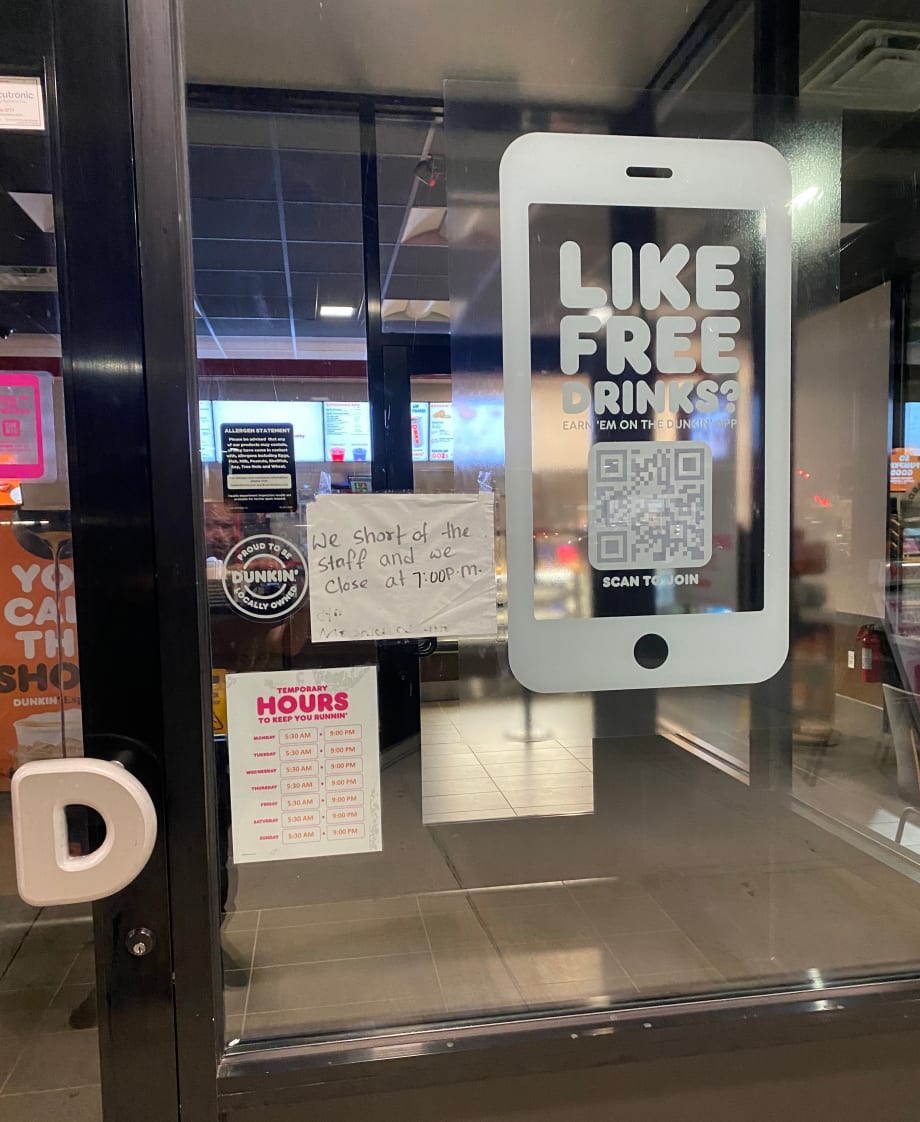
The worker and supply shortage has forced many businesses to cut hours and/or reduce services just to stay open. Those that can’t shut down.
Photo: John Possumato
5 min to read
The photos above and below were not staged, posed, or Photoshopped. Unfortunately, these scenes are quite common in almost every industry today throughout the nation. While it’s never been easy to hire good entry-level workers, there is now clearly a need bordering on crisis considering slowing production lines, reduced retail hours, and a general scarcity of goods and services leading to longer waiting times, less choices, and higher prices.

The pandemic has made filling even the most basic entry-level jobs (such as food service) difficult for countless employers, even with increasing wage offers and sign-on bonuses.
Photo: John Possumato
Part of the problem in finding entry-level employees is a transportation issue; it’s hard to afford a new vehicle without much capital. Public transportation, unfortunately, is not an option, as in most areas of the country it doesn’t go to and from the right places in a “workable” timely manner. Alternate transportation options now popular with more economically affluent households — such as ride sharing and car sharing — are too expensive to be a practical sustainable long-term solution. This has led to what is now referred to as “transportation deserts” which has led to further unemployment and “food deserts” etc., as researched and documented in the academic research study, “The Poverty of the Carless: Toward Universal Auto Access,” prepared by university professors David A. King (Arizona State University), Michael J. Smart (Rutgers, The State University of New Jersey), and Michael Manville (University of California).
The study notes that not owning a vehicle perpetuates poverty, as the means to get to where jobs are is impossible in a practical, sustainable way, creating the “poverty of the carless.” Between 1960 and 2014, for example, the U.S. poverty rate fell from 24% to 14%, while for households without a personal vehicle, the poverty rate rose from 42% to 44%. Households without vehicles are falling further behind households with vehicles and are poorer in absolute terms today than they were 60 years ago.
Closer at home and independent of this study — and years before the pandemic crisis and the current labor shortage — a large employer of entry-level employees identified that the No. 1 impediment of entry-level employee success was a lack of transportation. This firm studied the issue and implemented a program through outsourced providers to empower those who had no means to get to work; they provided access to a technology and process that facilitated a rent-to-own program with available employer incentives so that any individual, regardless of credit or down payment, could begin the vehicle ownership process through rental, with money accruing towards the required down payment to purchase with each rental payment. It was a transparent, easy process by which any employee could purchase a quality used vehicle over time while driving it, with the freedom to access employment, complete errands, “or generally move around in the same manner as the vast majority of fellow residents.” This became a viable solution for a sector of the public that in general lacked both the credit and down payment capital for an immediate vehicle purchase except for in self-financed used car lots — the notorious “Buy Here/Pay Here” area of the retail car business.
For those unfamiliar, Buy Here/Pay Here in the retail car business is akin to what “pay day loans” are in lending—legal, but they offer absurdly high mark-ups and interest rates to those who can afford it. Customers rarely exit successfully.
Turnkey and comprehensive third parties handled insurance, telematics, servicing, etc., and while this company didn’t involve fleet management, imagine how much more effective such a plan would be if an expert fleet manager were involved, working together with human resources and those in the organization supporting environmental, social, and governmental goals and objectives—it’d truly be a win/win for all.
This is admittedly far removed from providing a company fleet vehicle or even remarketing off-fleet vehicles to company employees; it wouldn’t be “day to day” but rather provide high-level mission, planning, and program oversight and evaluation for an outsourced third-party administered program to facilitate ownership to struggling entry-level employees. While the parent company assumes no liability or commits direct company assets or costs, it would most effectively utilize the fleet department’s well-honed expertise in proper vehicle selection, proper maintenance, and safety instruction, especially when combined with the human resources expertise for employee selection, credit and finance counseling, and general entry-level ramp up.
Such an approach may alarm many large corporate entities as this area has long been recognized as the responsibility of government or charitable institutions (although, as the “Poverty of the Carless” treatise points out, while there are many programs for those disadvantaged whose house has no electricity, there are next to none who lack household transportation). On the other hand, during times when entry-level employees are in great demand, the introduction and facilitation of such a program may have a profound effect on company goals and the bottom line, and who better than fleet management to oversee such a program, as it involves the use, care, and ownership of a motor vehicle?
One final positive note—such a program turns the service pyramid on its head by providing a vehicle enablement program to those who need it most in a transparent and fair process and helps to achieve employment objectives and company ESG (environmental, social, and governance) goals at the same time.
In today’s market, many companies offer thousands of dollars in “sign-on” bonuses and increased hourly pay yet still lack quality entry-level employees applying for jobs (some companies are actually offering equity for the first time to recruit hourly employees). Offering a vehicular rent-to-own purchase enablement program not only gives a strong recruitment incentive but enables a new pool of entry-level employees to accept jobs in the first place. Such a program not only builds incredible goodwill and empowerment—it may literally change lives both in and outside of the workplace.
About the Author

John F. Possumato is a noted consultant, author, and speaker in the automotive industry. He is founder and CEO of Driveitaway Inc., which provides a turn-key cloud platform/consumer app enabling dealers and employers to offer new mobility solutions to their employees, including a transparent, easy, turn-key digital rent-to-own vehicle ownership program.
Photo: John Possumato
John F. Possumato is a noted consultant, author, and speaker in the automotive industry. He is founder and CEO of Driveitaway Inc., which provides a turn-key cloud platform/consumer app enabling dealers and employers to offer new mobility solutions to their employees, including a transparent, easy, turn-key digital rent-to-own vehicle ownership program.
Subscribe to Our Newsletter
More Operations

Fleet Has a Talent Pipeline Problem. What Comes Next? | AF News Recap
Where will fleet’s next generation of leaders come from? This week, we’re looking at the industry’s talent pipeline, what certification can add to a fleet career, how to build an award-worthy track record, and the return of Automotive Fleet’s Personal Use Survey.
Read More →
Smith System Launches Driver Risk Management Program
Fleets have more driver data than ever, but identifying risky behavior doesn't necessarily correct it. Smith System's new Driver Risk Management program combines monitoring, training, and follow-up coaching to help fleets connect risk signals with driver intervention.
Read More →
Automotive Fleet Opens 2026 Personal Use Survey for Commercial Fleet Managers
Less than two weeks left! Commercial and corporate fleet managers are invited to share how their organizations handle company vehicle personal-use policies, charges, and driver eligibility.
Read More →
From AI Prompts to AI-Generated Safety Songs | AF News Recap
Can better prompts make AI more useful for fleet managers? This week, we’re breaking down smarter fleet analysis, an AI-assisted experiment that turned safety training into music, and what happened to fuel prices in August.
Read More →
How to Write Better AI Prompts for Fleet Analysis
Include these six elements in your fleet prompts to generate more relevant analysis and accurate answers.
Read More →
Fleet Meets: Eric Kilgore
This edition of the Fleet Meets series features one of the industry's best leaders driving multi-market and national operations.
Read More →
Why Reactive Fleet Management Is Becoming Too Expensive to Sustain
Research highlights a growing need for proactive management strategies to address rising costs in fleet operations effectively.
Read More →
Sponsored•August 12, 2026
What Your Fleet KPIs Aren’t Telling You
Tracking fleet metrics is only useful when the data leads to better decisions. This guide helps fleet leaders assess cost, utilization, and downtime more accurately, identify performance gaps, and prioritize the actions that can improve operational results.
Read More →
Sponsored•August 7, 2026
Hidden in Plain Sight: Fleet Compliance Risks
Fleet compliance isn't just about having policies — it's about consistently enforcing them. This practical guide reveals six hidden compliance risks common in public sector and shared fleet operations and outlines proven strategies to improve visibility, accountability, and audit readiness
Read More →
Turning Fleet Payment Data into Executive Insights
Does data alone drive results in operations?
Read More →