




Learn More: How to Extend the Life of Air Disc Brake Pads & Rotors
Brake Safety Week: What to Expect, How to Prepare
Bendix put together a guide to help fleets get ready for Brake Safety Week.
from Bendix
August 19, 2021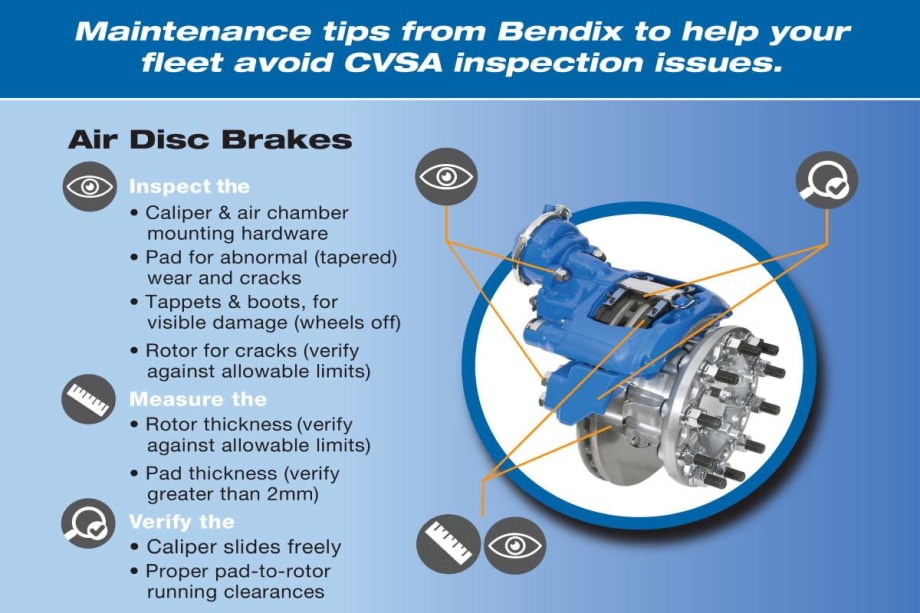
Bendix, a designer, developer, and supplier of active safety technologies, has put together a guide to help fleets get ready for brake safety week.
Photo: Bendix
5 min to read
Brake Safety Week is held each August by the Commercial Vehicle Safety Alliance (CVSA). Thousands of trucks are put out of service across North America during this weeklong inspection event.
“So many of these out-of-service violations – situations that present actual hazards to roadway safety for the drivers and everyone around them – are preventable through proper maintenance practices and regular equipment examination,” said Fred Andersky, Bendix director – demos, sales, and service training.
“Now is the time for fleets and owner-operators to prepare, not just with the goal of passing inspections, but to help make sure vehicles are running at their safest, and that today’s higher-level safety systems like full stability and collision mitigation are supported by optimally maintained brakes at the wheel-ends.”
Brake Safety Week is part of CVSA’s Operation Airbrake initiative – an outreach and enforcement campaign that aims to reduce the number of highway crashes caused by faulty brake systems on commercial motor vehicles. The event involves local, state, provincial, territorial, and federal motor carrier safety officials in the United States, Canada, and Mexico inspecting large trucks and buses, focusing on brake system violations.
What to Expect During Inspection
Brake Safety Week roadside inspectors regularly conduct North American Standard Inspections, which cover a range of driver qualifications, documentation, and vehicle equipment conditions. Where brake systems in particular are concerned, they’ll be checking for:
Loose or missing parts
Air or hydraulic fluid leaks
Trouble-indicator lights on the dash, including antilock brakes (ABS)
Worn linings, pads, drums, or rotors
Mismatched air chamber sizes across axles
Warning device functionality (such as antilock braking system indicator lights)
Proper brake adjustment
Brake hoses and tubing condition (a special focus for this year)
When possible, inspectors will measure pushrod stroke to ensure brakes are properly adjusted. Drivers can incur fines if more than 25% of a vehicle’s wheel-ends are out of adjustment, and too many out-of-adjustment brakes can lead to the vehicle being placed out of service.
How to Get Ready and Prevent Violations
What you do in the shop and during pre-trip walkarounds – looking at every aspect of your vehicle – can make an important difference on the road and during a brake system inspection, simply by catching brake-related issues before they become problems.
Every Day
Check for damaged or loose-hanging air chambers, pushrods, or slack adjusters.
Make sure slack adjusters on each axle are extended out to the same angle. Different angles can indicate an out-of-adjustment brake or a broken spring brake power spring.
Examine tubing and hose condition, positioning, and connections.
Every Week
Perform a 90- to 100-psi brake application with the wheels chocked and the parking brakes released, and listen for leaks.
Check air disc brake rotors for cracks.
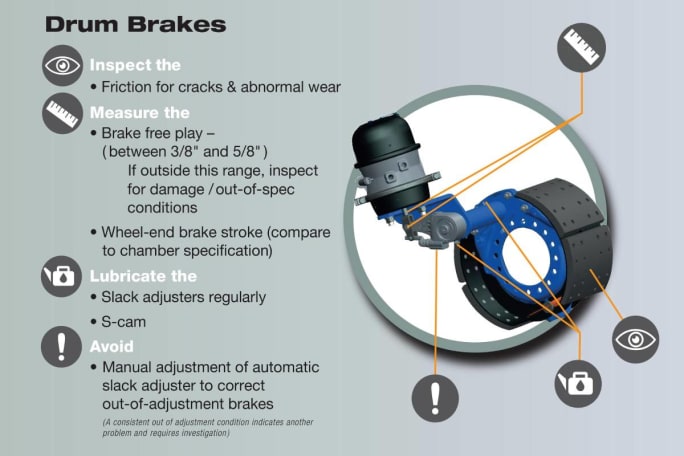
Inspect drum brake linings for wear and cracks.
Every Month
Check for moisture in the air system to prevent contamination that leads to component deterioration and system leaks.
“Any time you’ve got a vehicle in the shop, it’s also worth greasing the S-cam brake tubes and automatic slack adjusters: This quick process helps prevent rust and corrosion, and helps keep the slack functioning properly,” said Mark Holley, Bendix director of marketing and customer solutions – Wheel-End. “Additionally, Bendix recommends that before drivers get on the road, they routinely perform 90- to 100-psi brake applications – with the wheels chocked and the parking brakes released – and listen for leaks that might be attributed to hoses and/or tubing.”
What you do in the shop and during pre-trip walkarounds – looking at every aspect of your vehicle – can make an important difference on the road and during a brake system inspection, simply by catching brake-related issues before they become problems.
Photo: Bendix
Drum and Disc Differences
Air disc brakes and drum brakes have a few differing maintenance needs where Brake Safety Week is concerned, key among them the measurement of brake stroke. Because air disc brakes include an internal adjustment mechanism, their brake stroke is not measured externally, as is the case with drum brakes.
“Measuring a drum brake’s chamber stroke is a matter of checking the distance from the air chamber to the clevis pin with the brakes released, and then again after a fully charged brake application,” Holley explained. “The difference between these is the brake stroke, and its maximum length depends upon the brake chamber type and size.”
Improperly adjusted brakes can also drag – impacting fuel efficiency and speeding up pad wear – or experience decreased stopping power.
Parts Selection and Brake System Health
When it’s time to replace a component in your brake system, whether it’s at the wheel-end or in the air supply, be sure to select parts that won’t degrade the performance level or bring it below the original equipment manufacturer’s standards.
“This is particularly true when it comes to brake friction, where the aftermarket is more crowded than ever, and the wrong choice can actually harm your system and your vehicle safety,” Holley said. “Not all replacement linings that are marketed as acceptable for federal stopping distance requirements will actually perform to the standard.
"Other complications arising from improper friction selection can include cracks, degradation of braking performance, or damage to other wheel-end components. Again, these are things a roadside inspector will note and penalize you for.”
To protect the air supply against corrosive oil aerosols that lead to leaks and potential violations, Bendix recommends using an oil-coalescing air dryer cartridge. It’s important to note while oil-coalescing cartridges can be used to replace standard cartridges, the reverse is not the case: You shouldn’t downgrade from an oil-coalescing cartridge to a standard.
Parts and the Whole
“Taken individually, these things inspectors are looking for – an active full-stability light on the dash, a kink in an air hose – may seem inconsequential,” Andersky said.
“But the complex interconnectivity of the entire brake system and more advanced safety technologies mean it’s critical to take this holistic approach to upkeep. One small sign of something out of compliance can be an indicator of more widespread maintenance issues.”
Holley agreed, and offered further avenues of support available in advance of Brake Safety Week 2021.
“There’s a lot to keep in mind, we know,” he said. “Bendix has also compiled resources for trucking professionals at the Knowledge Dock, which features an archive of the Bendix Tech Tips series, as well as videos, blog posts, podcasts, and white papers, and we offer around-the-clock access to training at Brake School. We’ve got nine decades of expertise to share, and we’re happy to put it all to work in support of our entire industry’s goals of safer roads for everyone.”
Originally posted on Work Truck Online
Subscribe to Our Newsletter
More Safety

IIHS Crash Avoidance Tests Reveal Safety Gaps in Cargo Vans and Work Trucks
New crash-avoidance ratings from the Insurance Institute for Highway Safety reveal inconsistent performance among commercial vehicles, with several popular cargo vans and heavy-duty pickups struggling to avoid collisions with other vehicles and pedestrians.
Read More →
What’s Next for Fleet? Safety, AI & Industry Recognition | AF News Recap
Could your company's culture be encouraging distracted driving? This week, we're exploring how workplace expectations affect driver safety, what AI, EVs, and autonomous vehicles could mean for the future of fleet management, and how fleet professionals can strengthen their award nominations.
Read More →
Does Your Fleet's Culture Encourage Distracted Driving?
What happens when the people responsible for enforcing safety rules are the ones setting the wrong example? The answer may reveal why some of the biggest risks to fleet drivers have little to do with what's written in the employee handbook.
Read More →
Sponsored•October 1, 2026
Fleet Manager’s Ultimate Playbook: Navigating the New Standard in OEM Connectivity
Rising operating costs, driver safety concerns, and unplanned downtime are putting unprecedented pressure on modern fleets. Discover how fleet managers use embedded OEM connectivity and real-time vehicle data to cut TCO, prevent downtime, and protect drivers without aftermarket telematics hardware.
Read More →
From Driver Well-Being to EV Charging | AF News Recap
Mental health belongs in the fleet safety conversation. This week, we’re looking at five ways fleets can support employee well-being before a crisis, plus Holman’s expansion in Mexico, new one-day Fleet Forward passes, and why EV charging demand is outpacing infrastructure growth.
Read More →
Nexar-Nauto Merger Aims to Give Fleets Better Safety Intelligence Through Larger Driving Dataset
Stefan Heck tells Automotive Fleet that combining more than 10 billion miles of driving history with Nexar's AI models will give fleets deeper insights into driver risk and roadway conditions than either company could provide independently.
Read More →
Don't Wait for a Crisis: 5 Ways to Build Mental Health Into Your Fleet Safety Program
For Suicide Prevention Month, fleet and safety leaders have an opportunity to put mental health where it belongs: at the center of workplace safety.
Read More →
How Camera Data Can Strengthen a Fleet’s Insurance Renewal
Insights from a commercial insurance carrier and a broker show how fleets can turn video telematic data, driver coaching, and improved claims results into a stronger case at insurance renewal.
Read More →
The Safest Fleets Aren’t the Ones with the Most Technology
You’ve made the telematics investment. Here’s how to capture the other half of its value and build the safest fleet on the road.
Read More →
Sponsored•August 7, 2026
Hidden in Plain Sight: Fleet Compliance Risks
Fleet compliance isn't just about having policies — it's about consistently enforcing them. This practical guide reveals six hidden compliance risks common in public sector and shared fleet operations and outlines proven strategies to improve visibility, accountability, and audit readiness
Read More →