




As Ford Halts F-150 Lightning, What Now for Electric Pickups?
As Ford ends Lightning production, the company joins a market fragmenting into extended-range hybrids, budget models, and traditional EVs. Which strategy will fleets actually buy?
December 16, 2025

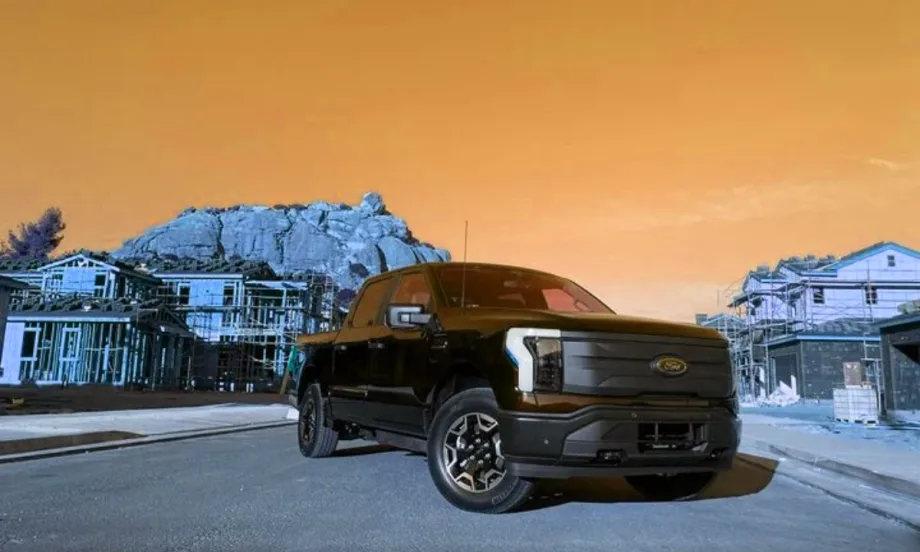
Ford's F-150 Lightning ends production after a brief, turbulent run.
Photo: Chris Brown
6 min to read
“F-150 Lightning, we hardly knew ye.”
Ford Motor Co. will stop producing the current all-electric F-150 Lightning after fewer than four years on the market, pivoting instead to an extended-range version of the truck, according to The Wall Street Journal.
In a Dec. 15 WSJ interview, CEO Jim Farley said the company is redirecting capital from loss-making EV projects toward models with higher profitability, calling it a shift informed by “a lot more certainty in this second inning” of reduced-emissions powertrains.
WSJ also reported that Ford expects a $19.5 billion charge, largely tied to its electric-vehicle business, reflecting challenges in U.S. EV demand.
F-150 Lightning Affordability and Price Fluctuations
Since its launch in April 2022, the Ford F-150 Lightning has experienced significant, dramatic pricing shifts that at the time reflected unstable market conditions, production realities, and supply chain constraints.
Lightning debuted with a base Pro model MSRP of around $40,000, but successive price increases quickly pushed it to $60,000 by late 2022.
By mid-2023, Ford reversed course with substantial price reductions, cutting nearly $10,000 from the base Pro model and proportionally lowering pricing across higher trims. According to Ford, these reductions were made possible by increased plant capacity, scaling efficiencies, and improvements in battery raw material costs.
While high initial prices reflected the cost of new technology and constrained supply, the reductions coincided with expanded production and growing EV inventories — understandable, but a whipsaw for fleets that only highlighted affordability challenges.
Work Truck Reality Check
Beyond pricing, electric pickups face a more fundamental challenge: how real-world work use affects range.
Towing and hauling — core use cases for fleets — significantly reduce EV range, often by 40% or more. While electric pickups can pencil out favorably in controlled cost-per-mile scenarios, operational realities have proven harder to overcome.
When it came to paper ownership costs, the Lightning performed well. The F-150 Lightning Pro SuperCrew ranked second out of 13 pickup models in Vincentric’s 2024 total cost of ownership analysis (five years/75,000 miles).
However, external factors quickly eroded that advantage. The expiration of federal EV tax credits and a soft wholesale market for used EVs weakened the economic case for electric pickups. The rollback of CARB’s regulatory authority over private fleets in California and CARB-following states further eroded the impetus for e-pickups, particularly for fleets without strong sustainability mandates.
A Crowded Field, Then a Pullback
When EV momentum accelerated pre-pandemic, pickups were not initially central to OEMs’ electrification strategies. That changed quickly.
Rivian launched the R1T in 2021, followed by the F-150 Lightning in 2022 and Chevrolet’s Silverado EV in late 2023. Consumer-oriented entries like the GMC Hummer EV (2022) and Tesla Cybertruck (late 2023) soon followed.
Yet by the time Ram unveiled the Ram 1500 Revolution BEV concept at CES 2023, cracks were already forming. Questions about EV affordability, charging infrastructure, and adoption speed intensified, eventually coalescing into a broader market sales slowdown later that year.
By 2024 and into 2025 — coinciding with the Trump administration’s push to reduce funding for EV manufacturing, public charging, and battery projects — automakers began openly “recalibrating” their electric strategies.
Today, Rivian continues to offer the R1T to both consumers and fleets, while Chevrolet’s Silverado EV remains the only true half-ton electric work truck actively targeting fleet buyers. The revived Scout Motors brand will introduce an electric pickup in 2027, though fleet plans remain unconfirmed.
New Paths for Electric Pickups
Despite Ford’s retreat from the current Lightning, two developments show electric pickups are still part of Ford’s electric landscape.
First, Farley confirmed Ford is developing an extended-range version of the F-150 Lightning. He also reiterated plans for a $30,000 electric pickup arriving around 2027, built on a new, lower-cost EV platform.
The larger industry is converging on these two distinct solutions to the challenges of electric pickup adoption: lower-cost simplicity and extended-range capability.
Is There a Market for a Sub-$30,000 Electric Truck?
Startup Slate — positioning itself as a “blank slate” for fleet branding and customization — is developing a stripped-down, two-seat electric pickup focused on cost containment rather than premium features. Slate is targeting a starting price in the mid-to-upper $20,000 range, even without federal tax credits, and volume production in 2027.
Ford’s upcoming midsize electric pickup, expected in 2027, aims for a similar price point. Built on the company’s new Universal EV Platform, Ford says the architecture uses 20% fewer parts, 25% fewer fasteners, and dramatically simplified wiring — thousands of feet shorter and significantly lighter than current designs.
The truck is expected to be roughly the size of today’s Maverick, with interior space comparable to a compact crossover, while delivering acceleration on par with a Mustang EcoBoost. For fleets, the appeal may be less about performance and more about right-sizing electrification for urban and light-duty applications.
Extended-Range EVs: A More Practical Answer?
The second path addresses the electric pickup’s most persistent weakness: range loss under load.
Ram’s newly renamed 1500 REV pairs a 92-kWh battery with a 3.6-liter V6 that acts solely as an onboard generator. The engine never drives the wheels, preserving electric driving characteristics while delivering approximately 145 miles of all-electric range and up to 690 miles of total range via a 27-gallon fuel tank.
Ford appears headed in a similar direction. The automaker has confirmed its next-generation half-ton electric pickup will adopt extended-range electric vehicle (EREV) technology, targeting more than 700 miles of total range.
By using an onboard generator as a safety net, EREVs retain electric drivetrains while eliminating dependence on public fast-charging infrastructure — a critical consideration for fleets operating long routes, remote job sites, or unpredictable duty cycles.
AF’s View: Questions Remain
Ford’s pivot toward extended-range electric pickups may address one of Lightning’s most persistent shortcomings, but it also introduces new cost concerns.
Adding a large battery pack alongside an internal combustion engine used solely as a generator increases complexity, materials costs, and manufacturing costs. EREVs will not be cheap, likely starting at around $60k.
That raises a more fundamental question: Will fleets actually value extended range at that price point, particularly in a regulatory environment that no longer compels electrification? Outside of a relatively small subset of sustainability-driven organizations, most fleets are not “green for green’s sake.”
They electrify when the economics work, when duty cycles align, or when regulations leave little alternative. If extended range solves a problem that many fleets don’t routinely face, its premium may be difficult to justify without incentives or mandates.
On the opposite end of the spectrum, the promise of low-cost electric trucks is intriguing but equally uncertain. Slate’s stripped-down pickup has generated attention largely because of its projected starting price, yet it remains an unproven product.
No one has driven one, real-world durability is unknown, and its true fleet suitability has yet to be demonstrated. Just as importantly, the economics may change quickly. The moment fleets begin adding racks, storage systems, safety equipment, branding, or telematics, the “cheap” truck becomes meaningfully more expensive, narrowing the gap with more established alternatives.
That reality leads to another uncomfortable question for electric pickups: at similar price points, would many fleets simply choose something else? For light-duty applications that don’t require a bed, a base Chevrolet Equinox EV or comparable crossover from an incumbent automaker may offer greater certainty.
One thing we know: The market is still searching for the right fit and hasn’t found it yet.
Subscribe to Our Newsletter
More Fleet Forward

Erin Gilchrist Receives Mike Antich Spirit of Fleet Award
Last week at AFLA in Vegas, Erin Gilchrist received the inaugural, brand-new Spirit of Fleet Award.
Read More →
Dominika Leja Named the 2026 Fleet Manager of the Year
The AstraZeneca associate director of fleet was recognized for her leadership in fleet electrification, cost savings, and operational transformation.
Read More →
Jamie McKay Named the 2026 Fleet Visionary Award Winner
The Aptive Pest Control fleet manager was recognized for her approach to operations, data, lifecycle management, and driver needs.
Read More →
Fleet Forward Conference Introduces One-Day Passes for 2026
New one-day registration gives fleet professionals the flexibility to attend Tuesday, Wednesday, or Thursday, with passes available for $199 through Sept. 18.
Read More →
Vibe Coding: When Fleet Managers Become Software Builders
Five fleet professionals — none with programming skills — discuss how they’re using AI to build fleet solutions in-house and in a fraction of the time.
Read More →
Fleet Forward Conference Tackles Fleet Industry’s Growing Leadership Gap
This session will examine succession planning, knowledge transfer, and the skills the next generation of fleet leaders will need as veteran professionals leave the industry.
Read More →
2026 Fleet Manager of the Year Finalists Announced
Who are the 2026 Fleet Manager of the Year finalists?
Read More →
John Rossant to Deliver Opening Keynote at 2026 Fleet Forward Conference
The CoMotion founder will draw on developments across Europe, China, the Middle East, and other international markets to identify trends that could influence how U.S. fleets plan for the coming decade.
Read More →
How to Build Custom Fleet Tools With AI and Vibe Coding [Webinar]
A new Automotive Fleet webinar explores how fleet managers are using AI and vibe coding to automate routine work and create simple operational tools without traditional programming skills.
Read More →