




As Fleet Manager Salaries Rise, So Does the Workload
Some of the issues that fleet managers found challenging for their operations included a heavy workload, an abundance of telematics data, and aging vehicles.

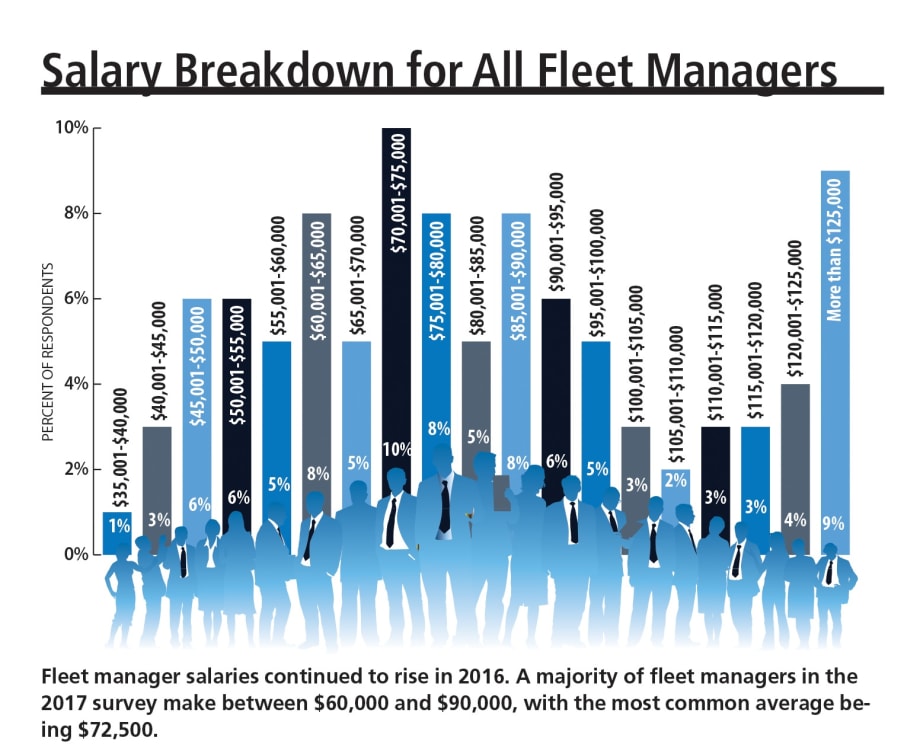
Fleet manager salaries continued to rise in 2016. A majority of fleet managers in the survey make between $60,000 and $90,000, with the most common average at $72,500. Illustrations by Armie Bautista
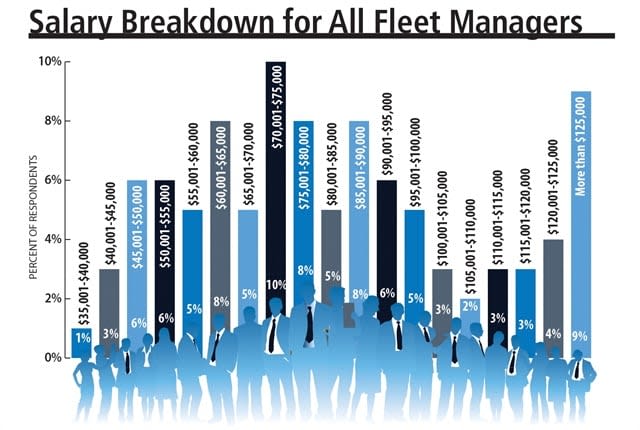
Fleet manager salaries continued to rise in 2016. A majority of fleet managers in the survey make between $60,000 and $90,000, with the most common average at $72,500. Illustrations by Armie Bautista
Fleet manager salaries have continued to inch higher over the years, a trend which Automotive Fleet has reported over the last several years in its Fleet Salary Survey.
This year, 74% of fleet managers that participated in the 2017 survey reported earning an income that was somewhere between $40,000 and $100,000. In comparison, only 67% of respondents last year reported earning a salary in that range. Overall, approximately 74% of fleet managers reported that they earned a payment increase, a percent that is static with what the survey reported last year.
Analyzing the Data
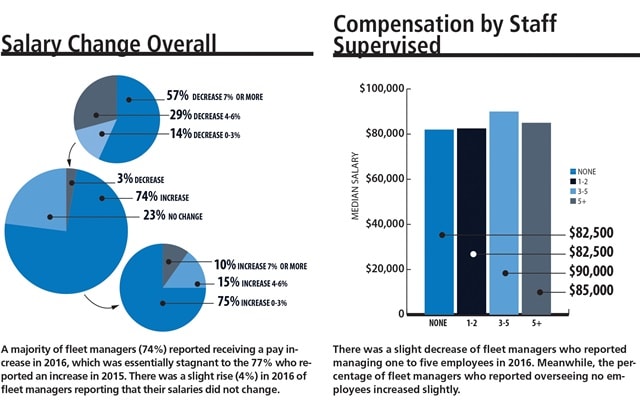
This year’s report also found 73% of fleet managers reported an increase in average overall salary. As with previous years, this continued to heavily outweigh the number that reported a decrease, which was 3%. However, while not many fleet managers are seeing their salaries decrease, a growing percentage of them are seeing stagnant wages, as approximately 25% reported no salary fluctuation, up 6% from the previous survey.
A majority of fleet managers in the 2017 survey reported an annual salary between $60,000 and $90,000, with the most common amount at $72,500. This income range has shown a significant increase compared to the last two surveys in 2015 and 2013.
The report also found that 24% of fleet managers earn between $80,000 and $100,000.
Also notable in the survey was the fact that managers who do not manage any employees earned a median salary of $82,500, which was a $2,000 decrease from last year.
Workload and Staff
Also, staff sizes appeared to be shrinking. Indeed, fleets that have one to five employees have decreased since 2013, while the percentage of managers that manage no employees has increased, according to survey data.
“(Our staff size) has decreased over the last few years. We are seeing some of the fleets responsibilities are being consolidated into a shared service center within the company,” said a fleet manager who requested anonymity. “So the shared service center would not only do fleet jobs but also other shared service duties as well.”
He said that his employees perform several fleet-related duties, including taking questions from the field, handling loss, the fleet fuel card, and questions regarding registration.
Illustrations by Armie Bautista
Meanwhile, Rick Sauter, fleet service manager, Allstate Leasing, also reported a slight decrease in fleet size and stated that some of his vehicle services have been outsourced.
The survey found that a larger majority of fleet managers who do not manage any employees spend a majority of their efforts on actual fleet management, versus those who manage one or more employees.
Still, a majority of fleet managers in the survey reported that they manage more than five employees in a given operation.
Another anonymous fleet manager reported to 11 employees working for him since 2004. The manager stated that 60% of his day was involved with fleet-related duties and the remaining 40% was administrative work.
The anonymous fleet manager who reported a decreasing staff said there will always be the need for a fleet manager who acts as the leader for fleet.
“You still need that internal leader in the company to manage the efforts that include other cross-functional groups. You still need a fleet manager to work with finance, you still need the fleet manager to work with procurement, you still need the fleet manager to work with safety directors, and that sort of that thing. That nucleus of that position has stayed,” the anonymous manager said.
Fleet Duties
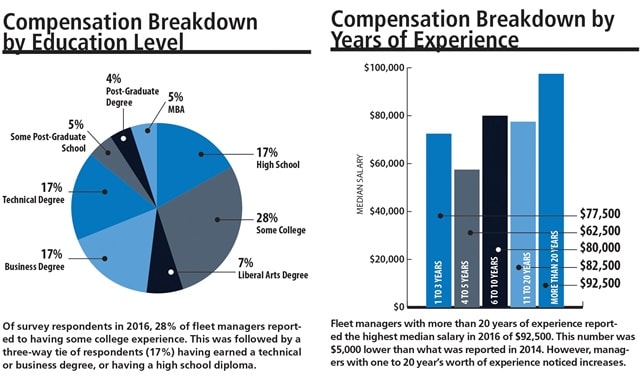
The duties of a fleet manager continue to expand beyond that of simply fleet management, according to survey data. Several respondents of the survey reported that the time spent on the amount of work that they put in for fleet usually exceeds an eight-hour work day.
Sauter stated that his other duties include: vehicle reconditioning, vehicle remarketing, keeping up with new vehicle specs, and more.
Illustrations by Armie Bautista
“I love what I do, but it is becoming more strenuous and difficult to accomplish in an eight- to 10-hour day,” said another anonymous fleet manager.
Another anonymous fleet manager echoed similar sentiments.
“Fleet salaries are important. One must look at the wage and how that is measured. But I know a lot of people in our industry once they get into the industry, the passion overcomes the expectations on the wages,” the anonymous manager said.
Indeed, the level of enjoyment managers get in working in fleet stayed static from the previous survey report in 2015.
Aging Fleets
Meanwhile, several fleet managers have reported that aging fleets contribute to issues in their operations.
“My biggest challenge is convincing management that we need to spend more money on new vehicles. We need extra options like navigation. The prices that I am given keep our vehicles stripped down to the bare minimum. It makes it hard for our employees to do their job safely and to feel like they are appreciated,” according to an anonymous fleet manager.
Another area of challenge that some fleet managers stressed was keeping up with evolving technology, including data from telematics.
Sauter stated that there is a lot existing material and information, but consolidating it all into one place is challenging
“There are many large telematics companies and the most difficult part is matching the GPS systems with the customer/buyer’s needs. Some companies focus on safety, some operations, some vehicle maintenance. It is not one size fits all,” he said.
Editor's note: To view full charts showing fleet salary data, click here.
More Operations

Avis Budget Group Deploys Neology Toll Management Technology Across Major Brands
Neology’s neoFleet platform will manage toll transactions and toll-authority operations for vehicles across Avis, Budget, Payless, Budget Truck and Zipcar.
Read More →
Fleet Personal-Use Charges Edge Higher in 2026
Nearly eight in 10 surveyed fleets allow personal use of company vehicles, while just over half of respondents report charging employees for the privilege.
Read More →
The Future of Fleet + What’s Changing Right Now | AF News Recap
Could developments overseas offer a preview of what’s coming for U.S. fleets? This week, we’re looking at the future of AI, autonomy, and electrification, plus Ford Pro’s new certified pre-owned program, smarter vehicle offboarding, and a new way for fleets to manage toll expenses.
Read More →
How to Handle Vehicle Offboarding
What do fleet managers need to do when a driver leaves?
Read More →
Fleet Manager’s Ultimate Playbook: Navigating the New Standard in OEM Connectivity
Rising operating costs, driver safety concerns, and unplanned downtime are putting unprecedented pressure on modern fleets. Discover how fleet managers use embedded OEM connectivity and real-time vehicle data to cut TCO, prevent downtime, and protect drivers without aftermarket telematics hardware.
Read More →
U.S. Bank Adds Verra Mobility Toll Management to Voyager Fleet Platform
The integration allows U.S. Bank Voyager fleet customers to manage toll payments and violations alongside fuel, EV charging and maintenance expenses.
Read More →
ADAS Prevents Crashes. But Repairs Cost More | AF News Recap
ADAS-equipped vehicles may crash less often, but they can cost more when they do. This week, we’re breaking down what that tradeoff means for fleets, plus Subaru’s first Forester Wilderness Hybrid, Nissan’s new e-POWER Rogue, and why Calstart has become Catalyst Mobility.
Read More →
Moventum Fleet Management Names Mark Iorillo Head of Sales
Iorillo brings nearly 20 years of fleet management and sales experience to the role, including previous positions at Element Fleet Management, CEI, Donlen and Ryder.
Read More →
Fleet Has a Talent Pipeline Problem. What Comes Next? | AF News Recap
Where will fleet’s next generation of leaders come from? This week, we’re looking at the industry’s talent pipeline, what certification can add to a fleet career, how to build an award-worthy track record, and the return of Automotive Fleet’s Personal Use Survey.
Read More →
Smith System Launches Driver Risk Management Program
Fleets have more driver data than ever, but identifying risky behavior doesn't necessarily correct it. Smith System's new Driver Risk Management program combines monitoring, training, and follow-up coaching to help fleets connect risk signals with driver intervention.
Read More →