





See historical fleet manager salary data — and more — in the 2025/2026 Feet Fact Book
2026 Salary Survey: Six-Figure Fleet Manager Salaries Become the Norm
After a decade of lagging compensation, fleet manager pay is climbing. But expanding responsibilities, larger fleets, and growing complexity continue to redefine the role.
April 20, 2026
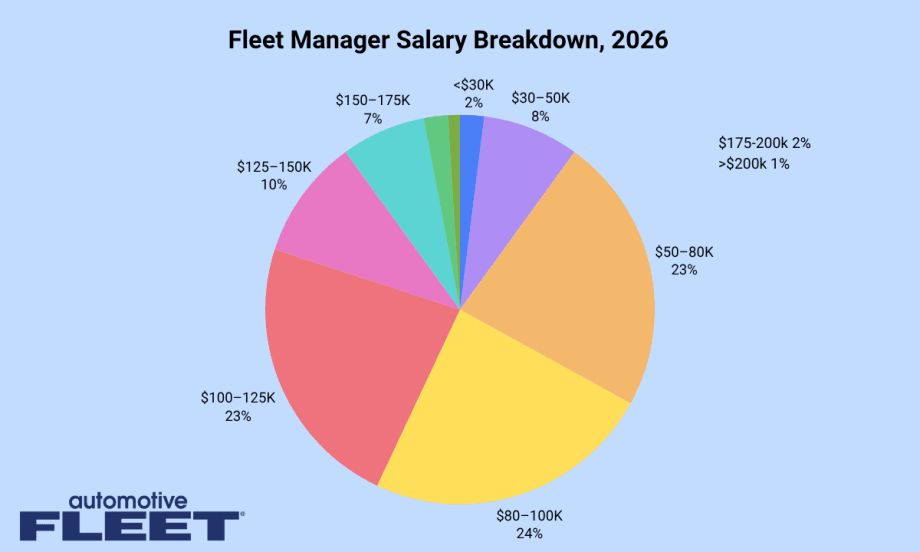
Fleet manager compensation continues its upward shift in 2026, with nearly half of respondents earning between $80,000 and $125,000. Compared to 2024, the distribution shows a continued migration into higher salary bands.
Credit: Automotive Fleet
5 min to read
For much of the past decade, fleet managers have been asked to take on more vehicles, crunch more data, and assume more responsibilities without a corresponding increase in pay. However, that dynamic may finally be shifting.
New data from the 2026 salary survey — produced by Automotive Fleet, Work Truck, and Government Fleet — show that compensation is rising substantially, particularly in the $100,000 to $150,000 range. However, the role of the fleet manager has evolved faster than compensation has followed.
A look back at the salary surveys from 2013 through 2024 shows how fleet managers took on larger fleets, saw staffing levels shrink, and assumed new responsibilities spanning electrification, safety, compliance, and data management, as well as non-fleet roles.
Median pay rose from about $77,500 in 2013 to $95,000 in 2022 — a 23% increase — but much of that growth was offset by inflation. This year’s survey suggests compensation may be beginning to outpace rising costs.
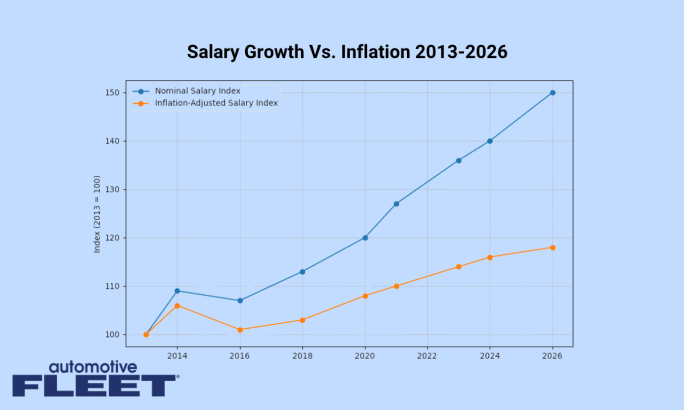
Analyzing historical compensation data, salaries are rising meaningfully in nominal terms, but real (inflation-adjusted) gains are much more modest.
Credit: Automotive Fleet
$100K Becomes the New Center
The 2026 data shows a shift upward in the core salary range.
In the previous survey (2024), the largest share of fleet managers (24%) reported earning between $80,000 and $100,000, with the average salary at $97,545. Roughly 70% of respondents fell between $50,000 and $125,000.
While the average salary has grown to near $98,000 in 2026, the distribution has shifted upward, with more fleet managers reporting earnings in higher compensation tiers.
In 2026, the largest group of respondents now falls in the $100,001 to $125,000 range, followed closely by those earning $125,001 to $150,000. While the $80,000 to $100,000 band remains significant, it is no longer the dominant category.
At the same time, a growing share of respondents report salaries above $150,000.
Fleet Size Still Drives Pay
As in prior surveys, the strongest predictor of compensation remains fleet size.
Compared to previous surveys, today’s respondents are significantly more likely to oversee large fleets. In 2026, nearly half report managing more than 1,000 vehicles, up from just 25% two years earlier. At the same time, the share of respondents overseeing smaller fleets has declined.
Fleet managers overseeing fewer than 50 vehicles earn an average of about $64,700, while those managing more than 1,000 vehicles earn nearly double at $126,900. This relationship has remained consistent over time.
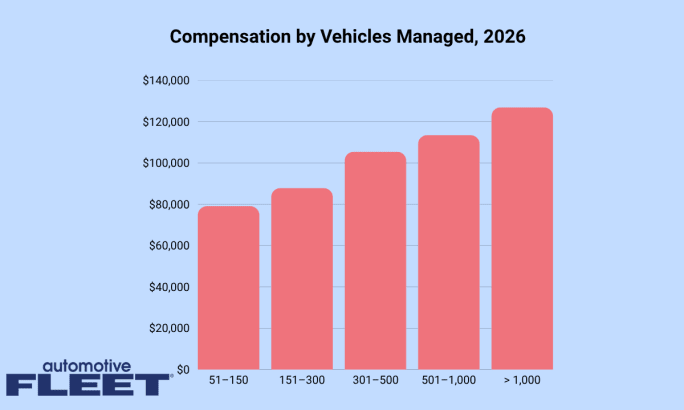
Fleet size continues to correlate directly with compensation, with managers overseeing larger fleets earning significantly higher salaries.
Credit: Automotive Fleet
Experience (Mostly) Matters
Compensation rose steadily with years of experience, from roughly $52,000 for those with less than a year in the role to more than $117,000 for those with over 20 years.
The largest gains occur early and late in a fleet manager’s career, while mid-career managers often see more gradual increases, suggesting that tenure is not the sole driver of higher pay.
In many cases, advancement is tied less to years in the role and more to expanded responsibilities, larger fleets, or broader organizational roles.
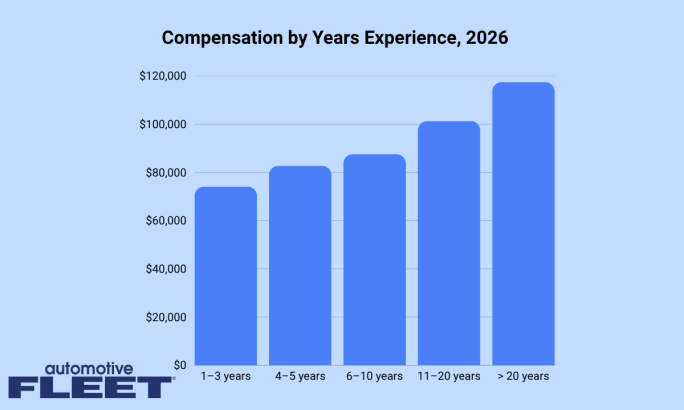
Experience remains a strong driver of compensation, though six-figure salaries become far more common once fleet managers cross the 10-year experience threshold.
Credit: Automotive Fleet
Education (Mostly) Matters
Education also plays a role, though its impact is uneven. Fleet managers with high school diplomas, some college, or bachelor’s degrees tend to cluster in a similar salary range, generally between $80,000 and $95,000.
On the upper end, those with MBAs earn an average of about $127,000, while professionals with CAFM certification earned an average of $122,000, or $8,000 more than their non-certified peers.
The data suggests that CAFM certification can help close the gap with MBA-level compensation, even for those without advanced academic credentials.
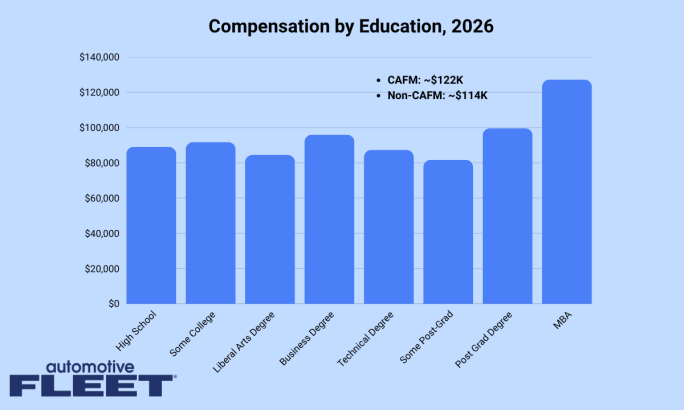
Fleet managers with CAFM certification report higher average salaries than their non-certified peers, regardless of formal education level.
Credit: Automotive Fleet
More Responsibility Hats
Fleet managers today are responsible for more than just vehicles, overseeing additional functions such as facilities, travel, and mobility.
In 2024, nearly 80% of respondents reported managing fleet exclusively. By 2026, that figure dropped to just 62%, meaning nearly four in 10 fleet managers now oversee responsibilities beyond fleet.
However, some responsibilities that were gaining traction, such as facilities management and mobility services, have leveled off, while other areas are becoming more prominent.
Electrification stands out. Nearly one-quarter of respondents now cite it as part of their responsibilities, up from about 20% in 2024. While that increase may seem modest, it is the only major category to show clear growth. (Note: The growth in electrification can be tied in great part to government fleets.)
Fleet Teams Growing?
For much of the past decade, fleet teams have gotten leaner, with many managers overseeing large vehicle populations with little to no internal support. As recently as 2024, one-third of respondents operated as a team of one.
That model now appears to be changing. In 2026, more than half of fleet managers report supervising five or more staff members. (Note: Public-sector fleets continue to make up the majority of respondents, and they tend to operate with larger, more formalized staff structures. Private-sector fleet managers, by contrast, have historically been more likely to operate with smaller teams or as a “team of one.”)
Of course, some of this shift may reflect changes in the respondent pool, including a higher share of larger or more structured fleet operations in 2026. Even so, the data points to a broader trend of increasing organizational investment in fleet management.
Technology has enabled this shift, but it has also increased expectations. Telematics, automation, data systems, and now AI allow fleets to operate more efficiently, but they also create greater expectations for performance.
Biggest Takeaways from This Year’s Survey
Fleet management is increasingly a six-figure profession, with a growing concentration of roles at the higher end of the pay scale.
At the same time, the role itself is expanding. Today’s fleet managers are expected to be data analysts, compliance experts, sustainability strategists, and business partners. The job has grown in both scope and complexity, and that evolution is far from over, particularly as AI and advanced analytics are playing a larger role in fleet operations.
That shift is also being driven by a broader change in how organizations view fleet.
Merchants Fleet CEO Matt Dyer sums up what’s behind these changes as a fundamental repositioning of fleet within the business. “Fleet is really being seen as a strategic asset,” he said. “It’s driving revenue, it’s driving fulfillment rates, it’s contributing to client retention.”
That’s a departure from the way fleet was viewed just a decade ago, when it was often treated primarily as a cost center. Today, fleet is increasingly tied to core business performance, that brings with it higher expectations, greater visibility, and, ultimately, higher compensation.
Subscribe to Our Newsletter
More Operations

How Fleets Can Recruit and Train Veterans for Technician Roles
Here's how the technician shortage has affected uptime for fleets, and what to do about it.
Read More →
Avis Budget Group Deploys Neology Toll Management Technology Across Major Brands
Neology’s neoFleet platform will manage toll transactions and toll-authority operations for vehicles across Avis, Budget, Payless, Budget Truck and Zipcar.
Read More →
Fleet Personal-Use Charges Edge Higher in 2026
Nearly eight in 10 surveyed fleets allow personal use of company vehicles, while just over half of respondents report charging employees for the privilege.
Read More →
The Future of Fleet + What’s Changing Right Now | AF News Recap
Could developments overseas offer a preview of what’s coming for U.S. fleets? This week, we’re looking at the future of AI, autonomy, and electrification, plus Ford Pro’s new certified pre-owned program, smarter vehicle offboarding, and a new way for fleets to manage toll expenses.
Read More →
How to Handle Vehicle Offboarding
What do fleet managers need to do when a driver leaves?
Read More →
Sponsored•October 1, 2026
Fleet Manager’s Ultimate Playbook: Navigating the New Standard in OEM Connectivity
Rising operating costs, driver safety concerns, and unplanned downtime are putting unprecedented pressure on modern fleets. Discover how fleet managers use embedded OEM connectivity and real-time vehicle data to cut TCO, prevent downtime, and protect drivers without aftermarket telematics hardware.
Read More →
U.S. Bank Adds Verra Mobility Toll Management to Voyager Fleet Platform
The integration allows U.S. Bank Voyager fleet customers to manage toll payments and violations alongside fuel, EV charging and maintenance expenses.
Read More →
ADAS Prevents Crashes. But Repairs Cost More | AF News Recap
ADAS-equipped vehicles may crash less often, but they can cost more when they do. This week, we’re breaking down what that tradeoff means for fleets, plus Subaru’s first Forester Wilderness Hybrid, Nissan’s new e-POWER Rogue, and why Calstart has become Catalyst Mobility.
Read More →
Moventum Fleet Management Names Mark Iorillo Head of Sales
Iorillo brings nearly 20 years of fleet management and sales experience to the role, including previous positions at Element Fleet Management, CEI, Donlen and Ryder.
Read More →
Fleet Has a Talent Pipeline Problem. What Comes Next? | AF News Recap
Where will fleet’s next generation of leaders come from? This week, we’re looking at the industry’s talent pipeline, what certification can add to a fleet career, how to build an award-worthy track record, and the return of Automotive Fleet’s Personal Use Survey.
Read More →